The Enterprise Agentic AI Buyer’s Guide
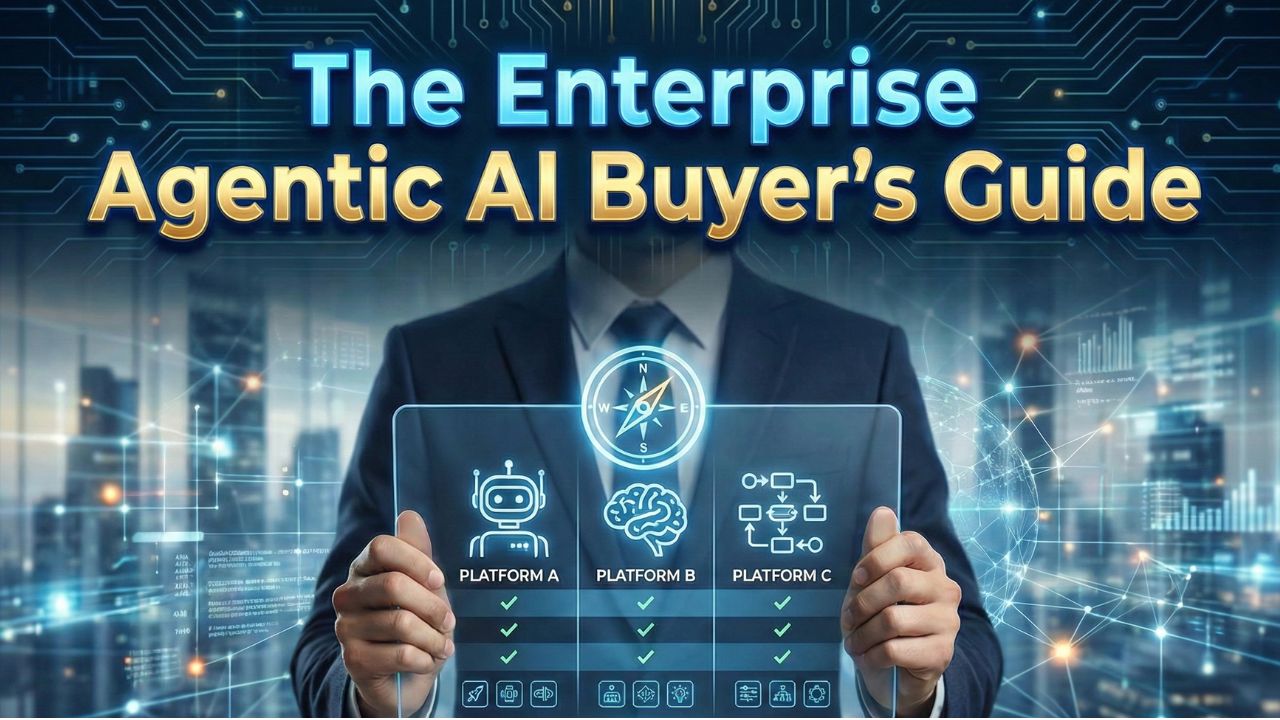
Welcome to the definitive procurement hub for Indian Technology Leaders and CIOs. As we move rapidly into the agentic era, the challenge is no longer just about "using AI", it is about architecting a resilient, cost-effective, and compliant workforce of autonomous agents.
This guide is designed to help you evaluate, compare, and price-check the essential technology stack required to build, deploy, and govern autonomous AI agents in 2026. Whether you are calculating the total cost of ownership for vector databases or scrutinizing indemnity clauses in vendor contracts, this hub serves as your primary resource for enterprise AI stack comparison and AI agent procurement for Indian CIOs.
Our goal is simple: To provide a transparent agentic AI technology stack India roadmap that moves beyond hype and focuses on autonomous AI agent software pricing and the AI vendor evaluation framework.
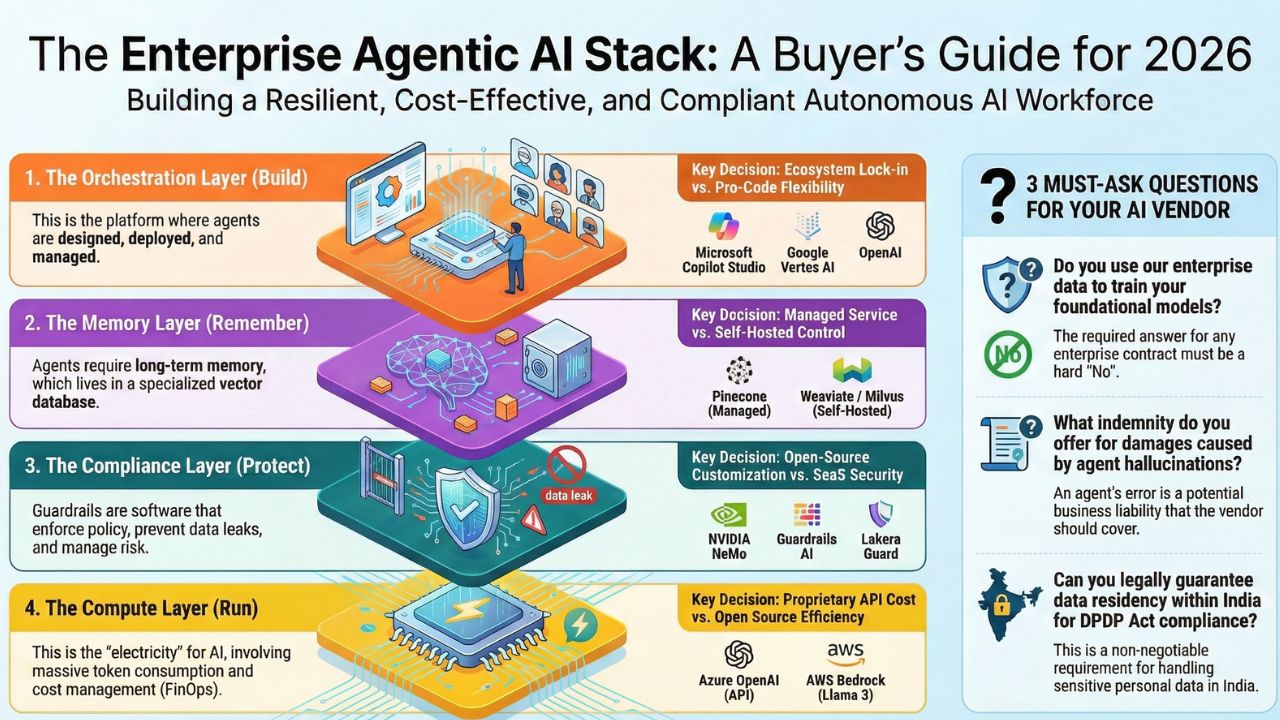
1. The Orchestration Layer: The "Build" Decision
The foundation of any agentic workforce is the platform used to build it. Indian enterprises face a critical choice between "low-code" ease and "pro-code" flexibility, all while balancing data sovereignty and integration costs.
In this section, we provide a feature-by-feature showdown of the top low-code agent platforms. We move beyond marketing brochures to analyze Microsoft Copilot Studio vs Google Vertex AI pricing, helping you determine which ecosystem offers the best value for your specific infrastructure. We also dissect OpenAI Enterprise for Indian business, specifically focusing on data residency and latency.
- Comparison: Low-code AI agent platforms comparison focusing on developer velocity vs. vendor lock-in.
- Cost Analysis: A deep dive into Copilot Studio consumption pricing versus seat-based models.
- Security: An audit of enterprise AI security features India required for regulated industries.
- Builder Costs: A transparent agentic AI builder cost analysis.
Platform teams are increasingly responsible for selecting the "Golden Path" for agent creation. You can find more details on our Platform Engineering page.
Read the Full Comparison: Microsoft Copilot Studio vs. Google Vertex AI vs. OpenAI Enterprise Covering: Pricing models, integration, and security readiness2. The Memory Layer: The "Infrastructure" Decision
Autonomous agents differ from simple chatbots because they remember. They require long-term memory to execute multi-step workflows, and this memory lives in the Vector Database.
This infrastructure layer can quickly become a hidden cost center if not optimized for scale. We compare the Total Cost of Ownership (TCO) of managed vector databases versus self-hosted options, focusing strictly on scalability and latency for high-throughput agent workflows.
Our guide includes a Pinecone vs Weaviate cost comparison and an analysis of Milvus managed service pricing for those preferring open-source roots.
- TCO: Calculating the real vector database TCO India when scaling to millions of vectors.
- Performance: Identifying the best vector database for enterprise RAG based on retrieval speed.
- Architecture: The trade-offs between self-hosted vs managed vector db for agents.
- Scale: Solutions for high-throughput agent memory solutions.
3. The Compliance Layer: The "Risk" Decision
In 2026, an agent that hallucinates isn't just a bug; it's a liability. Sitting between your autonomous agents and the public internet must be a robust layer of "Guardrails"—software designed to enforce policy and prevent data leakage.
This section offers an evaluation of tools like Guardrails AI, Lakera, and Arthur.ai. We focus on the critical intersection of performance and policy, specifically regarding AI guardrails for DPDP Act compliance. We also compare tools for preventing AI hallucinations enterprise-wide and ensuring sovereign AI compliance India.
- Tools: A review of Guardrails AI vs Lakera vs Arthur.ai.
- Data Safety: Implementing AI data leakage prevention tools in real-time agent workflows.
- Risk Management: Selecting the right enterprise AI risk management software.
4. The Compute Layer: The "FinOps" Decision
Inference is the electricity of the agentic economy. Running open-source models (like Llama 3) on private clouds versus utilizing proprietary APIs involves complex math regarding token consumption and "Green FinOps."
We provide a breakdown of the hidden costs of running models on AWS Bedrock vs Azure OpenAI pricing India. This section includes a critical look at Google Model Garden enterprise costs and the financial realities of running Llama 3 on private cloud cost. To help you budget, we utilize an AI token economics calculator framework.
- Cloud Pricing: A direct comparison of proprietary API vs open source model cost.
- Sustainability: Implementing Green FinOps for AI agents to measure carbon and cash impact.
- Budgeting: Understanding the AI token economics calculator metrics.
To measure the carbon cost of these agents, you first need to understand the inference pricing models. For more on sustainability, visit our Green FinOps page.
Read the Pricing Breakdown: AWS Bedrock vs. Azure OpenAI vs. Google Model Garden Covering: Hidden costs, token economics, and private cloud options5. The Procurement Toolkit: The "Action" Asset
Knowledge is power, but execution requires the right paperwork. We have condensed our research into a practical, downloadable asset for your procurement team: a comprehensive Request for Proposal (RFP) guide.
This toolkit covers questions for AI vendors 2026, ensuring you ask the hard questions about AI model training rights legal clauses and autonomous agent SLA guarantees. It serves as an essential India AI vendor assessment guide.
- Download: AI agent RFP template free download.
- Checklist: An enterprise AI procurement checklist to avoid vendor lock-in.
Frequently Asked Questions (FAQ)
A: The answer depends on your existing stack. For Microsoft-heavy shops, Copilot Studio offers bundled pricing, but consumption costs can rise quickly. Our Orchestration Layer guide breaks down these specific consumption models.
A: Compliance requires a dedicated "Guardrail" layer that filters agent outputs before they reach the user. We recommend evaluating specific AI guardrails for DPDP Act compliance tools detailed in our Compliance Layer review.
A: For high-volume, repetitive agentic tasks, hosting Llama 3 on private cloud can significantly reduce costs compared to proprietary APIs. However, the initial infrastructure setup is higher. See our Token Economics analysis for the math.
A: Beyond standard pricing, your RFP must cover AI model training rights (ensuring vendors don't train on your data), indemnity for hallucinations, and specific SLA guarantees for agent uptime. Download our RFP Template for the full list.
Sources & References
- Platform Engineering & Architecture: Platform Engineering: The Future of DevOps and Developer Efficiency
- Governance & Risk: Agentic AI Governance: Managing Risk in Autonomous Systems
- FinOps & Sustainability: Green FinOps: Measuring the Carbon Cost of AI Agents
- Market Data: Hiring for the Agentic AI Era: Roles, Salaries & Skills in India (2026)