Microsoft Copilot Studio vs. Google Vertex AI vs. OpenAI Enterprise
The foundation of any agentic workforce is the platform used to build it. Indian enterprises face a critical choice between "low-code" ease and "pro-code" flexibility, all while balancing data sovereignty and integration costs.
This is the Orchestration Layer—the software where your agents are designed, deployed, and managed. For Indian CIOs, the decision often boils down to three major ecosystems: Microsoft, Google, and OpenAI.
In this guide, we move beyond marketing brochures to analyze the real pricing models, builder velocity, and enterprise security readiness of these three giants. We specifically focus on the nuances for Indian businesses, such as data residency under the DPDP Act and latency for local users.
1. The Strategic Choice: Ecosystem Lock-in vs. Velocity
Before looking at the price tag, you must look at your existing "Digital Gravity." Where does your data live? Building an agent on a platform that cannot easily access your data lake will result in high integration costs and latency issues.
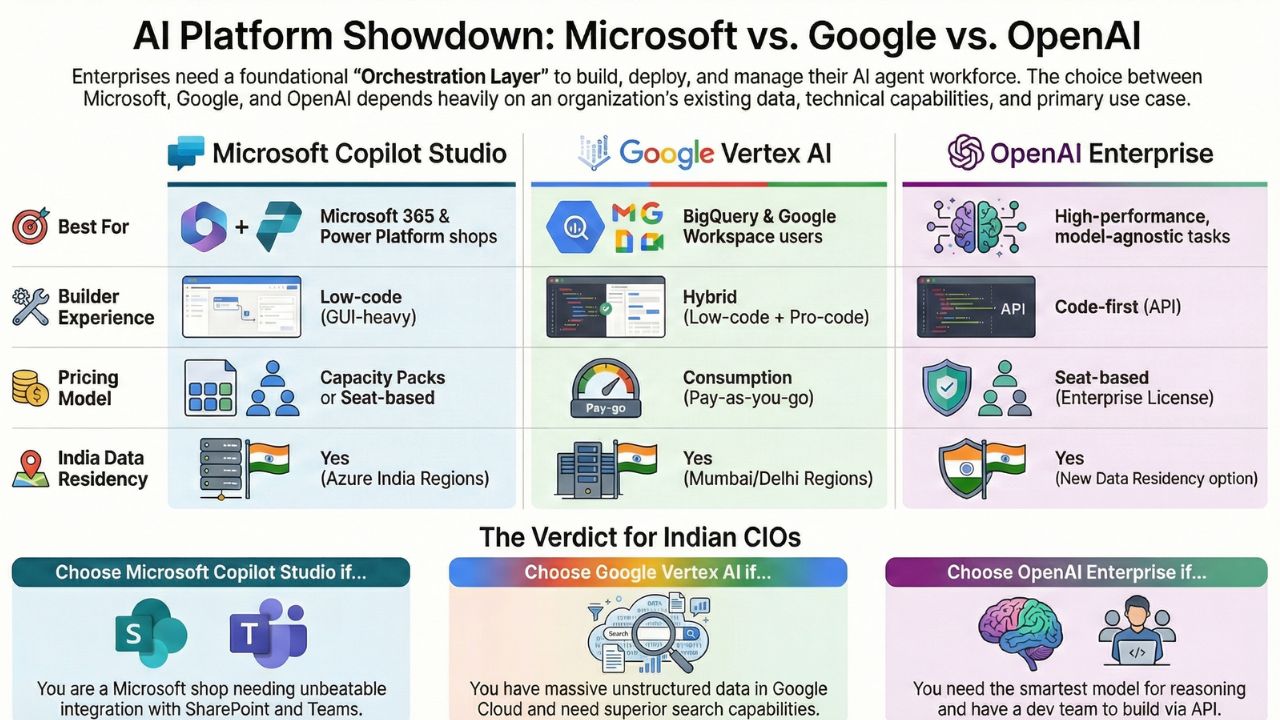
| Feature | Microsoft Copilot Studio | Google Vertex AI Agent Builder | OpenAI Enterprise |
|---|---|---|---|
| Best For | Microsoft 365 & Power Platform shops | BigQuery & Google Workspace users | High-performance, model-agnostic tasks |
| Pricing Model | Capacity Packs (Credit-based) or Seat-based | Consumption (Tokens + Node hours) | Seat-based (Enterprise License) |
| India Data Residency | Yes (Azure India Regions) | Yes (Mumbai/Delhi Regions) | Yes (New Data Residency option) |
| Builder Experience | Low-code (GUI-heavy) | Hybrid (Low-code + Code) | Code-first (API) or No-code (GPTs) |
2. Microsoft Copilot Studio: The "Bundled" Choice
For organizations already entrenched in the Microsoft ecosystem, Copilot Studio is the "Golden Path." It allows you to build agents that live directly inside Teams and Outlook.
The Pricing Reality
Microsoft uses a hybrid model that can be confusing.
- Internal Use: If your employees have a Microsoft 365 Copilot license (approx. $30/user/month), they get Copilot Studio for personal agent building included.
- External/High-Volume Use: For standalone agents or customer-facing bots, you must purchase "Copilot Studio" tenant licenses. This is typically priced around $200/month/tenant for a "Capacity Pack" of 25,000 credits.
3. Google Vertex AI Agent Builder: The "Performance" Choice
Google has rebranded its "Gen App Builder" into the Vertex AI Agent Builder. It shines in two areas: search and speed. If your agents need to parse massive PDFs or search internal wikis, Google's "Enterprise Search" infrastructure is often faster than Microsoft's semantic index.
The Pricing Reality
Vertex AI is strictly Pay-As-You-Go. You pay for what you use, which is great for startups but dangerous for unoptimized enterprise agents.
- Search Standard: ~$1.50 per 1,000 queries.
- Search Enterprise (with GenAI): ~$4.00 per 1,000 queries.
- Vector Storage: Charged per GB/month.
Platform teams are increasingly responsible for selecting these tools. For more on how engineering teams manage this, see our Platform Engineering guide.
4. OpenAI Enterprise: The "Raw Power" Choice
OpenAI remains the benchmark for model intelligence. With OpenAI Enterprise, you get the raw power of GPT-4o without the API rate limits of the public version. It is the preferred choice for R&D teams building highly complex, reasoning-heavy agents that don't depend on the Office 365 graph.
Security & India Data Residency
Historically, Indian banks hesitated to use OpenAI due to data leaving the country. However, OpenAI has recently launched Data Residency for India.
- Data at Rest: Enterprise customers can now pin their data storage to the India region.
- Compliance: This aligns with the requirements of India's DPDP Act for sensitive personal data.
5. The Verdict for Indian CIOs
Which platform should you sign off on?
- Choose Microsoft Copilot Studio if: You are a Microsoft shop. The integration with SharePoint and Teams is unbeatable, and the security "just works" via Entra ID.
- Choose Google Vertex AI if: You have massive unstructured data (documents, PDFs) in Google Cloud Storage. Its retrieval (RAG) capabilities are often superior for "Search" use cases.
- Choose OpenAI Enterprise if: You need the absolute smartest model for reasoning tasks and have a development team capable of building custom orchestration layers via API.
Frequently Asked Questions (FAQ)
A: Microsoft Copilot Studio is the clear winner for M365 users due to its bundled integration, allowing agents to access SharePoint and Teams data securely within the existing trust boundary.
A: Yes, OpenAI has recently expanded data residency options to include India for Enterprise and API customers, allowing data-at-rest to be stored locally to meet compliance needs.
A: Copilot Studio typically uses a "capacity pack" model ($200/month/tenant) or per-user licensing for internal use, whereas Google Vertex AI uses a granular consumption model based on tokens and node-hours.