50 Questions to Ask Your Agentic AI RFP Vendor
Knowledge is power, but execution requires the right paperwork. As you move to procure autonomous agent platforms, the standard software RFP template is no longer sufficient. You are not just buying code; you are hiring a digital workforce.
This "Procurement Toolkit" provides a comprehensive list of 50 critical questions designed to protect your organization. It covers the new realities of 2026: Model Training Rights (ensuring vendors don't learn from your secrets), Indemnity for Hallucinations, and SLA Guarantees for non-deterministic software.
Category 1: Data Sovereignty & DPDP Compliance
For Indian enterprises, compliance with the Digital Personal Data Protection (DPDP) Act is non-negotiable. Your agents must respect data boundaries.
Data Residency & Privacy
-
1
Does your platform offer guaranteed data residency within India? Crucial for DPDP Act compliance for sensitive personal data.
-
2
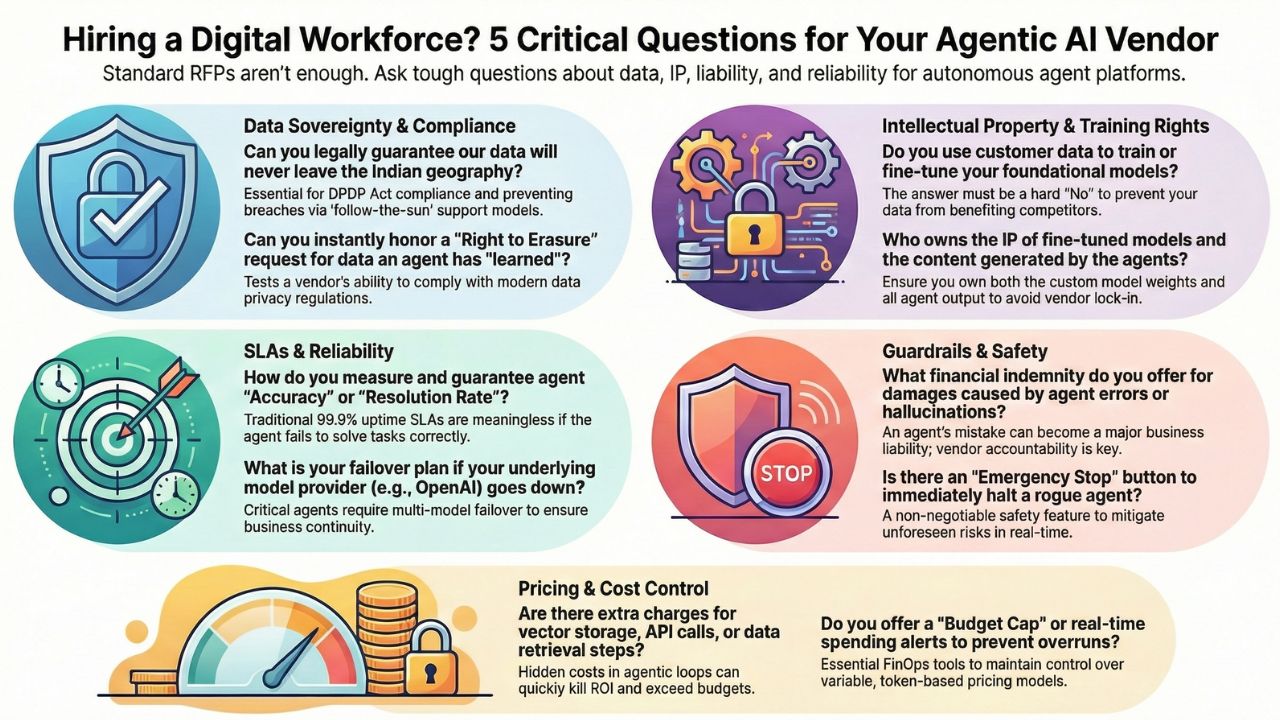
Can you legally guarantee that our data will never leave the Indian geography? Check for "follow-the-sun" support models that might inadvertently breach this.
-
3
Do you support "Data Principal" rights like the Right to Erasure (Right to be Forgotten)? If an agent "learns" a user's name, can you unlearn it instantly?
-
4
Is your data encrypted both at rest and in transit using industry-standard protocols?
-
5
Do you support "Bring Your Own Key" (BYOK) for encryption? Ensures the vendor cannot access your data even if subpoenaed.
-
6
How do you handle PII redaction before data is sent to the LLM? Do you have a built-in PII scrubber?
-
7
Are you compliant with ISO 27001 and SOC 2 Type II?
-
8
Do you have a dedicated Data Protection Officer (DPO) we can interface with?
-
9
What is your data retention policy for agent logs? Can we set custom retention periods (e.g., 30 days)?
-
10
Do you conduct regular third-party penetration testing?
Category 2: Intellectual Property & Training Rights
The biggest risk in 2026 is "Model Leakage"—vendors using your data to make their competitors smarter.
Model Ownership & Usage
-
11
Do you use customer data to train or fine-tune your foundational models? The answer must be a hard "No" for enterprise contracts.
-
12
If we fine-tune a model on your platform, who owns the weights? You should own the IP of any custom model trained on your data.
-
13
Does your platform segregate our data from other tenants? Ask for proof of logical or physical separation.
-
14
Can we export our fine-tuned models if we leave your platform? Avoid vendor lock-in.
-
15
Do you claim any IP rights over the content generated by the agents? Ensure you own the output.
-
16
Do you log prompts and completions for your own analysis? If yes, can we opt out?
-
17
What indemnity do you offer for IP infringement claims? If the model generates copyrighted code, are we protected?
-
18
Do you use any open-source models with "viral" licenses (e.g., AGPL)?
-
19
Can we audit your data usage logs?
-
20
Do you have a "Model Card" or transparency report for your AI?
Category 3: SLAs & Reliability
Agents are non-deterministic. How do you measure uptime for software that "thinks"?
Performance Guarantees
-
21
What is your guaranteed uptime SLA? Standard is 99.9%, but critical agents may need 99.99%.
-
22
Do you offer SLAs on inference latency? e.g., "95% of requests processed under 2 seconds".
-
23
What happens if the underlying model provider (e.g., OpenAI) goes down? Do you have multi-model failover?
-
24
Do you guarantee rate limits (TPM/RPM)? Critical for scaling agents.
-
25
What is your policy on model deprecation? How much notice do we get before GPT-4 is retired?
-
26
Do you offer "Provisioned Throughput" options?
-
27
How do you measure "Accuracy" or "Resolution Rate"? Do you have tools to benchmark agent performance?
-
28
What is your disaster recovery (DR) plan?
-
29
Do you support "streaming" responses to minimize perceived latency?
-
30
Can we run load tests on your platform before signing?
Category 4: Guardrails & Safety
Preventing hallucinations and brand risk. See our Guardrails Review for context.
Risk Mitigation
-
31
Does your platform include built-in guardrails against hallucinations?
-
32
Can we define custom "Denied Topics"? e.g., preventing the agent from discussing politics.
-
33
Do you offer protection against "Prompt Injection" attacks?
-
34
How do you handle "Jailbreak" attempts?
-
35
Can we bring our own guardrail libraries (e.g., NeMo)?
-
36
Do you offer indemnity for damages caused by agent errors (hallucinations)?
-
37
Is there a "Human-in-the-Loop" workflow for low-confidence queries?
-
38
Can we audit the "Chain of Thought" reasoning of the agent?
-
39
Do you support role-based access control (RBAC) for agent tools?
-
40
Do you have an "Emergency Stop" button for rogue agents?
Category 5: Pricing & Cost Control
Hidden costs can kill ROI. Reference our Pricing Guide.
Financial FinOps
-
41
Is your pricing based on Tokens, Seats, or Throughput?
-
42
Do you mark up the underlying model costs? If so, by how much?
-
43
Are there extra charges for vector storage or retrieval steps?
-
44
Do you offer a "Budget Cap" or spending alerts?
-
45
Is fine-tuning billed as a one-time fee or recurring hosting?
-
46
Do you charge for "Input Caching"?
-
47
Are there volume discounts for high token usage?
-
48
Does the license fee include support and upgrades?
-
49
Are there exit fees to retrieve our data?
-
50
Do you offer a pilot pricing tier?
Frequently Asked Questions (FAQ)
A: The "Model Training Rights" clause is critical. You must ensure the vendor is legally prohibited from using your enterprise data to train their public models.
A: Traditional SLAs focus on uptime (99.9%). Agentic SLAs must cover "Resolution Rate" (did the agent solve the task?) and "Latency" (how fast did it think?).
A: Ask specifically if they support "Data Principal" rights (like the right to erasure) and if they can guarantee data localization for sensitive PII.