Top 5 AI Guardrail Platforms for 2026
In 2026, an agent that hallucinates isn't just a bug; it's a liability. As Indian enterprises move from "Chatbot Pilot" to "Agentic Production," the biggest barrier is risk. Sitting between your autonomous agents and the public internet must be a robust layer of "Guardrails"—software designed to enforce policy and prevent data leakage.
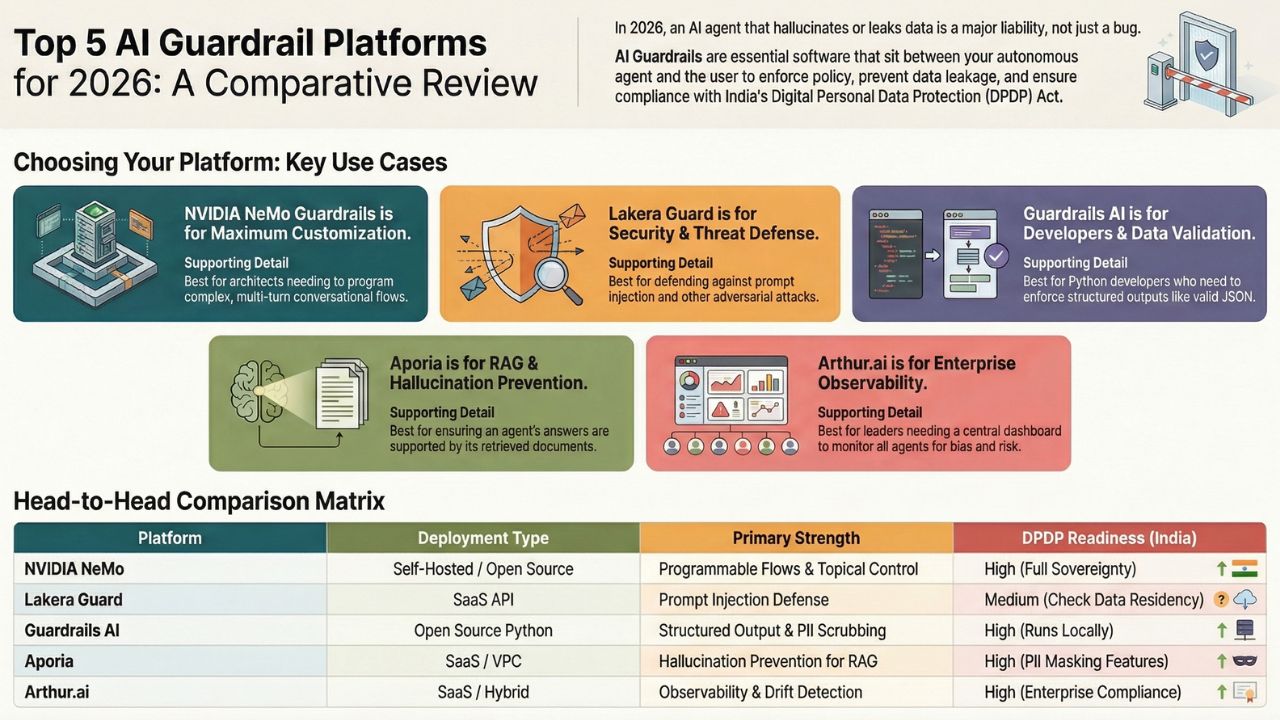
For Indian CIOs, the stakes are doubled by the Digital Personal Data Protection (DPDP) Act. You cannot afford an agent that leaks customer PII or processes sensitive data on non-sovereign servers. This guide evaluates the top 5 platforms designed to mitigate these risks, focusing on performance, policy, and compliance.
1. NVIDIA NeMo Guardrails: The "Architect's" Choice
Best For: Complex, multi-turn conversational flows and maximum customization.
NVIDIA NeMo Guardrails is an open-source toolkit that sits between the user and the LLM. It uses a specialized language called "Colang" to define programmable rails. It is particularly strong at keeping agents "on topic" and preventing jailbreaks.
- Latency: Supports streaming modes to decouple validation from generation, minimizing perceived latency.
- DPDP Compliance: Excellent. Being open-source, you can self-host it entirely within your own Indian VPC, ensuring zero data egress.
- Key Feature: "Topical Rails" that prevent your banking agent from discussing politics or competitors.
2. Lakera Guard: The "Security" Choice
Best For: Defense against Prompt Injection and adversarial attacks.
Born from the team that created "Gandalf" (the famous AI jailbreak game), Lakera focuses intensely on security. It acts as an API proxy that filters inputs for malicious intent before they reach your model.
- Latency: Extremely low. Designed as a lightweight API wrapper specifically for real-time inference.
- Performance: Claims to have one of the world's largest databases of prompt injection attacks, allowing it to block "unknown" threats better than static rules.
3. Guardrails AI: The "Open Source" Choice
Best For: Python developers and structured data validation.
Guardrails AI is a Python framework that wraps LLM API calls. It is famous for its "RAIL" specs—xml-like definitions that enforce structure. If you need your agent to output valid JSON every single time, this is the tool.
- DPDP Compliance: High. It includes pre-built validators for PII detection (Anonymize, Redact) that run locally in your environment.
- Ecosystem: Features a "Hub" of community-contributed validators for everything from toxicity to SQL injection prevention.
4. Aporia: The "RAG" Choice
Best For: Preventing Hallucinations in RAG workflows.
Aporia markets itself as an "AI Control Platform." It shines in RAG (Retrieval Augmented Generation) setups by validating that the agent's answer is actually supported by the retrieved documents, effectively killing hallucinations.
- Real-Time: Claims to sit in the flow with sub-second latency, masking PII and blocking off-policy answers instantly.
- Multimodal: One of the few platforms offering guardrails for text, audio, and vision.
5. Arthur.ai: The "Observability" Choice
Best For: Enterprise-wide monitoring and "Firewalls."
Arthur is less of a code wrapper and more of an operations platform. It provides an "AI Firewall" that monitors for data drift, bias, and toxic outputs. It is ideal for CIOs who need a dashboard to see how all their agents are performing globally.
- Governance: Strong role-based access control and audit logs, essential for banking and insurance sectors.
Comparison Matrix: Enterprise AI Guardrails
Choosing the right tool depends on your primary risk vector. Use this table to compare capabilities.
| Platform | Deployment Type | Primary Strength | DPDP Readiness (India) |
|---|---|---|---|
| NVIDIA NeMo | Self-Hosted / Open Source | Programmable Flows & Topical Control | High (Full Sovereignty) |
| Lakera Guard | SaaS API | Prompt Injection Defense | Medium (Check Data Residency) |
| Guardrails AI | Open Source Python | Structured Output & PII Scrubbing | High (Runs Locally) |
| Aporia | SaaS / VPC | Hallucination Prevention for RAG | High (PII Masking Features) |
| Arthur.ai | SaaS / Hybrid | Observability & Drift Detection | High (Enterprise Compliance) |
Frequently Asked Questions (FAQ)
A: For strict DPDP Act compliance, self-hosted options like NVIDIA NeMo Guardrails or Guardrails AI (open source) are superior because they ensure sensitive PII never leaves your own infrastructure/VPC.
A: Yes, adding a guardrail layer introduces latency. However, optimized platforms like Lakera and Aporia claim sub-100ms latency overhead, and NeMo Guardrails supports streaming to minimize perceived delay.
A: No tool guarantees 100% prevention. Platforms like Aporia use RAG-specific validators to check if an answer is supported by retrieved context, significantly reducing—but not eliminating—hallucinations.