Green FinOps: Measuring the Carbon Cost of AI Agents
Back to AI-Native Infrastructure Strategy Hub
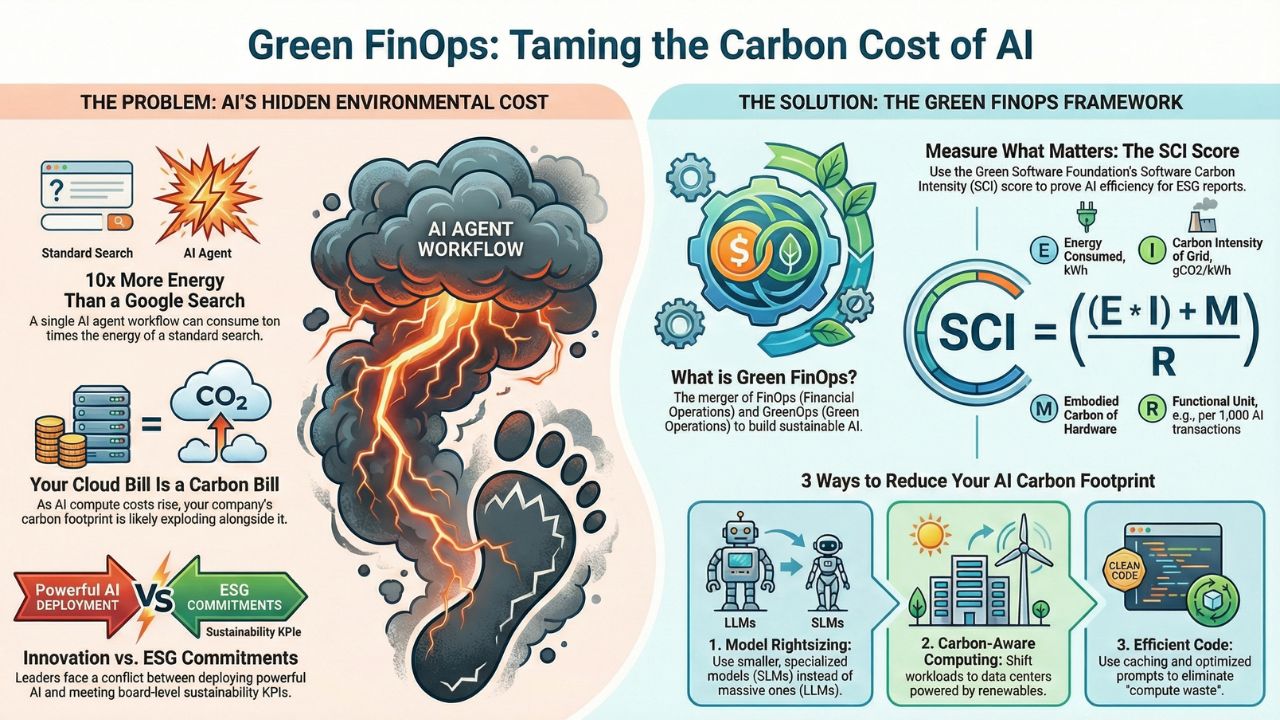
In the rush to deploy autonomous agents, a hidden cost is accumulating—not just in rupees, but in carbon. AI is energy-hungry. A single agentic workflow, with its complex chain-of-thought reasoning and multiple tool invocations, can consume 10x the energy of a standard Google search.
For Indian enterprises, this presents a dual challenge. You are under pressure to innovate with AI, but you are also bound by corporate ESG (Environmental, Social, and Governance) commitments. As "Sustainability" becomes a Board-level KPI, CTOs must measure and mitigate the carbon impact of their AI fleet.
This article introduces Green FinOps—the strategic merger of FinOps (Financial Operations) and GreenOps (Green Operations)—to help you build a sustainable AI strategy.
The Green FinOps Framework: Cost + Carbon
Traditionally, FinOps focused on reducing the dollar cost of cloud computing. GreenOps focuses on reducing the carbon emissions. In the era of Agentic AI, these two disciplines must merge.
Why? because the most expensive compute (inefficient GPUs running idle) is often the most polluting. By optimizing for cost, you often optimize for carbon, but not always. Green FinOps introduces new variables into your architectural decisions:
- Carbon Intensity of the Region: Is your AI model running in a coal-powered region or a renewable-powered region?
- Hardware Efficiency: Are you using older, power-hungry GPUs (like V100s) or modern, efficient ones (like H100s or L40s)?
- Time Shifting: Can non-urgent batch jobs (like nightly data reconciliation agents) run when the grid is greenest?
Key Topics: Sustainable AI computing, measuring AI carbon footprint, and eco-friendly data center strategies.
Measuring the Invisible: The SCI Score
How do you report AI sustainability to the board? The Green Software Foundation provides the standard: The Software Carbon Intensity (SCI) score.
Unlike total emissions (which grow as you scale), SCI measures efficiency:
SCI = ((E * I) + M) / R
E: Energy Consumed (kWh)
I: Carbon Intensity of Grid (gCO2/kWh)
M: Embodied Carbon of Hardware
R: Functional Unit (e.g., per 1,000 AI Agent Transactions)
By tracking SCI, you can prove that even if your total emissions rose because you gained 1 million customers, your per-transaction footprint decreased due to better engineering. This is critical for ESG reporting.
Why it matters: Don't let your AI innovation ruin your ESG rating.
3 Strategies to Reduce AI Carbon Footprint in 2026
1. Model Rightsizing (SLMs over LLMs)
The most effective Green FinOps move is to stop using a cannon to kill a mosquito. Do not use GPT-4 (Trillions of parameters) for simple classification tasks. A specialized Small Language Model (SLM) like Llama 3-8B consumes a fraction of the power for the same accuracy on specific tasks.
2. Carbon-Aware Computing
Indian Data Centers are rapidly adopting solar and wind power. Shift your AI workloads to regions with lower Carbon Intensity. If your agentic workload isn't latency-sensitive (e.g., document summarization), configure your Kubernetes cluster to schedule pods in "Green Regions" or during daylight hours when solar energy is abundant.
3. Efficient Agentic Code
Agents often get stuck in loops, repeatedly calling tools or hallucinating steps. This "compute waste" is "carbon waste."
- Implement Caching: Don't re-generate the same answer twice. Use a semantic cache (Vector DB) to serve previous answers instantly at zero compute cost.
- Optimize Prompt Engineering: Concise prompts generate fewer tokens, requiring less GPU time.
Frequently Asked Questions (FAQ)
A: Green FinOps is the practice of combining financial accountability (FinOps) with environmental sustainability (GreenOps). It aims to optimize cloud usage not just for cost reduction, but for carbon footprint reduction, ensuring AI operations are both economically and ecologically viable.
A: A single agentic workflow, which may involve multiple chain-of-thought steps and tool calls, can consume up to 10 times the energy of a standard keyword-based Google search.
A: The SCI score is a standard metric defined by the Green Software Foundation. It calculates the rate of carbon emissions per unit of work (e.g., per API call or per user journey), allowing organizations to benchmark the efficiency of their software regardless of total scale.
