The Modern GCC 4.0 – An Intelligence Arbitrage Hub
For two decades, the India story was simple: Cost Arbitrage. You hired smart people in Bengaluru or Hyderabad to do the same work for less money. That era is over.
The new battleground is Intelligence Arbitrage, where the goal is not just to save money, but to generate speed, innovation, and non-linear revenue growth. We have entered the era of GCC 4.0. The traditional "Headcount = Growth" metric is obsolete.
In an agentic world, headcount is often a liability. The Global Capability Centers (GCCs) that survive 2026 will be those that transition from being "Help Desks" to becoming AI Control Towers for the global enterprise.
The Evolution: GCC 1.0 to 4.0
To understand the future, we must look at the trajectory of the Indian captive unit. The GCC moves from supporting the business to running the business through autonomous agents and product ownership.
- GCC 1.0 (Cost Arbitrage): Back-office processing and call centers.
- GCC 2.0 (Skill Arbitrage): IT services and R&D support.
- GCC 3.0 (Innovation Hubs): Digital transformation and Centers of Excellence (CoEs).
- GCC 4.0 (The Cognitive GCC): Value Realization & Agentic Operations.
1. The Commercial Shift: The Death of the FTE Model
The Problem: The "Full-Time Equivalent/Employee" (FTE) model punishes efficiency. If an AI agent completes a task in 10 seconds that used to take a human 2 hours, billing by the hour destroys your revenue model.
The Solution: Outcome-Based Pricing. GCC leaders must restructure contracts to charge for the value delivered (e.g., claims processed, code deployed, risks mitigated) rather than the effort exerted. This decouples revenue from headcount and aligns the GCC with the "Intelligence Arbitrage" of the agentic era.
2. The Operational Structure: Building the AI Control Tower
The Concept: As the GCC stops being a "factory of humans," it must become a "Control Tower for Agents." This requires a shift from pyramid hierarchies (many doers, few thinkers) to diamond-shaped teams (highly skilled humans managing fleets of AI agents).
The Strategy: Indian GCCs are uniquely positioned to become the central command for global AI fleets. This involves establishing new governance protocols ("Who watches the bots?") and measuring success through "Intelligence Arbitrage" rather than seat utilization.
3. The Technical Execution: Agentic Modernization
The Context: India holds the keys to much of the world's legacy infrastructure. The old model was to maintain these systems; the GCC 4.0 model is to aggressively modernize them.
The Opportunity: We are seeing a massive trend in "Agentic Modernization"—using AI agents not just to document legacy code, but to actively refactor and migrate mainframes to the cloud 10x faster than human teams. This is the "2026 Playbook" for reducing technical debt at scale.
Read: Agentic Modernization The 2026 Playbook for Mainframe-to-Cloud4. The Leadership Mandate: The CAIO Agenda
The Shift: The GCC Head is no longer just an administrator; they are effectively the Chief AI Officer (CAIO) for the global enterprise. This role demands a new 90-day roadmap focused on Audit, Pilot Selection, and Scaling.
The Roadmap:
- Days 1-30: Audit & Talent Assessment.
- Days 31-60: Pilot Selection (The "Low Hanging Fruit").
- Days 61-90: Scaling & Governance implementation.
5. Agentic Agile: Reimagining Scrum for AI Squads
The Shift: Standard Scrum assumes a human-only team. Agentic Agile integrates autonomous AI agents into the daily standup, treating them as squad members rather than tools.
The Strategy: Master the orchestration of multi-agent squads to reduce technical debt automatically and accelerate velocity beyond human limits.
Read: Agentic Agile Framework Why Your Next Scrum Team Member is an Autonomous Agent6. Intelligence Arbitrage: The GCC 4.0 Value Model
The Concept: Moving beyond "cheaper" to "smarter." This model defines how GCCs realize value through capability density and AI multipliers rather than labor arbitrage.
The Metric: Shift your KPIs from cost savings to EBITDA impact, validating the GCC as a profit center through high-value product ownership.
Read: The GCC 4.0 Value Model Why Indian GCCs are No Longer Just "Cheaper"7. The Defensive Leader: AI Security & Governance Mastery
The Risk: In an agentic world, a single hallucination can cost millions. Security must evolve from perimeter defense to "Zero Trust AI" architectures.
The Solution: Implement governance agents and "kill switches" to monitor autonomous fleets, ensuring compliance with evolving regulations like the EU AI Act.
Read: AI Security Management Protecting Your Firm from the $100M Hallucination8. AI-Driven Decision Intelligence for CXOs
The Reality: Intuition is no longer enough. The most effective CXOs use predictive analytics and AI agents to separate signal from noise.
The Skill: Learn to challenge AI reasoning and turn machine-generated insights into high-quality, strategic decisions that drive market leadership.
Read: AI-Driven Decision Intelligence Why Your Intuition is No Longer Enough9. Leading Cultural Change for AI Adoption
The Challenge: "AI Displacement Anxiety" is real. Leaders must bridge the "Meaning Gap" to retain top talent in an automated world.
The Approach: Build an AI-first culture that fosters trust, upskills the workforce for agentic collaboration, and redefines performance expectations.
Read: Leading Cultural Change Stop Your Best Talent from Fearing the Bot10. GCC Product Ownership Framework 2026
The Shift: GCCs are moving from "delivery centers" to strategic owners of global products. This framework defines the roadmap for transferring P&L responsibility to the India hub.
The Goal: Empower "Mini-CEOs" within the GCC to lead end-to-end product lifecycles, aligning local innovation directly with global enterprise revenue targets.
Read: GCC Product Ownership Framework 2026 Why India is Moving to the Enterprise Core11. Who Owns AI-Generated Code in an Indian GCC?
The Crisis: As autonomous agents write more code, a critical IP sovereignty crisis is emerging. Indian law requires "significant human input" for copyright.
The Strategy: Navigating the 2026 legal landscape requires robust documentation of human-in-the-loop workflows and clear contractual definitions to prevent IP leakage into the public domain.
Read: Who Owns AI-Generated Code? Navigating the 2026 IP Sovereignty Crisis12. The Intelligence-to-FTE Ratio
The Shift: Master how to measure intelligence arbitrage in global capability centers.
The Strategy: Use our 2026 KPI framework to track non-linear value and justify AI-led growth to your CFO.
Read: The Intelligence-to-FTE Ratio How to Measure Intelligence Arbitrage: The New Math of GCC Success13. The AI Control Tower Blueprint
The Shift: Learn how to build an AI control tower for global agent fleets.
The Strategy: Discover the operational blueprint for governing, scaling, and auditing autonomous AI swarms.
Read: The AI Control Tower Blueprint How to Build an AI Control Tower: Managing Your Global Fleet of Autonomous Bots14. Predictive Workforce Economic Modeling
The Shift: Master predictive analytics for GCC workforce planning in an AI-first world.
The Strategy: Learn to forecast talent needs and balance human-digital headcount effectively.
Read: Predictive Workforce Economic Modeling Predictive Analytics for GCC Workforce Planning: Hiring for the Bot-Manager Era15. Agentic Mainframe Modernization ROI
The Shift: Analyze the cost of agentic mainframe to cloud modernization for GCCs.
The Strategy: Compare AI-led ROI against manual refactoring to eliminate your technical debt faster.
Read: Agentic Mainframe Modernization ROI Cost of Agentic Mainframe Modernization: Why 2026 is the Year to Kill Technical Debt16. Bio-IT & Deep-Tech GCC Strategy
The Shift: Discover hiring strategies for Bio-IT and deep tech talent in Indian GCCs.
The Strategy: Learn why 2026 demands a shift from generic engineering to specialized scientific R&D.
Read: Bio-IT & Deep-Tech GCC Strategy Bio-IT & Deep Tech Hiring: Why Your GCC Needs Scientists, Not Just Coders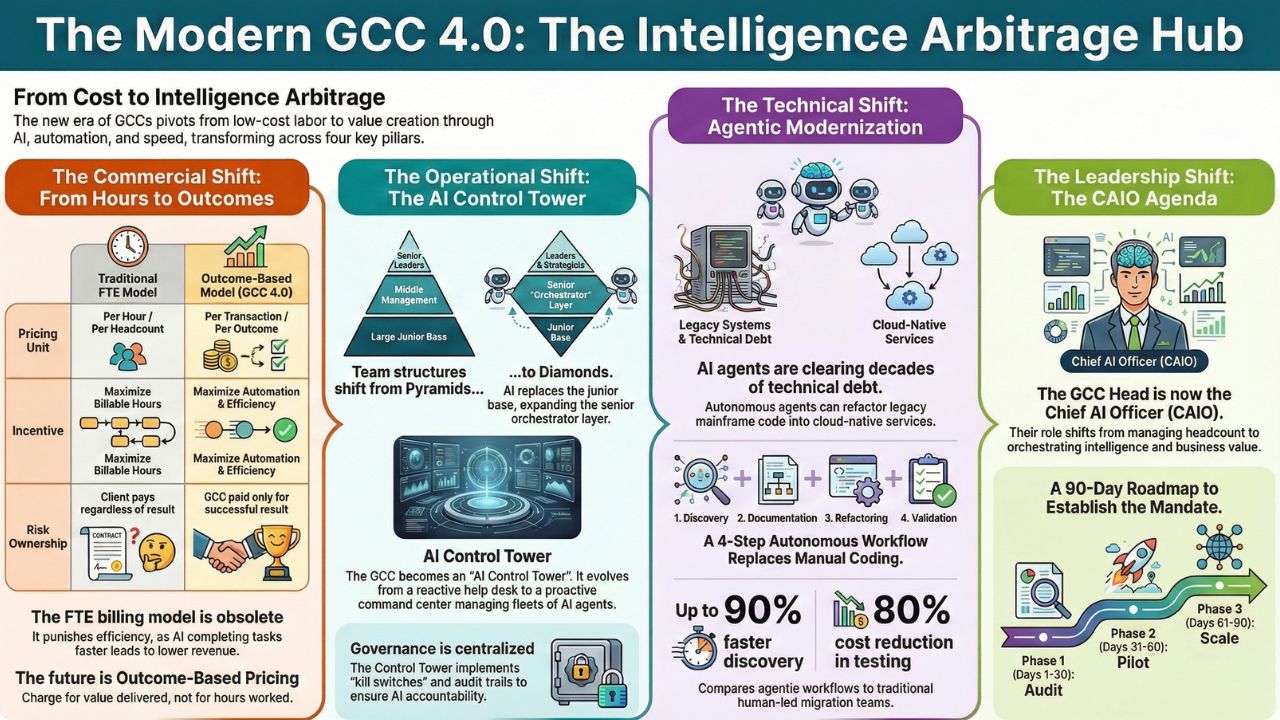
FAQ: The Modern GCC 4.0
GCC 4.0 represents the fourth wave of Global Capability Center evolution, characterized by a shift from "Cost Arbitrage" (saving money via low-cost labor) to "Intelligence Arbitrage" (creating value via AI and product ownership).
Intelligence Arbitrage is the leverage gained by using superior AI models, data assets, and automated workflows to solve business problems faster and cheaper than competitors, regardless of human labor costs.
The FTE (Full-Time Equivalent) model relies on billing for hours worked. As AI agents automate tasks instantly, billable hours collapse. GCCs must shift to outcome-based pricing to capture the value they create rather than the time they spend.
Traditional modernization relies on human developers to rewrite code manually. Agentic modernization uses autonomous AI agents to read, document, refactor, and test legacy code, significantly compressing the timeline for mainframe-to-cloud migrations.

Sources and References
- GCC 4.0 Evolution: Defines the shift from Cost/Scale to Value/Innovation.
- The Cognitive GCC Model: Focuses on Product Ownership and Revenue Generation.
- FTE vs. Outcome Pricing: Highlights the failure of hourly billing in an AI world.
- AI Control Tower: Describes the shift to managing global agent fleets.
- Agentic Modernization: Details the use of AI for legacy code migration.
- CAIO Roadmap: Outlines the 90-day plan for GCC leadership.