(Return to the main hub: The Modern GCC 4.0 - An Intelligence Arbitrage Hub)
Agentic Agile: Why Your Next Scrum Team Member is an Autonomous Agent
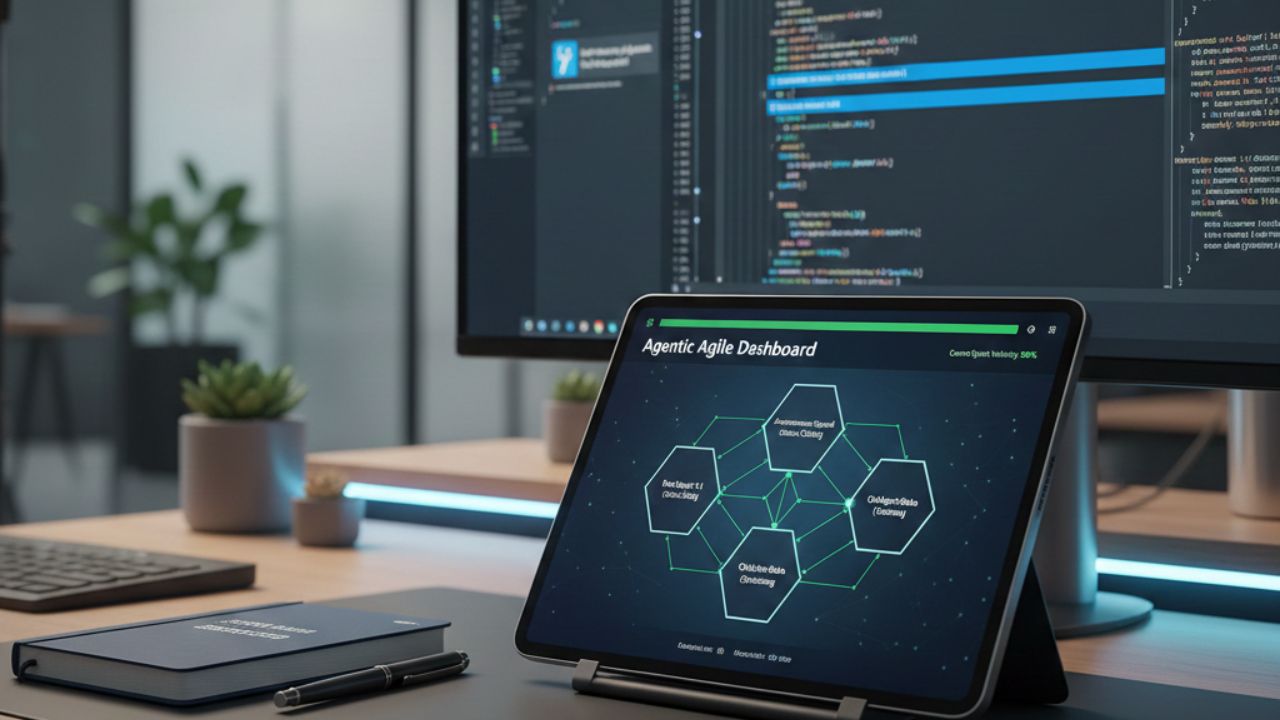
- Shift to Agentic Agile: Transition from manual task management to the Agentic Agile framework 2026 where AI agents function as full squad members.
- Multi-Agent Orchestration: Moving beyond simple bots to "digital assembly lines" that automate entire development workflows.
- Redefined Roles: AI agents now support or augment roles like the Scrum Master and Product Owner through A2A protocols.
- Self-Healing SDLC: Implement self-healing apps that automatically reduce technical debt within the sprint cycle.
This deep dive into the future of software development is part of our extensive guide on agentic AI leadership.
In 2026, the definition of a "colleague" has fundamentally shifted. High-impact "hybrid squads" are no longer composed solely of humans; they are powered by the Agentic Agile framework 2026. This evolution represents the "microservices moment" for AI, where autonomous agents don’t just assist—they execute, govern, and optimize.
The Microservices Moment: Orchestrating Multi-Agent Agile Squads
The jump from basic Generative AI to Agentic Agile is like the move from monolithic codebases to microservices. Instead of one large LLM, we now see the orchestration of multi-agent Agile squads.
These agents communicate via Agent-to-Agent (A2A) protocols, allowing a "Developer Agent" to hand off code to a "QA Agent" without human intervention. This creates a digital assembly line that operates 24/7.
From Execution to Self-Healing Apps
One of the most significant advantages of this framework is the rise of self-healing apps. By integrating agents directly into the CI/CD pipeline, the Agentic Agile framework 2026 allows teams to reduce technical debt automatically.
If a bug is detected in production, an autonomous agent can trigger a roll-back, write a patch, and submit it for human review before the next daily standup.
Redefining the Scrum Rituals
Integrating an AI agent into your daily standup is no longer a gimmick; it’s a strategic necessity.
- Daily Standups: Agents provide real-time data on hybrid human-AI squad velocity, highlighting bottlenecks that a human might miss.
- Sprint Planning: AI agents can take on aspects of the Product Owner role by analyzing vast amounts of user feedback to prioritize backlogs.
- Governance: To ensure safety, many firms are adopting AI security management and governance for executives to monitor these autonomous fleets.
Measuring Velocity in a Hybrid World
How do you measure the productivity of a team that never sleeps? Measuring the velocity of a hybrid human-AI squad requires new metrics. We no longer just track story points; we track "Agentic Throughput" and the reduction rate of "AI-detected technical debt".
Frequently Asked Questions (FAQ)
Standard Scrum relies on human-to-human collaboration. Agentic Agile introduces autonomous AI agents as active participants that own specific outcomes within the sprint.
Integrate agents via A2A-supported tools that allow the AI to report on task completion, blocker identification, and automated testing results directly into your communication channels.
Yes. Agents can now assist in backlog grooming (PO) or facilitating ceremonies and removing blockers (Scrum Master), though human oversight remains critical for ethical alignment.
Sources & References
- Internal: agentic AI leadership (Parent Pillar).
- Internal: AI security management and governance for executives.
- Internal: leading cultural change for AI adoption.
- External: IEEE Standards on Autonomous and Intelligent Systems (2026).
- External: Scrum Alliance Guide to AI-Native Agile Squads.