Building the AI Control Tower: Structuring the Next-Gen CoE
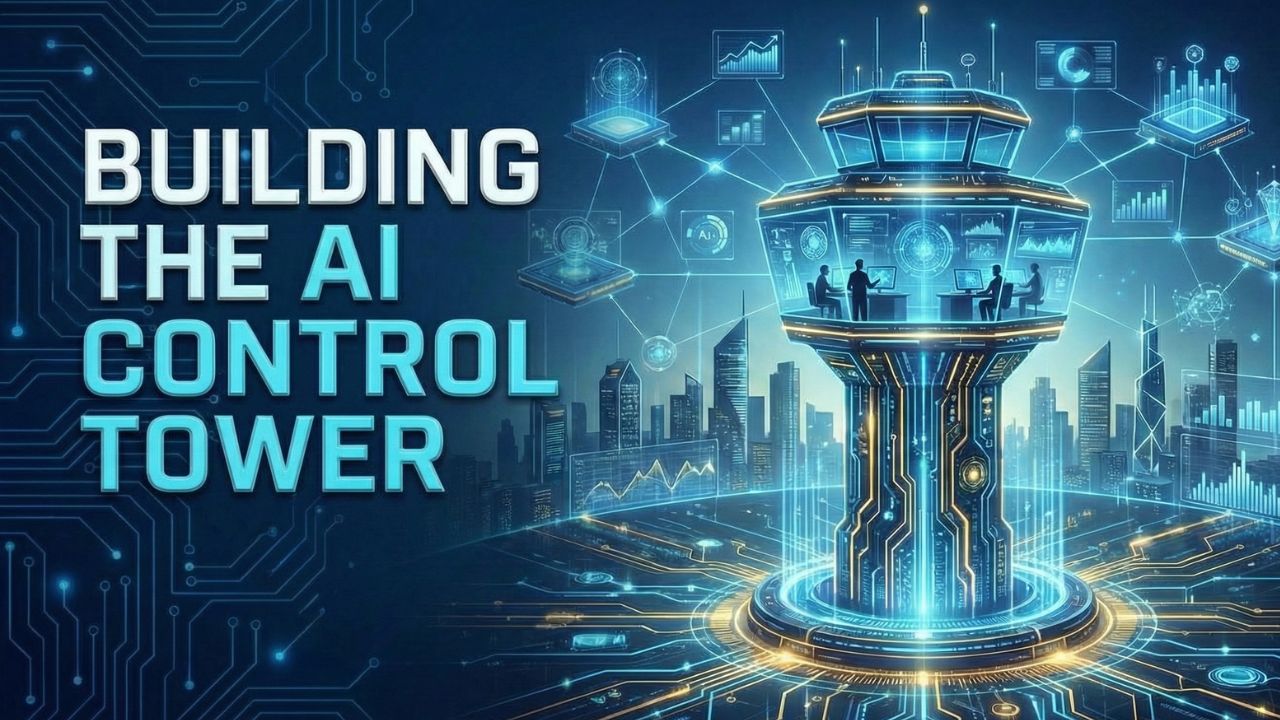
For the last decade, the organizational chart of a typical Indian Global Capability Center (GCC) looked like a pyramid. A massive base of junior talent executing repetitive tasks, managed by a layer of leads, reporting to a few senior heads.
Agentic AI collapses the pyramid. When autonomous agents can handle L1 support, data entry, and basic coding, the "bottom" of the pyramid disappears. The GCC must evolve from a "Factory of Doers" into an "AI Control Tower"—a command center that manages fleets of digital workers.
This article outlines the structural blueprint for GCC 4.0, detailing how to build the governance, talent, and operational frameworks required to manage the agentic workforce.
The Structural Shift: From Pyramid to Diamond
The most painful transition for GCC leaders is the realization that "Headcount" is no longer a proxy for "Scale." In the Control Tower model, the team structure changes shape.
The Diamond Team Structure
Instead of hiring thousands of freshers for process execution, the Next-Gen Center of Excellence (CoE) prioritizes a "Diamond" shape:
- The Automated Base (The Bottom): Tasks previously done by junior FTEs are now handled by Agentic Workflows.
- The Fat Middle (The Waist): A significantly expanded layer of Senior Architects, Prompt Engineers, and Compliance Officers. These are the "Bot Wranglers" who orchestrate the agents.
- The Strategic Top (The Cap): CAIOs and Product Owners who align agent outputs with business revenue.
Operationalizing the Control Tower
A "Help Desk" reacts to tickets. A "Control Tower" proactively manages flow. To make this shift, Indian GCCs must implement three specific operational layers:
| Layer | Traditional Function (Legacy GCC) | Control Tower Function (GCC 4.0) |
|---|---|---|
| Observability | Monitoring server uptime and ticket volume. | Monitoring Agent "Thought Chains" and hallucination rates. |
| Governance | Annual audits and manual QA checks. | Real-time "Guardrails" that block non-compliant agent outputs. |
| Intervention | Escalating complex tickets to L2 humans. | "Human-in-the-Loop" (HITL) teams retraining agents that drift. |
Governance: Who Watches the Bots?
The single biggest risk in Agentic AI is lack of accountability. If an autonomous agent approves a fraudulent claim or pushes bad code to production, who is responsible?
The AI Control Tower must act as the Governance Hub for the global enterprise. This involves:
- The Kill Switch Protocol: Every agentic workflow must have a hard-coded manual override accessible to the CoE team in India.
- Audit Trails: Unlike black-box models, enterprise agents must log their "reasoning steps" (Chain of Thought) for compliance review.
- Role-Based Access Control (RBAC) for Agents: Treating agents as "users" with specific permissions that limit their blast radius if compromised.
Why India? The Strategic Advantage
India is uniquely positioned to host the global AI Control Tower. It is the only geography that combines deep legacy context (we built the old systems) with new-age AI talent.
By moving up the value chain from "Support" to "Command," Indian GCCs can secure their relevance for the next decade. The goal is not to be the back office, but the central nervous system.
Back to Pillar: The Modern GCC 4.0 Explore the full Intelligence Arbitrage Hub Previous Step: The Commercial Shift Read "Beyond the FTE: Outcome-Based Pricing"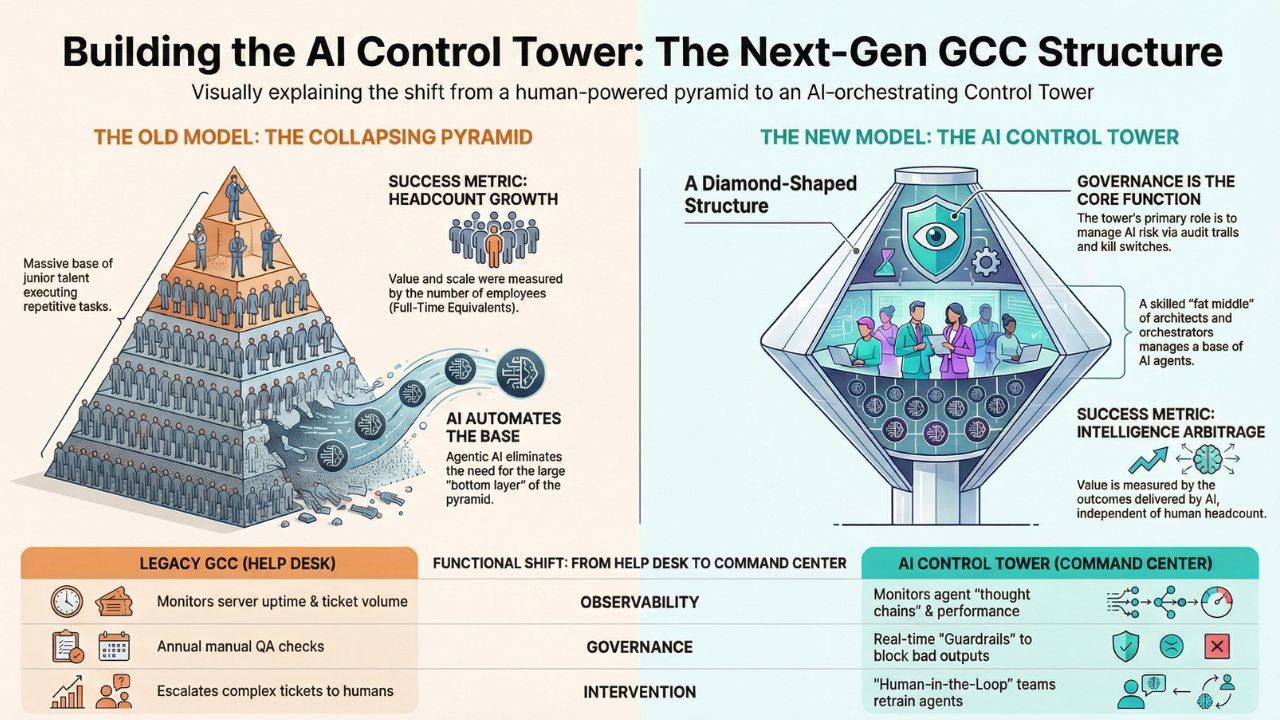
FAQ: Building the AI Control Tower
The Diamond Structure replaces the traditional labor pyramid (many juniors at the bottom). In the AI era, the bottom layer is automated by agents. The organization shifts to a diamond shape: a wide middle layer of senior architects and AI orchestrators who manage the bots, with fewer junior executioners.
An AI Control Tower is a centralized governance hub within a GCC. Unlike a Help Desk that fixes broken tickets, a Control Tower proactively monitors the health, compliance, and performance of autonomous agent fleets across the global enterprise.
Governance belongs to the "Human-in-the-Loop" (HITL) compliance team within the CoE. Their role is to audit agent decisions, manage "kill switches" for rogue agents, and ensure data sovereignty compliance (e.g., DPDP Act).