The AI Agent Observability Standard Nobody Explains (June 2026)
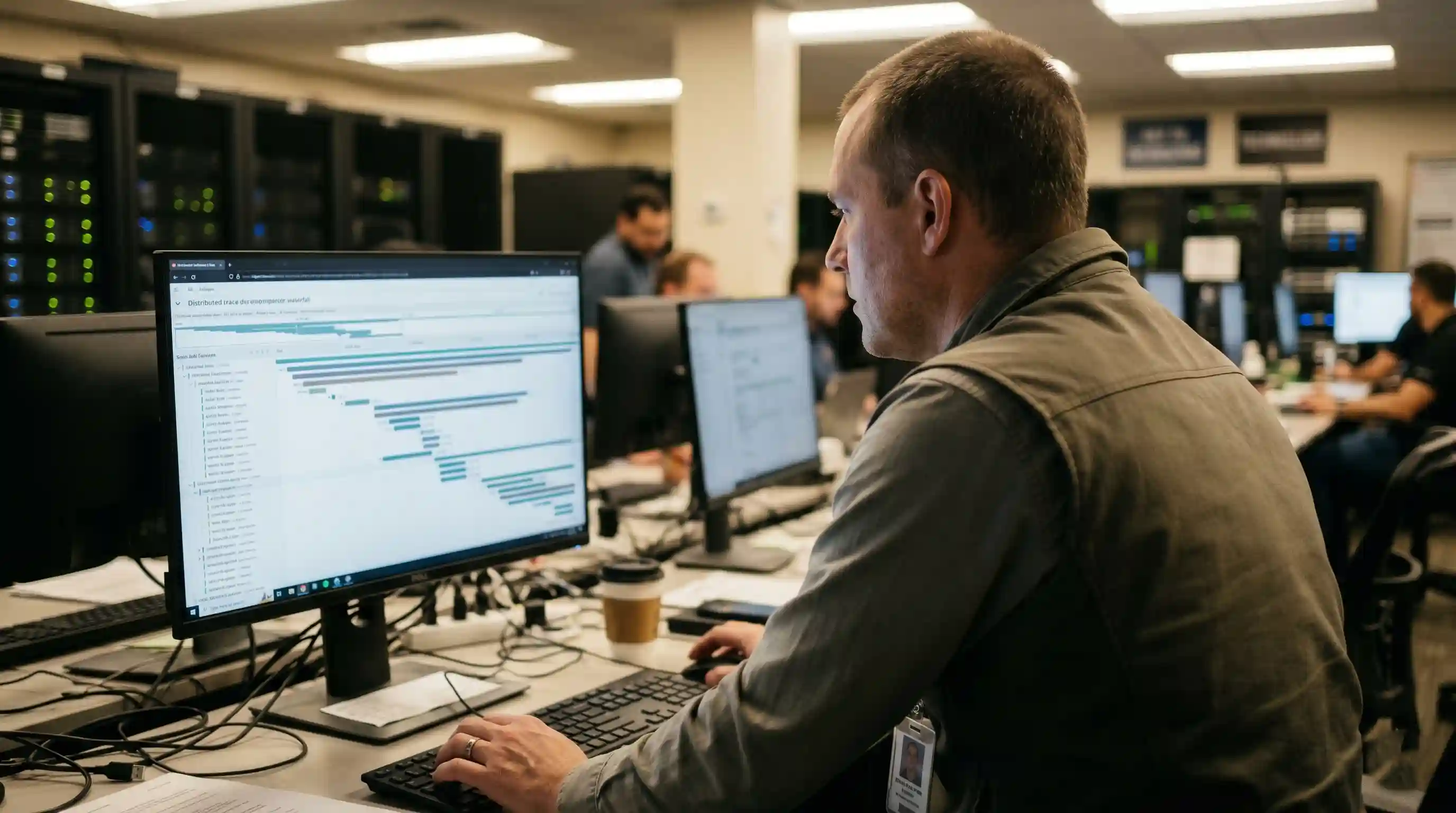
- The problem: Traditional APM watches infrastructure. It cannot see inside an agent's reasoning, tool calls, or prompts—so it reports "healthy" while the agent is wrong.
- The shift: The OpenTelemetry (OTel) GenAI semantic conventions now define a vendor-neutral way to trace LLM calls, agents, and tool use under one (gen_ai.*) namespace.
- The catch: The conventions are still in Development (experimental) status, and three competing instrumentation formats—OTel GenAI, OpenInference, and OpenLLMetry—are fighting to be the default.
- The strategy: Standardize on the open convention for instrumentation, treat the dashboard as a swappable layer, and verify export fidelity before you commit budget.
- The payoff: Portable telemetry, faster root-cause analysis, trace-level cost control, and audit-ready records for the EU AI Act—without vendor lock-in.
Your agents pass every test in the demo and fail silently in production. The dashboard stays green—200 OK, latency nominal—while a customer gets a hallucinated answer and a runaway loop quietly burns your token budget.
This guide is the strategic map to fixing that blind spot: what AI agent observability actually is, why the OpenTelemetry GenAI semantic conventions are reshaping the entire tooling market, and how to choose a stack in 2026 without locking your enterprise into the wrong format for years.
The fast version for leaders who need the decision, not the lecture, is laid out below to show the specific layers of your system.
| Layer | What it watches | Tooling example | Owner |
|---|---|---|---|
| Infrastructure / APM | CPU, latency, error codes, uptime | Datadog APM, Dynatrace, New Relic | Platform/SRE |
| LLM observability | Single model call: prompt, tokens, cost, latency | Helicone, OTel GenAI spans | AI Platform |
| Agent observability | Reasoning steps, tool calls, retrieval, handoffs | Langfuse, Arize Phoenix, LangSmith | AI Platform / Eval |
| Enforcement | Kill-switches, circuit breakers, budgets | AgentOps controls | Platform/ FinOps |
What AI Agent Observability Actually Means (and Why APM Isn't It)
Most enterprises already run a mature observability stack. Logs, metrics, traces, dashboards—the discipline is decades old. The instinct is to assume it covers agents too.
It does not. APM was built for deterministic systems: a request comes in, services respond, you watch latency and error rates. An agent breaks that model completely.
An agent's behaviour is non-deterministic. The same prompt can trigger different tool calls, different reasoning paths, and different costs on every run. None of that fits a fixed metric schema.
The result is the most dangerous failure mode in production AI: the silent one. The agent returns a confident, well-formatted, completely wrong answer—and every infrastructure signal stays green.
Logs and metrics versus the trace
Logs tell you what happened in isolation. Metrics tell you how often. Neither tells you why an agent chose the wrong tool on step four of a seven-step task.
Agent observability is built on distributed tracing. Each step—an LLM call, a retrieval, a tool invocation, a handoff—becomes a span, and the spans link into one connected trace.
That trace is the unit of truth. It shows the full causal chain, so you can replay exactly how a decision was made instead of guessing from scattered log lines.
LLM observability is not the same as agent observability
These terms get used interchangeably, and that confusion costs teams money. LLM observability tracks a single model call: the prompt, the completion, token usage, latency. It is necessary but narrow.
Agent observability is the superset. It captures the orchestration around those calls—the loops, the tool selection, the multi-agent coordination.
Most real failures live in the gaps between calls, which is precisely where single-call tooling is blind.
The OpenTelemetry GenAI Standard, Explained Without the Jargon
For two years, every LLM tracing tool invented its own attribute names. One called the model (model), another (11m.model), another (openai.model). Same concept, three incompatible schemas, zero portability.
That fragmentation is the problem the OpenTelemetry GenAI semantic conventions were created to solve. They define a single, shared vocabulary for AI telemetry.
OpenTelemetry itself is the de facto open standard for distributed tracing. The GenAI conventions extend it with a dedicated (gen_ai.*) namespace for AI-specific operations.
So instead of bespoke attributes, you emit (gen_ai.request.model, gen_ai.operation.name gen_ai.system), and standardized token-usage metrics. Any backend that understands the convention can read your traces.
What the conventions actually standardize
The GenAI conventions, driven by OpenTelemetry's GenAI Special Interest Group since 2024, now span six layers of AI telemetry. Together they cover far more than a single model call.
The layers include LLM inference spans, embeddings, retrieval operations, tool-execution spans, agent and framework spans, and even Model Context Protocol (MCP) tool calls.
There are matching metrics for token usage—including billable tokens—and events for capturing prompts and completions when you opt in.
That breadth is the point. A single trace_id) can now link an agent's first decision, through every tool and retrieval, to the final response—across any compliant backend. To go a level deeper on the exact attributes and the opt-in mechanics, our companion guide breaks down the full specification field by field.
Stable, experimental, or stalled? The status nobody states plainly
Here is the fact most vendor blog posts gloss over: as of mid-2026, the GenAI conventions are officially in Development status—experimental, not yet stable.
The specification says so directly. Agent and framework spans in particular remain experimental, even though they have been stable in practice through 2026.
What that means operationally: instrumentations emit the older convention version by default, and you opt into the latest by setting OTEL_SEMCONV_STABILITY_OPT_IN=gen_ai_latest_experimental
This matters for planning. "Experimental" is not a reason to wait—it is a reason to instrument behind a thin abstraction so a future breaking change costs you a config update, not a rewrite.
The Three Warring Stacks of 2026 (And the "Native Support" Myth)
This is the section the tooling vendors would rather you skipped. Everyone agrees observability is essential. What nobody agrees on is which semantic convention wins—and that disagreement has hardened into three competing camps.
Understanding the three is the single highest-leverage decision in your observability strategy, because it determines how portable your telemetry will be in 2027.
The three formats, plainly
OTel GenAI is the upstream, vendor-neutral standard—the gen_ai.* namespace itself. It is the format the broader ecosystem is converging toward.
OpenInference, maintained by Arize and native to its Phoenix platform, is a complementary convention built on OpenTelemetry. It is broader than OTel GenAI—covering retrieval, evaluation, and agent-kind attributes—and leans toward eval-heavy workflows.
OpenLLMetry, built by Traceloop under an Apache 2.0 licence, is the option most aligned with pure OpenTelemetry. It exports standard OTLP data straight into existing backends like Datadog and Honeycomb.
The reassuring news: these are translatable. Phoenix, for instance, uses span processors to convert OpenLLMetry and OTel GenAI traces into OpenInference.
The likely long-term path is OTel GenAI graduating to stable while OpenInference settles into a superset around it. A full, decision-grade breakdown of which format to bet on—and how to translate between them—lives in our dedicated comparison.
The Information Gain: "native support" is half a promise
Here is the counter-intuitive insight that reframes the whole buying decision. Every major platform now advertises "native OpenTelemetry support." Leaders read that as "no lock-in." That reading is wrong.
In practice, the interoperability is more marketing than engineering. OTLP exports often exist but are partial, and the real product value—the dashboards, the replay views, the eval tooling—is built around each vendor's proprietary data model.
So the lock-in does not live in the wire format. It lives in the layer above it: the workflows your team builds on a vendor's UI and the attributes that vendor captures but does not fully export.
The defensive move is simple and most teams skip it: before you commit, run a real export test. Instrument a representative agent, export the traces over OTLP to a neutral backend, and confirm that the spans you actually debug with survive the round-trip.
If they do not, you have found your lock-in before it found you.
Choosing Your Observability Platform Without Locking In
Once you have settled the convention question, the platform choice gets clearer. The market has consolidated around a handful of serious contenders, each with a distinct lineage that shapes its strengths.
LangSmith came from the LangChain team. Langfuse emerged from the open-source community. Arize Phoenix grew out of ML model monitoring. Those origins predict their blind spots.
The platform landscape at a glance
LangSmith offers the deepest integration for LangChain and LangGraph stacks—often a single environment variable to start tracing, plus a genuinely strong agent IDE. The trade-off is the highest lock-in risk, closed source, and self-hosting reserved for enterprise tiers.
Langfuse is the open-source leader: framework-agnostic via OpenTelemetry, strong on operational telemetry and cost analytics, and fully self-hostable. The trade-off is heavier self-hosting infrastructure (it expects ClickHouse, Redis, and object storage) and some features positioned in paid tiers.
Arize Phoenix is OpenTelemetry-native through OpenInference, framework-agnostic, and strong on RAG evaluation and drift detection. It is the natural pick for eval-heavy, notebook-driven teams already thinking in open conventions.
For Datadog-standardized enterprises, Datadog LLM Observability maps the OTel GenAI conventions into its existing product, letting platform teams extend coverage without a new vendor relationship.
A full feature-and-pricing comparison of the three purpose-built platforms is in our head-to-head breakdown.
Self-hosted versus SaaS: the real cost equation
The self-host-versus-SaaS decision is rarely about licence cost alone. It is about total cost of ownership and data residency.
SaaS gets you running in an afternoon and bills you on trace volume and retention. Self-hosting eliminates per-trace fees but hands your platform team an always-on operational burden—scaling, upgrades, storage.
For regulated industries and Indian enterprises under DPDP, self-hosting can be less about cost and more about keeping prompt and trace data inside your own boundary. We unpack when that maths actually works in our self-hosting guide.
Instrumenting Agents the Right Way
A standard is only as good as your instrumentation. This is where most observability projects quietly fail—not in tool selection, but in incomplete coverage that leaves blind spots in the trace.
The goal is a complete, connected span tree: every LLM call, tool execution, and retrieval represented, with context propagated across the whole agent run.
The instrumentation path
In 2026, you no longer write custom attributes for "model name." You install an OTel-aligned instrumentation, register it, and your spans emit the right gen_ai.* names automatically.
Auto-instrumentation covers a large share of the work for common frameworks. The remaining effort is custom spans for your own tool functions and ensuring trace context survives async boundaries.
The single most common failure is broken span lineage—async steps that lose the parent context, so spans arrive orphaned and the trace tree fractures. Our step-by-step setup guide walks through closing that gap.
Multi-agent tracing: where single-agent tooling collapses
Single-agent tracing is largely solved. Multi-agent systems are where the discipline gets genuinely hard.
When a supervisor agent delegates to sub-agents, you need parent-child spans that model the orchestration and span links that capture fan-out and fan-in. Most tooling built for a single agent simply cannot represent a handoff.
The OTel agent and framework conventions are extending to cover this, but the patterns are still maturing.
If your roadmap includes orchestrated, agent-to-agent systems, treat multi-agent tracing as a first-class requirement, not an afterthought.
Seeing Cost and Failure in the Trace
Once your agents are instrumented, the trace becomes the place where two expensive problems finally become visible: runaway cost and silent failure.
Token cost as a first-class span attribute
The GenAI conventions carry token usage—including billable tokens—as standard span and metric data. That changes how you think about cost.
Instead of a single monthly invoice you cannot decompose, you get cost per span, per agent, per user. You can finally answer "which workflow is burning the budget" from the trace itself.
This is cost visibility. It is the diagnostic layer that sits upstream of cost optimization—routing, caching, model arbitrage—and upstream of hard enforcement like budgets and kill-switches.
Debugging failure modes logs will never show
The traces also expose failure signatures that logs structurally cannot. A runaway tool loop, a silently truncated context, a wrong-tool selection, a hallucination that passed validation—each leaves a distinct shape in the span tree.
Logs flatten that shape into disconnected lines. Trace-based debugging lets you reconstruct and replay a production failure instead of guessing.
Our debugging guide catalogues the common failure signatures and how to alert on them.
From visibility to enforcement
Seeing a runaway loop is not the same as stopping one. Observability is the sensor; enforcement is the actuator.
The moment a trace reveals a cost spike or an infinite loop, you want an automated response—a budget ceiling, a circuit breaker, a kill-switch.
That is a separate discipline, tightly coupled to this one.
Observability and the Compliance Clock
For PMO directors, the strongest business case for agent observability is not debugging speed. It is audit-readiness.
High-risk AI systems face record-keeping and traceability obligations under frameworks like the EU AI Act, and data-handling duties under regimes such as India's DPDP Act. Both demand that you can demonstrate what an automated system did and why.
A trace is that evidence. Properly instrumented, observability produces a timestamped, queryable record of inputs, decisions, and outputs as a natural byproduct of the tooling you already need for engineering.
The strategic reframe: stop treating observability as an engineering cost centre and an audit burden as separate line items. Done once, correctly, the same instrumentation satisfies both.
This grounding question—how an agent's reasoning gets recorded and trusted—connects directly to the broader self-healing and platform-reliability work that sits one level up in our coverage.
A 90-Day Rollout Framework for Enterprise Agent Observability
Strategy without sequencing stalls. Here is a defensible 90-day path from zero to production-grade agent observability.
| Phase | Focus | Key milestones |
|---|---|---|
| Days 0-30: Standardize | Convention + abstraction | Adopt OTel GenAI conventions; build a shared instrumentation wrapper; pin the stability opt-in; pick one pilot agent |
| Days 31-60: Instrument & evaluate | Coverage + platform | Instrument the pilot end-to-end; verify span lineage; run a real OTLP export test on two candidate platforms; confirm multi-agent traces render |
| Days 61-90: Operationalize | Cost, failure, compliance | Wire token-cost dashboards; define failure alerts; set dual retention policy; document the audit-evidence path; expand to the next two agents |
This sequence deliberately puts the standard before the tool. Choose your convention and abstraction first, and every later decision becomes reversible. Choose a proprietary tool first, and you have pre-committed your lock-in.
For the platform-engineering and governance scaffolding that this rollout plugs into, our MCP enterprise hub and orchestration playbook provide the adjacent operating model.
How Agent Observability Compares to Your Existing AIOps Stack
A final clarification, because the overlap confuses procurement. Your infrastructure AIOps tools—the engines comparing Datadog Watchdog, Dynatrace Davis, and New Relic AI—watch the platform layer: anomalies, incidents, infrastructure health. They are not going away.
Agent observability watches the agent layer: reasoning, tools, prompts, cost. The two are complementary, not competitive. Most mature enterprises run both and correlate them through a shared (trace id).
If your current evaluation is specifically about the infrastructure-monitoring engines, that comparison lives in our existing AIOps analysis rather than here.
And if your question is about scoring agent quality (evaluation) rather than tracing agent behaviour (observability), that is a distinct discipline covered in our evals comparison.

Frequently Asked Questions (FAQ)
AI agent observability captures the reasoning steps, tool calls, prompts, and token costs inside an LLM agent as connected traces. Traditional APM watches infrastructure health—CPU, latency, error codes. An agent can return a clean 200 OK while producing a wrong answer; only agent observability sees that failure.
Logs and metrics assume fixed, structured events. Agent behaviour is non-deterministic: variable prompts, multi-step reasoning, and tool calls that differ every run. A green dashboard can hide a hallucination or a runaway loop. You need trace-level visibility into each decision, not aggregate counters.
It is a set of OpenTelemetry semantic conventions defining standard span and metric names—the (gen_ai.*) namespace—for LLM calls, agents, and tool use. Developed by the OpenTelemetry GenAI Special Interest Group since 2024, it is supported natively by Datadog, Grafana, Honeycomb, and others.
Both, in practice. APM suites like Datadog now ingest OpenTelemetry GenAI spans natively, so existing shops can extend coverage. But purpose-built platforms such as Langfuse, Phoenix, and LangSmith add prompt, evaluation, and replay tooling that infrastructure APM lacks. Most enterprises pair one of each.
LLM observability tracks single model calls: prompt, completion, tokens, latency. Agent observability tracks the orchestration around them: multi-step reasoning, tool invocations, retrieval, and handoffs between agents. Agent observability is the superset; a single bad answer often hides in the steps between calls.
High-risk AI systems face record-keeping and traceability obligations. Trace-based observability produces the timestamped, queryable evidence of what an agent did and why—inputs, decisions, and outputs—turning a compliance burden into a natural byproduct of the instrumentation you already need for debugging.
Standardize on the OpenTelemetry GenAI conventions first, then choose a backend that consumes them. This keeps instrumentation portable if you switch vendors later. Bet on the open standard for the wire format, and treat the dashboard as a swappable layer above it.
The GenAI conventions, including agent and framework spans, remain in Development status. In practice they have been stable, but breaking changes are still possible. The main risk is re-instrumentation cost; mitigate it with the stability opt-in environment variable and a thin abstraction layer.
Cost scales with trace volume and retention, not seats alone. SaaS pricing runs from free developer tiers into thousands per month at high throughput. Self-hosting trades licence fees for infrastructure and operational effort. Sampling rate and retention policy are your biggest cost levers.
Mostly, if you instrument with open conventions—OpenTelemetry GenAI or OpenInference—rather than a vendor SDK. Traces then export over OTLP to any compatible backend. Lock-in creeps in through proprietary dashboards and partial exports, so always verify export fidelity before you commit.