Multi-Agent Tracing Breaks Single-Agent Tools
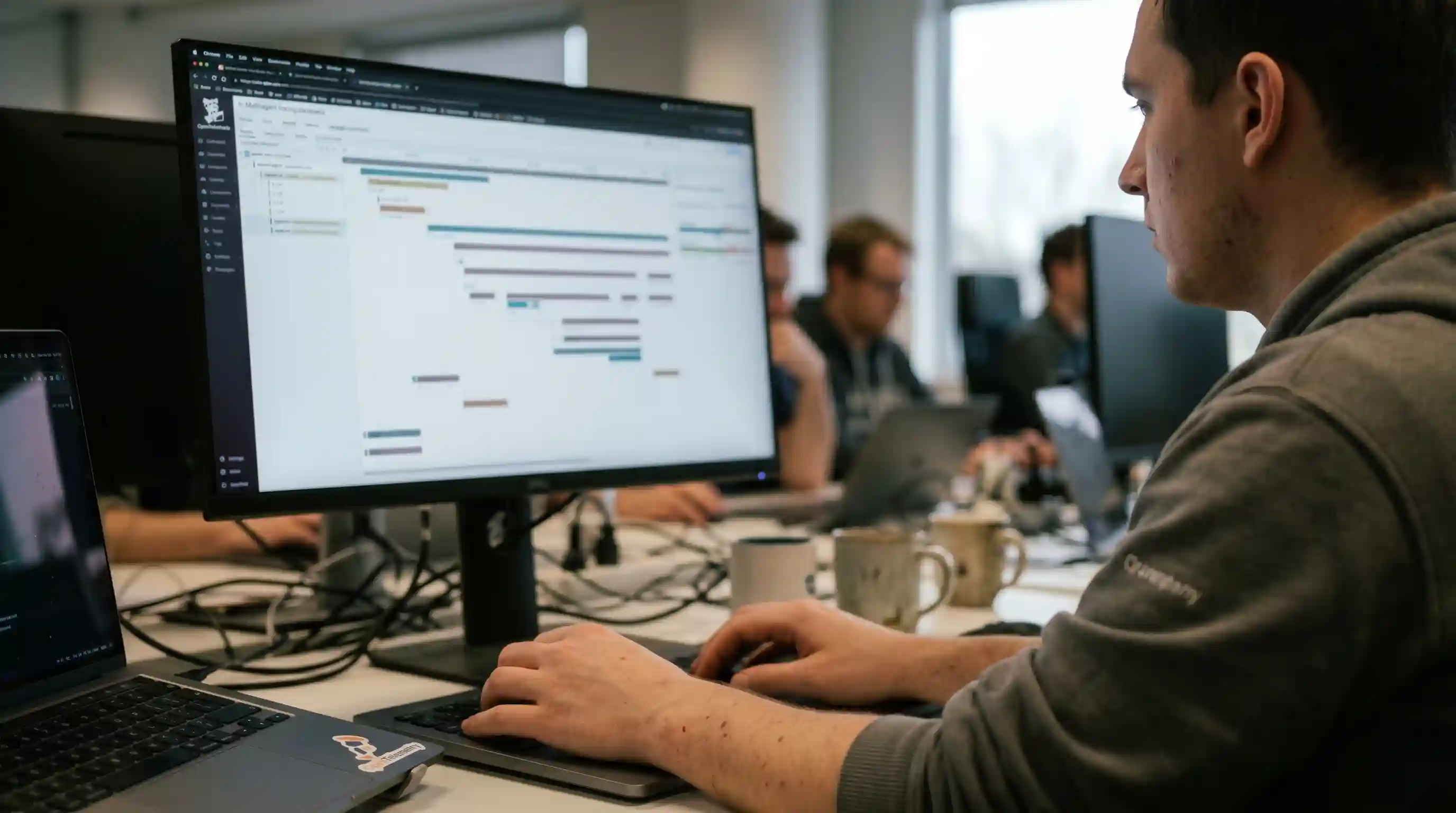
- The Orchestrator Collapse: Tooling designed for single-model calls cannot represent complex handoffs, leaving your supervisor agent completely blind to sub-agent failures.
- Parent-Child Hierarchies: Multi-agent visibility requires strict parent-child span modeling to correlate high-level goals with downstream executions.
- Fan-Out/Fan-In Tracing: You must utilize explicit OpenTelemetry span links to track asynchronous agent-to-agent (A2A) communications.
- Experimental Standards: The OTel framework conventions handling multi-agent orchestration remain in development, demanding abstraction layers to prevent vendor lock-in.
Agent tracing built for single agents quietly breaks on multi-agent observability. When you scale to an architecture where a supervisor delegates to multiple specialized sub-agents, traditional linear tracing fractures.
The resulting disconnected data silos make root cause analysis impossible, allowing silent failures to drain budgets undetected.
To survive these complex handoffs, your engineering team must look past legacy APM tools and adopt the multi-agent span models defined in the core AI agent observability OpenTelemetry framework.
Why Single-Agent Tracing Collapses
The Limits of Linear Request-Response Cycles
Single-agent observability relies on a straightforward, linear execution path. A user submits a prompt, the agent retrieves context, makes a single tool call, and returns an answer.
This flat structure fits perfectly within basic tracing dashboards. However, a multi-agent system does not operate linearly. It functions as a complex, non-deterministic graph of asynchronous operations.
When a basic tracing SDK encounters this distributed graph, it cannot automatically infer the relationships, causing the trace to splinter into dozens of disconnected requests.
The Cost of Disconnected Telemetry
When traces break, platform engineers lose the crucial "why" behind an application failure. You might see a sub-agent error in the logs, but without a connected trace graph, you cannot determine which supervisor trigger initiated the flawed sequence.
This exact blind spot is where runaway tool loops and cascading hallucinations occur in production.
Relying on aggregate metrics instead of connected multi-agent traces guarantees that these systemic errors will go unnoticed until they impact the end user.
Modeling Handoffs and Orchestration
Using Parent-Child Spans for Orchestrators
To accurately model a multi-agent system, telemetry must be hierarchical. The supervisor or orchestrator agent operates as the "Parent Span."
Every time the supervisor delegates a prompt to a specialized sub-agent, it must generate a localized "Child Span".
Implementation Rules for Parent-Child Spans:
- Context Propagation: The orchestrator must securely pass its active trace_id to the sub-agent payload.
- Execution Nesting: Sub-agent reasoning loops must resolve entirely within the lifespan of the orchestrator's parent span.
- Cost Roll-Up: Token costs incurred by sub-agents must bubble up to the parent span for accurate total-operation billing.
If your roadmap includes deploying advanced AI architectures, you must treat multi-agent tracing hierarchies as a primary infrastructure requirement from day one.
Correlating Traces Across Sub-Agents
In a distributed cloud environment, sub-agents often run on entirely different microservices or serverless functions.
Correlating these disparate operations requires standardized trace context headers. By injecting OpenTelemetry headers into the agent-to-agent (A2A) network requests, the receiving service can seamlessly attach its telemetry data to the original graph.
This ensures that even if an execution spans three different internal APIs, it renders as a single waterfall in your monitoring backend.
Tracing Agent-to-Agent (A2A) Communication
Span Links for Fan-Out and Fan-In Patterns
Advanced agent architectures frequently employ "fan-out" patterns, where a supervisor tasks three sub-agents to research a topic simultaneously.
Once completed, a "fan-in" step consolidates the findings. Standard parent-child spans struggle with this concurrent branching.
This is where OpenTelemetry Span Links become critical. Span links explicitly declare relationships between asynchronous, independent operations that do not strictly fit a synchronous parent-child timeline.
- Fan-Out Links: Connect the parallel execution branches back to the orchestrator's initiating trigger.
- Fan-In Links: Map the resulting sub-agent completions back to the final summarization agent.
Navigating OTel Multi-Agent Conventions in 2026
While the broader GenAI namespace is stabilizing, the specific OpenTelemetry conventions dictating agent and framework spans remain in official development status.
This means the schema defining how to label a "supervisor" versus a "worker" agent might shift. To protect your codebase, wrap these tracing initializers in an abstraction layer.
This limits your exposure to a single configuration file if the core standard updates.
For a deep dive into specific multi-agent error signatures—like runaway fan-out loops—review our comprehensive guides on observability fundamentals.
Conclusion & CTA
Multi-agent architectures are the future of enterprise AI, but they demand a fundamental shift in observability practices.
Relying on single-agent APM tools will leave you blind to the exact handoff failures and runaway costs that cripple distributed systems in production.

Frequently Asked Questions (FAQ)
Multi-agent observability is the technical practice of tracking execution paths, data handoffs, and tool usage across multiple distinct AI agents. It utilizes distributed tracing to link a supervisor agent's core reasoning down to the specific actions taken by its sub-agents.
Single-agent tracing is built for linear request-response cycles. When a supervisor agent delegates asynchronous tasks to multiple sub-agents, standard tracing tools fail to capture the handoff. This fractures the trace lineage, creating disconnected data silos that obscure systemic failures.
You trace handoffs by passing the active trace context from the supervisor agent to the sub-agent during the delegation call. The sub-agent then extracts this context, initiating its own internal processing while securely linking its generated spans back to the parent.
The orchestrator's primary execution loop is captured as a parent span. Every time it delegates a task or invokes a sub-agent, a child span is generated. This hierarchical relationship accurately models the orchestrator's top-down control flow and delegation logic.
Correlation is achieved by injecting a unified trace_id into the payload sent from the supervisor to the sub-agent. Both agents emit telemetry utilizing this exact same identifier, allowing the monitoring backend to stitch the disparate spans into one unified graph.
As of 2026, the OpenTelemetry agent and framework conventions addressing multi-agent orchestration remain officially in experimental development. While highly usable in production environments, teams should implement them via abstraction wrappers to mitigate the risk of future breaking specification changes.
Tracing A2A communication requires instrumenting the exact messaging bus or network protocol utilized by the agents. By injecting trace headers directly into the A2A message payload, you guarantee that the receiving agent continues the precise execution lineage established by the sender.
Visualizing complex agent graphs requires specialized observability backends like LangSmith or Phoenix. These platforms parse the parent-child span relationships and render interactive waterfall diagrams, allowing engineers to physically expand orchestrator nodes to inspect individual sub-agent reasoning loops and tool calls.
When an orchestrator triggers multiple asynchronous agents simultaneously, you utilize OpenTelemetry span links. These explicit relational markers connect the parallel execution branches back to the primary orchestration span, effectively mapping complex fan-out distributions and subsequent fan-in consolidation phases without breaking.
Debugging requires isolating the master trace ID and analyzing the span graph for cascading errors. By following the parent-child lineage, you can quickly determine whether an orchestrator provided flawed context or if a specific sub-agent hallucinated during its execution loop.