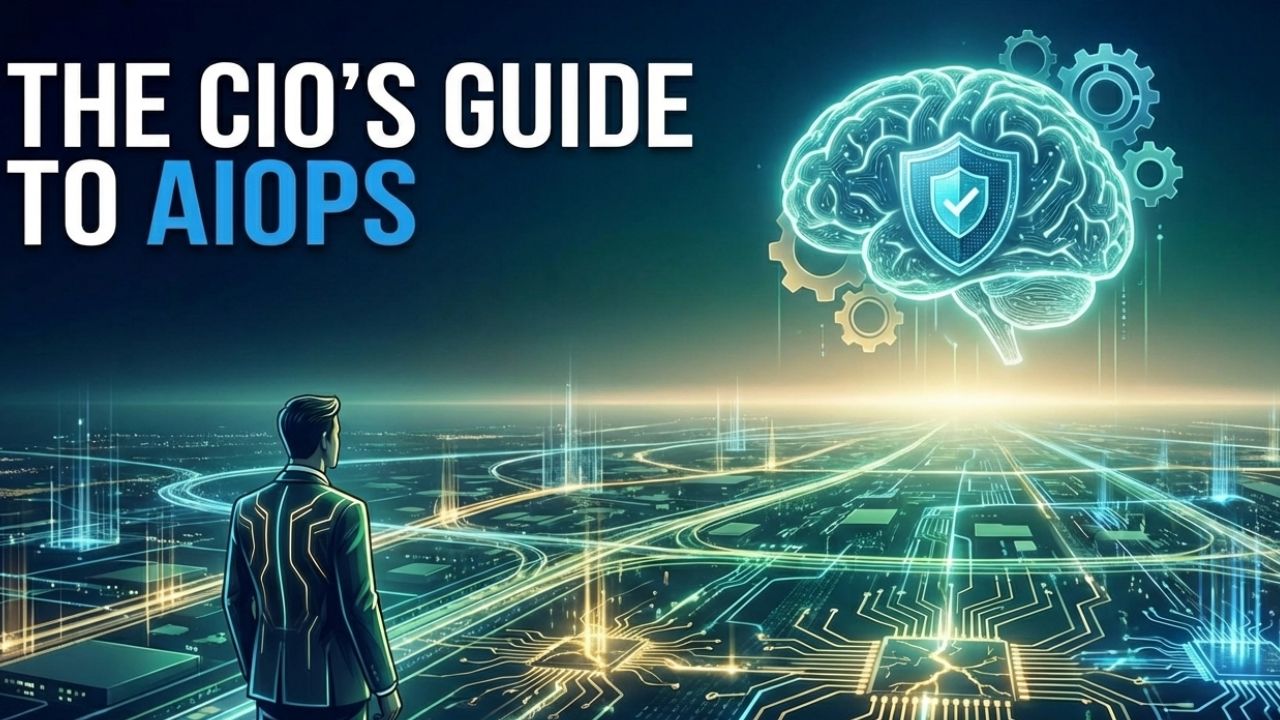
The CIO’s Guide to AIOps: Building the Self-Healing Enterprise in 2026
It is 3:00 AM. Your e-commerce checkout is throwing 500 errors. Your SRE team is waking up, groggy, trying to parse thousands of log lines to find the needle in the haystack. By the time they fix it, you have lost $100,000 in revenue.
In 2026, this scenario is obsolete.
In a Self-Healing Enterprise, the system detects the latency spike at 2:59 AM. An AI agent diagnoses a memory leak in a specific Kubernetes pod. The agent restarts the pod, clears the cache, and logs the incident in Jira, all before the human engineer even rolls over in bed.
This guide introduces AIOps (Artificial Intelligence for IT Operations). We are moving beyond "Monitoring" (seeing the red light) and "Observability" (knowing why it’s red) to "Action" (fixing the light automatically).
1. The Core Shift: Monitoring vs. Observability vs. AIOps
To build a self-healing infrastructure, you must understand the maturity curve. Most organizations are stuck at Step 2.
- Monitoring (The Dashboard): Tells you when something is wrong.
Question: "Is the server up?" - Observability (The Detective): Tells you why something is wrong.
Question: "Why is the checkout latency high?" - AIOps (The Healer): Uses machine learning to automate the fix.
Question: "How do we resolve this without a human?"
2. The 2026 Tooling Landscape
The market is crowded. Choosing the right "Brain" for your operations is the most critical decision a CIO will make this year.
- Datadog Watchdog: Best for Cloud-Native infrastructure. It excels at correlating metrics across thousands of microservices.
- Dynatrace Davis: Best for Enterprise Apps. Its causal AI is deterministic, meaning it gives you a precise root cause, not just a probability.
- New Relic Grok: Best for Full-Stack Visibility. Their GenAI assistant allows engineers to query logs using natural language.
4. The Architecture of a Self-Healing System
How does a "Self-Healing" loop actually work? It requires three components working in harmony:
- The Sensor (Observability): Tools like Datadog or Prometheus ingest logs and metrics.
- The Brain (The Agent): An AI model (like GPT-4o or a specialized SRE bot) analyzes the alert. It reads the logs, hypothesizes a root cause, and checks the runbook.
- The Actuator (The Tools): The agent triggers a script (via Ansible, Terraform, or PagerDuty) to remediate the issue—scaling up a cluster or rolling back a bad deployment.
5. The Cost of Intelligence: FinOps for Observability
The irony of AIOps is that "observing everything" costs a fortune. Data ingestion fees are the second highest cloud cost after compute.
- The Trap: Logging every "200 OK" success message.
- The Fix: Using AI for Intelligent Log Sampling.
We teach you how to use edge agents to discard 90% of the "noise" and only send the "signals" (errors/anomalies) to your expensive storage, slashing your observability bill.
Save money: The Cost of Observability: How to Use AI to Reduce Your Datadog Bill Learn cost reduction strategies6. Implementation Roadmap: The 90-Day Plan
Don't try to automate everything on Day 1. Follow this AIOps Implementation Roadmap:
- Month 1: Noise Reduction. Implement AIOps to group 1,000 similar alerts into 1 "Incident." Stop waking people up for non-issues.
- Month 2: Automated RCA. Connect your AI to your logs. When an alert fires, the AI should post a "Root Cause Analysis" summary in Slack automatically.
- Month 3: Automated Remediation. Start with low-risk actions. Allow the AI to clear caches or restart non-critical services.
7. Frequently Asked Questions (FAQ)
A: MLOps is about building and deploying machine learning models. AIOps is about using those models to fix IT operations. MLOps is for Data Scientists; AIOps is for DevOps and SREs.
A: AIOps reduces MTTR by automating the "Discovery" and "Diagnosis" phases. Instead of spending 30 minutes finding which server is broken, the AI tells you instantly. In mature setups, it also automates the "Repair," reducing MTTR to near zero.
A: It carries risk. That is why we implement "Human-in-the-Loop" for high-stakes actions. The AI can diagnose the issue and propose a fix (e.g., "Shall I roll back to v2.1?"), but a human must click "Approve" for critical infrastructure changes.
A: Datadog is generally considered the leader for cloud-native and microservices environments due to its strong integration with Kubernetes and AWS/Azure ecosystems.