SAFe 6.0 + AI Integration: The Practitioner's Survival Guide
- The real problem isn't skills — it's placement: 54.3% of practitioners name "integration uncertainty" as their single biggest barrier.
- Adoption is shallow: 83% use AI tools, but only 9% spend more than a quarter of their time with them.
- SAFe provides the home: The framework's cadence and Lean Portfolio layer provide the governance AI needs at scale.
- New roles are forming: The AI Product Owner and AI Model Steward are emerging inside Agile Release Trains.
- ROI requires economics: Tie flow improvements to value-stream economics, not just sprint velocities or demo speeds.
Eighty-three percent of Agile practitioners now use AI — yet most spend less than ten percent of their week actually working with it.
The reason is not fear of replacement; it is integration uncertainty: nobody has shown them where AI fits inside PI Planning, Agile Release Trains, and Value Streams without breaking the alignment that makes SAFe work.
This guide is the operating model that closes that gap — the practitioner's survival playbook for SAFe 6.0 in an AI-first enterprise.
Executive Summary: The 60-Second Briefing
If you read nothing else, read this. The data below is drawn from the Scrum.org AI4Agile Practitioners Report 2026 (289 practitioners, 20+ countries) and current SAFe 6.0 guidance from Scaled Agile, Inc.
| SAFe Layer | Where AI Adds Value | Primary Risk to Govern |
|---|---|---|
| Team / ART | Backlog refinement, story drafting, dependency detection | Erosion of shared understanding |
| Program (PI Planning) | Capacity forecasting, draft plan, risk surfacing | False confidence in the commitment |
| Value Stream | Flow analytics, bottleneck prediction | Optimizing delivery while weakening agility |
| Portfolio (LPM) | Epic outcome forecasting, funding signals | Unaccountable model-driven decisions |
What SAFe 6.0 AI Integration Actually Means
SAFe 6.0 AI integration is the disciplined practice of embedding artificial intelligence into the Scaled Agile Framework's events, roles, and artifacts — at the team, program, value-stream, and portfolio levels — without degrading flow, alignment, or Lean-Agile principles.
The distinction from AI-in-Scrum is not cosmetic. Scrum operates at the level of a single team. AI in Scrum is mostly personal productivity: a Scrum Master drafting a retrospective format, a developer pair-programming with a model.
SAFe operates across dozens of teams synchronized into Agile Release Trains. At that scale, an ungoverned AI suggestion does not stay local — it propagates across the program board and the dependency map.
That is precisely why integration uncertainty is highest among scaled practitioners. The mechanics of AI inside a single Sprint are now well understood. The mechanics of AI across a Value Stream are not.
If you are still grounding your team-level practices, start with our companion AI-Augmented Scrum Guide before scaling these patterns upward.
How AI Changes PI Planning in the Scaled Agile Framework
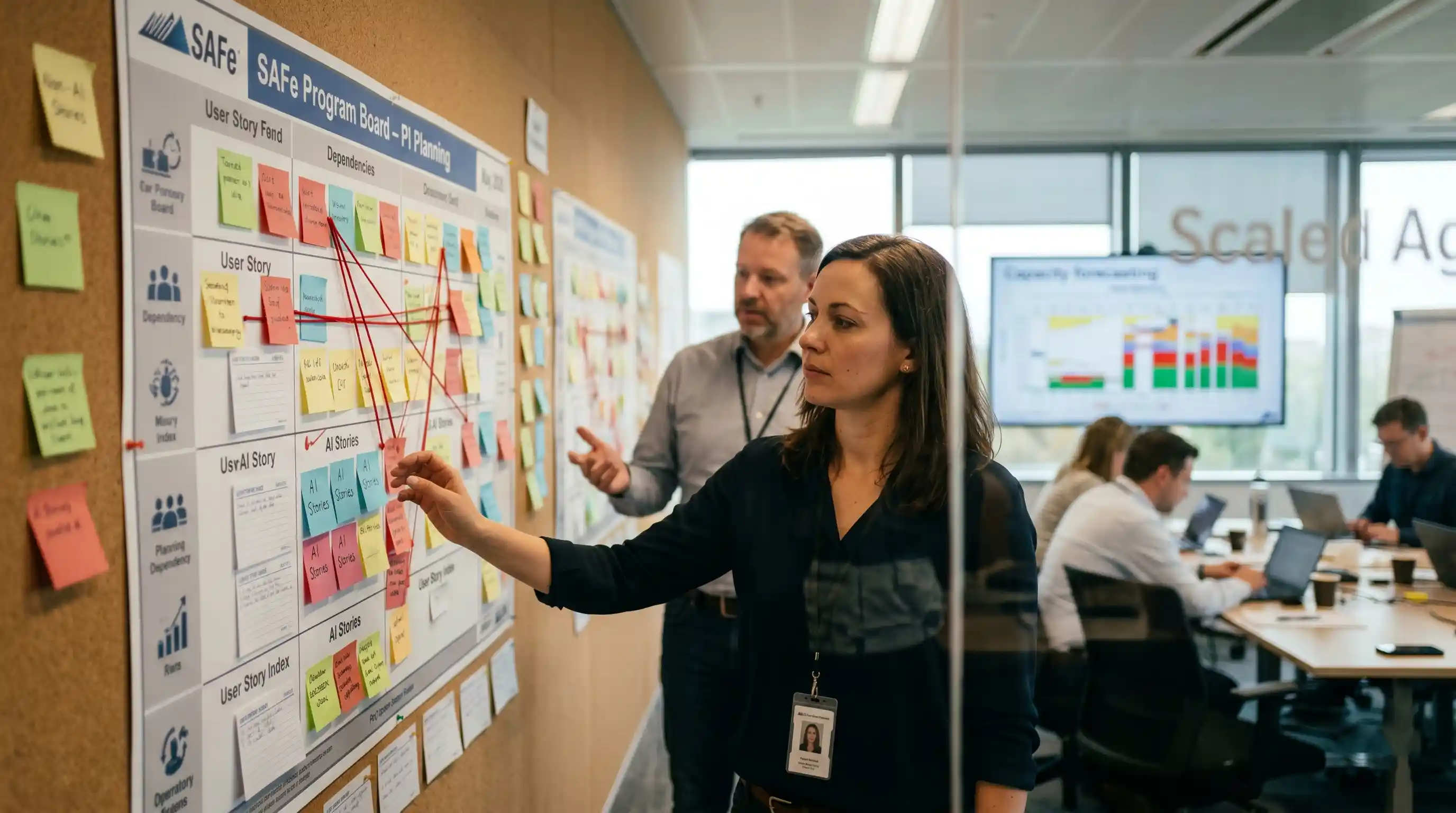
PI Planning is the heartbeat of SAFe — and the most fragile place to introduce AI carelessly. The value of PI Planning was never the plan itself; it was the alignment created when humans negotiate dependencies face to face.
Used well, AI accelerates the preparation: drafting candidate PI objectives, pre-computing team capacity, and surfacing likely cross-team dependencies before the event begins. This hands the room a stronger starting position.
Used badly, AI manufactures a polished plan that nobody argued over — and the confidence vote becomes theater. A high confidence vote on an AI-drafted plan that skipped the hard conversations is worse than a low one on a plan the teams genuinely wrestled with.
The Pre-Planning, In-Planning, Post-Planning Split
The reliable pattern separates AI's role by phase. Pre-planning: AI drafts and forecasts. In-planning: humans negotiate, AI only answers questions on demand. Post-planning: AI monitors the committed plan for emerging risk.
This keeps the irreplaceable human work — the negotiation — fully human, while removing the low-value preparation toil that exhausts teams before the event even starts.
We cover the full facilitation sequence, including how to handle AI-generated dependencies on the program board, in our dedicated guide to AI in PI Planning.
Agile Release Trains: Using AI Without Losing Human Alignment
The Agile Release Train is where SAFe either compounds AI's value or amplifies its noise. An ART coordinates 5–12 teams toward a shared mission on a fixed cadence — and that cadence is exactly what AI automation must respect, not override.
The highest-leverage AI applications at ART level are coordination tasks no human enjoys: continuous dependency detection across team backlogs, flow-metric aggregation, and early-warning signals when a feature's progress diverges from its forecast.
The Release Train Engineer's role shifts accordingly — from manually chasing status to curating and challenging the signals AI surfaces. The RTE becomes an editor of intelligence rather than a collector of it.
What must stay human is the System Demo's meaning and the Inspect & Adapt workshop's honesty. AI can assemble the metrics; only the train can decide what they mean and what to change.
For the operational mechanics of automating train-level coordination, see our deep dive on AI Agile Release Train automation.
The Information Gain: Why "AI Will Save Your SAFe Rollout" Is Exactly Backwards
Here is the counter-intuitive truth most vendors will not tell you: AI does not rescue a struggling SAFe implementation. It accelerates whatever is already true about it.
If your ARTs already have strong alignment, clear value streams, and honest Inspect & Adapt rituals, AI compounds those strengths. If they are a "feature factory" wearing Agile vocabulary, AI makes you a faster feature factory — shipping misaligned work at higher velocity.
The practitioners surveyed by Scrum.org sensed this precisely. Their dominant open-ended concern was not job loss; it was the erosion of Agile values — AI making it easy to skip the hard conversations that create shared understanding.
This reframes the entire integration question. The prerequisite for AI integration is not better tooling or more training. It is organizational honesty about whether your SAFe practice is real or ceremonial.
The common misconception — that an AI layer can paper over a weak transformation — is the single most expensive mistake in this space. The framework foundations have to be sound first. Our analysis of why AI won't save a broken SAFe or LeSS rollout unpacks this failure mode in detail.
The New SAFe Roles Emerging Because of AI in 2026
SAFe 6.0 already clarified existing role responsibilities — the Scrum Master/Team Coach, the renamed Product Owner, the Value Stream Engineer. AI is now forcing two genuinely new functions to crystallize inside Agile Release Trains.
The AI Product Owner
The AI Product Owner extends classic PO accountability into a world where part of the backlog is generated, prioritized, or estimated by models. Their new work is curation and provenance: deciding which AI suggestions enter the backlog and why.
This is not a rebranding exercise. The AI PO must understand model limitations well enough to reject confident-but-wrong outputs — a skill set most PO training has never addressed. We map the full responsibility shift in our AI Product Owner role in SAFe guide.
The AI Model Steward
The AI Model Steward is the quieter, more consequential role. Where the AI PO owns what the AI proposes, the Model Steward owns whether the model itself remains trustworthy — monitoring drift, governing access, and maintaining the evidence trail.
Most enterprises have not hired for this yet. They will — usually the first time an unsupervised model ships a decision into a Value Stream that nobody can explain to an auditor.
Is SAFe 6.0 Still Relevant in an AI-First Enterprise?
The fashionable take is that AI agents make heavyweight frameworks obsolete. The evidence points the other way. The more autonomous work becomes, the more an enterprise needs explicit cadence, alignment, and governance — the exact things SAFe codifies.
SAFe in 2026 has shifted emphasis from "adopt SAFe" to "operate SAFe for measurable outcomes," with Lean Portfolio Management leaning harder into continuous funding and connecting epics to economic results. That outcomes-and-flow orientation is what makes the framework a natural container for AI governance.
The relevance question is therefore the wrong one. SAFe is not competing with AI; it is the structure that lets you scale AI responsibly. The leadership challenge is transformation, not tooling — a theme we develop in our pillar on leading Agile transformation.
Measuring AI ROI Inside a SAFe Value Stream
Productivity anecdotes do not survive a portfolio funding review. Practitioners report real gains — 73.7% cite increased productivity and 71.6% reduced cognitive load — but those are perceived benefits, not economic ones.
The discipline that converts perception into funding is tying flow improvements to value-stream economics: lead time, deployment frequency, and most importantly the cost-of-delay the AI intervention actually reduced.
This is also where AI's hidden costs must surface — model spend, the rework caused by accepting low-quality AI output, and the governance overhead. A credible ROI model nets these against the gains rather than ignoring them.
Before you can prove anything, you need a pre-AI baseline. Teams that skip the baseline can never separate AI's contribution from normal improvement. Our framework for SAFe AI ROI measurement gives you the four-line model a CFO will actually sign.
Where to Start: Adding AI to an Existing SAFe Rollout
Do not begin with a framework-wide AI mandate. Begin with one ART, one Program Increment, and one well-chosen workflow — ideally backlog refinement or dependency detection, where value is high and blast radius is contained.
Run it as an empirical experiment with a clear hypothesis, a baseline, and an Inspect & Adapt checkpoint. Decide in advance what evidence would make you scale it — and what would make you stop.
Once one ART can demonstrate flow improvement tied to economics, you have a repeatable pattern and an internal proof point. That proof point, not a vendor slide, is what earns portfolio-level investment.
The right tooling foundation matters too: if your delivery platform cannot give you clean flow data, no AI layer can fix that. Choosing software built for scaled delivery is the unglamorous prerequisite — our buyer's guide to the best Agile software for the Scaled Agile Framework covers what to look for.

Frequently Asked Questions
SAFe 6.0 AI integration embeds AI across teams, programs, value streams, and the portfolio of the Scaled Agile Framework. It differs from AI in Scrum, which operates within one team, because at scale an ungoverned AI output propagates across many synchronized teams rather than staying local.
AI strengthens PI Planning preparation — drafting objectives, forecasting capacity, surfacing dependencies — but the negotiation itself must stay human. Use AI before and after the event; keep the in-room commitment and confidence vote driven by people, or alignment becomes theater.
Two roles are forming inside Agile Release Trains: the AI Product Owner, who curates what AI proposes to the backlog, and the AI Model Steward, who governs whether the model stays trustworthy by monitoring drift, access, and the evidence trail. Neither is yet fully official in SAFe.
Yes — arguably more relevant. The more autonomous work becomes, the more an enterprise needs the explicit cadence, alignment, and governance SAFe provides. SAFe is not competing with AI; it is the structure that lets organizations scale AI responsibly and tie it to outcomes.
ARTs apply AI to coordination toil — dependency detection, flow-metric aggregation, early-warning signals — while keeping the System Demo's meaning and Inspect & Adapt honesty human. The Release Train Engineer shifts from collecting status to curating and challenging the signals AI surfaces.
Integration uncertainty is not knowing where AI fits in real workflows. In the Scrum.org AI4Agile 2026 report, 54.3% named it their biggest barrier — 18 points ahead of anything else. It is a placement and operating-model gap, not a technical skills gap.
Re-certification is not mandatory to work with AI-augmented teams, but updated training helps. Providers now offer AI-empowered SAFe courses, and Scaled Agile reports most open SAFe roles prefer certification. Prioritize practical AI-in-Agile skills over collecting credentials.
Tie flow improvements — lead time, deployment frequency, reduced cost-of-delay — to value-stream economics, then net out model spend, rework, and governance cost. Establish a pre-AI baseline first; without it, you cannot separate AI's contribution from normal team improvement.
No. AI removes coordination toil and drafting work, but the RTE's facilitation and the PO's prioritization judgment remain human. Both roles shift toward curating and challenging AI output. The accountability for value and alignment cannot be delegated to a model.
Start with one ART, one Program Increment, and one contained workflow such as backlog refinement or dependency detection. Run it as an empirical experiment with a baseline and an Inspect & Adapt checkpoint, then scale only the patterns that prove flow improvement tied to economics.