Why AI Won't Save Your SAFe or LeSS Rollout
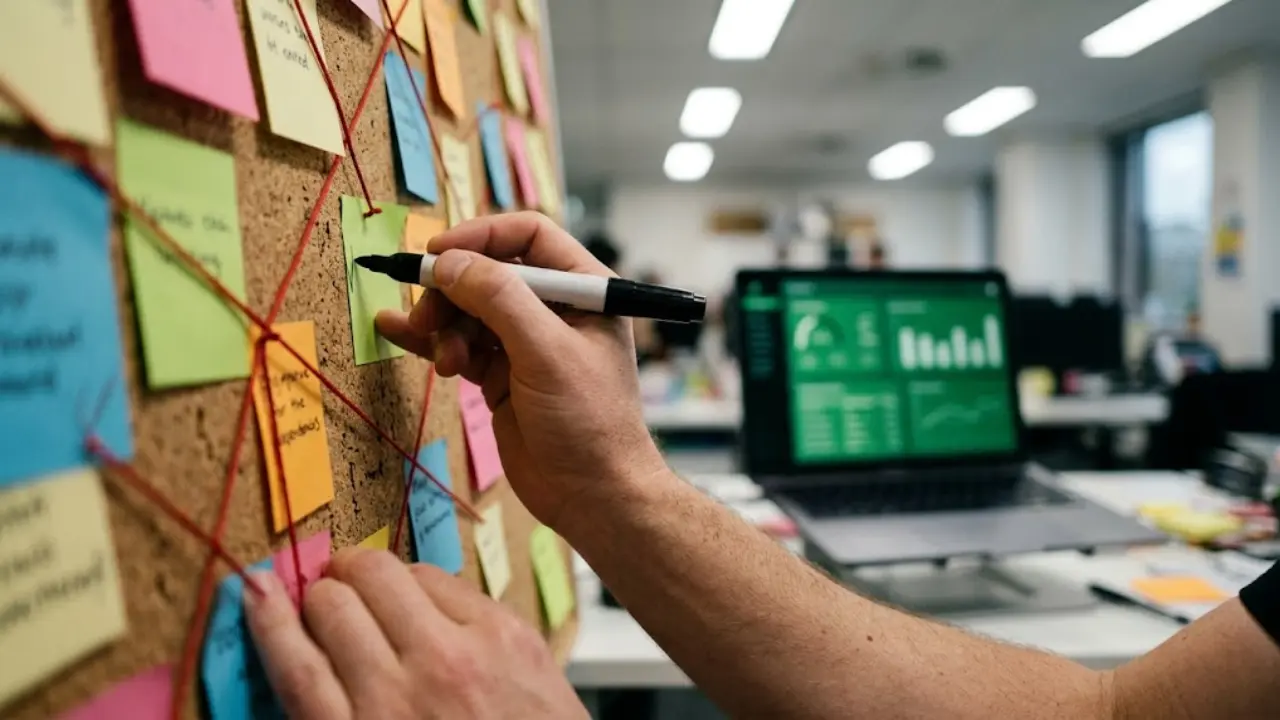
- AI for scaling Agile frameworks fails for the same reason previous scaling efforts failed: the problem was never coordination overhead, it was misaligned incentives and unresolved authority. AI accelerates whatever was already there.
- SAFe, LeSS, and Scrum@Scale rollouts collapse on five predictable traps: automating dysfunction, mistaking dashboards for alignment, replacing judgment with optimization, eroding RTE accountability, and conflating speed with flow.
- AI absolutely helps inside scaled environments — at PI Planning, with program-board maintenance, in cross-team dependency surfacing, and on flow metrics. The leverage is real after the human governance is sound, not as a substitute for it.
- The Release Train Engineer role is being elevated, not replaced. RTEs who treat AI as a coordination assistant outperform RTEs who treat it as a coordination authority — by a wide margin.
- The right question is not "what AI tools should we adopt for our rollout?" It is "what AI tools will reveal the dysfunction we are currently hiding, and are we prepared to act on what we see?"
Your leadership team just approved an AI platform that promises to "transform" your scaled Agile rollout. The vendor demo was impressive. The procurement decision is already made.
And inside six months, the rollout will produce the same outcomes your last two consulting engagements produced — slightly faster, slightly more documented, and just as politically stuck as before.
This is the pattern playing out across enterprise PMOs in 2026, and it is predictable.
The parent guide on AI for Agile coaching covers the general failure modes; this article zooms into the five specific traps that make AI for scaling Agile frameworks — SAFe, LeSS, Scrum@Scale — fail in exactly the same places your previous scaling efforts failed.
The traps are not technical. That is precisely the problem.
What Leaders Are Actually Buying When They Buy "AI for Scaled Agile"
The pitch is consistent across vendors: AI will reduce coordination overhead, surface dependencies automatically, generate program boards, identify risks, and free your scaling roles to focus on "strategic work."
The demo always works.
The implementation never lands the same way. Six months in, the program board is generated but not believed. Dependencies are surfaced but not resolved. Risks are flagged but not owned. The dashboards are excellent. The outcomes are unchanged.
The substitution that doesn't work
Most enterprise leaders are buying AI as a substitute for the hard human work of scaling: the political conversations, the prioritization fights, the resource trade-offs, the authority disputes between business and engineering.
AI cannot do this work. It can surface it, structure it, and accelerate the throughput around it. But the work itself — making contested calls between competing teams — remains a human responsibility, and one most leadership teams have been avoiding for years.
A scaled Agile framework is fundamentally a forcing function for these conversations. SAFe makes the trade-offs visible at PI Planning. LeSS makes them visible at Sprint Planning. Scrum@Scale makes them visible at the MetaScrum. The frameworks work when leadership engages with what becomes visible.
They fail when leadership uses the framework to look productive while avoiding the underlying decisions.
AI added to this dynamic does not fix the avoidance. It just makes the avoidance more elegantly documented.
The Five Traps That Kill AI for Scaling Agile Frameworks
These are not edge cases. They are the predictable failure modes across SAFe, LeSS, and Scrum@Scale rollouts in 2026.
Trap 1 — Automating Dysfunction
The single most common failure: leadership uses AI to make existing dysfunctional processes faster, instead of using the rollout to fix them.
Examples:
- Cross-team status reporting that was useless when humans wrote it is now useless at AI speed.
- Dependency tracking that was ignored manually is still ignored when AI-generated.
- Pre-PI Planning preparation documents are generated automatically but no one reads them more carefully.
The diagnostic test: if your process was broken before AI, AI will not fix it. The rollout will simply produce broken output at higher fidelity. The right question is not "how can AI speed up our current process?" but "which parts of our current process should not survive the AI rollout at all?"
Trap 2 — Mistaking Dashboards for Alignment
AI dashboards displaying program-level metrics give leaders the feeling of control without the substance of it. The dashboard updates in real time. The teams it represents are no closer to delivering than they were before.
Symptoms:
- Leadership meetings shift from "what should we do about X?" to "what does the dashboard say about X?"
- Action items get assigned to "the dashboard" instead of to humans.
- Discrepancies between the dashboard and ground truth get attributed to data quality instead of being treated as the actual problem.
The trap mechanism: dashboards are downstream artifacts of human alignment, not substitutes for it. When the human alignment doesn't exist, the dashboard is a mirage. Vendors selling AI dashboards optimize for the demo, not the alignment.
Trap 3 — Replacing Judgment With Optimization
AI excels at optimization. Scaled Agile rollouts almost never have an optimization problem — they have a judgment problem.
The difference:
- An optimization problem has a defined objective and known constraints. ("Maximize throughput given current capacity.")
- A judgment problem has contested objectives and unknown trade-offs. ("Should we ship the security feature now or the customer feature first, given that the regulator and our largest customer both want different things?")
AI delivers brilliantly on the first kind. It delivers fluent, confident, plausible-sounding nonsense on the second.
Leaders who don't distinguish between the two end up using AI recommendations to settle disputes that should have been resolved by senior judgment — and producing decisions that no human is willing to own.
Trap 4 — Eroding Release Train Engineer Accountability
The RTE in SAFe (or its equivalent in LeSS and Scrum@Scale) is fundamentally an accountability role. They hold the program together because they are personally responsible for it.
How AI erodes this:
- AI-generated PI plans dilute the RTE's ownership of the planning outcome.
- AI-flagged risks transfer perceived ownership from the RTE to the tool.
- AI-prepared communications obscure the RTE's voice and stance.
- AI-generated retrospective summaries replace the RTE's pattern recognition with the model's median synthesis.
Over time, the RTE becomes an operator of an AI system instead of a steward of a program. The role hollows out, the program drifts, and leadership eventually concludes that "scaling didn't work here." The conclusion is wrong; the implementation undermined the role.
Trap 5 — Conflating Speed With Flow
AI tools relentlessly optimize for speed — faster PI planning, faster dependency mapping, faster retros, faster status updates.
Scaled Agile frameworks exist to optimize for flow — the smooth movement of value through the system.
Speed and flow are not the same thing. A team can sprint ten times faster and still have value blocked at handoff points downstream. AI applied to local speed in the absence of system-wide flow thinking is what creates the most common pathology in scaled environments: every team is busy, every team is shipping, and nothing is reaching customers.
The corrective: every AI tool adopted in a scaling context must answer one question — does this improve flow, or just speed? If it only improves speed, it will produce more local heat and less global outcome.
Can AI Help You Implement SAFe, LeSS, or Scrum@Scale?
Yes, with serious caveats. AI is a legitimate accelerant after the human governance, role clarity, and prioritization discipline are sound. It is destructive when used to compensate for their absence.
Where AI genuinely helps
- PI Planning preparation — the RTE briefs an AI assistant with the program's current state, last PI's outcomes, known dependencies, and known risks. The AI produces a structured prep document the RTE refines. Time saved: significant. Risk: low.
- Dependency surfacing across teams — AI can read Jira/ADO data across multiple teams and surface implicit dependencies the teams themselves haven't noticed. The output is a hypothesis for humans to investigate, not a conclusion.
- Cross-team retrospective analysis — anonymized retros across an ART (Agile Release Train) or Requirement Area, analyzed for recurring patterns. The disciplined approach to AI in retros at the team level applies at the program level too, with even higher stakes. (See AI for sprint retrospectives).
- Flow metric calculation and visualization — flow efficiency, work-in-progress aging, throughput patterns. AI doesn't decide what to do; it makes the system state legible.
- Stakeholder communication drafting — turning a program's actual decisions into communications for executives, customers, and other stakeholders.
Where AI is at best neutral and at worst destructive
- Automatic program board generation — looks great in the demo; produces commitments the teams didn't actually make.
- AI-driven prioritization — turns contested business decisions into seemingly-objective outputs nobody owns.
- Replacing the RTE role with an "AI Release Train Engineer" — destroys the accountability the role exists to provide.
- Real-time dashboards shown to leadership — creates the illusion of oversight while obscuring the messy ground truth.
The pattern across both lists: AI works when it makes the system legible. It fails when it makes the system decided.
What Is the Role of AI in a SAFe PI Planning Event?
PI Planning is the highest-leverage moment in a SAFe rollout. It is also where AI is most aggressively marketed. The right use of AI in PI Planning is narrow.
Useful pre-PI activities
- Generating the "draft of a draft" — a starting structure for the PI objectives based on the portfolio backlog, last PI's commitments, and known constraints. The RTE and Product Managers heavily edit this. Saves 20–40% of pre-planning time. Critical: never present this draft to the teams as "the plan." It is preparation material for the RTE only.
- Dependency hypothesis surfacing — analyzing recent sprint data and backlogs across teams to suggest possible cross-team dependencies. Teams investigate and confirm or reject in the event itself.
- Risk pattern analysis — comparing this PI's setup to the last 4–6 PIs and flagging patterns associated with past risks (e.g., "the last three times we tried this combination of teams + scope, mid-PI scope changes occurred").
Useful in-event activities
- Note-taking and decision capture — the AI scribe, not the AI facilitator. The RTE and SPC facilitate; the AI documents.
- Real-time clarification queries — teams ask "what was the velocity profile of Team X in the last PI?" and get a fast answer.
Counterproductive in-event activities
- AI-generated program board on the wall — replaces the human-built program board that creates ownership and shared understanding.
- Live AI commentary on team commitments — creates pressure to perform against an algorithm.
- AI-driven facilitation prompts shown to teams — converts a collaborative event into a guided procedure.
Can AI Replace Release Train Engineers or Chief Scrum Masters?
No. And the leaders who think it can are about to teach themselves an expensive lesson.
What the role actually does
The RTE (or LeSS Chief Scrum Master, or Scrum@Scale equivalent) does five things that AI cannot:
- Holds accountability — when a PI fails, someone has to own it. AI cannot be accountable. Accountability is a human attribute.
- Reads the political weather — knowing which conversation to have with which leader at which moment. This is interpersonal craft, not pattern recognition.
- Resolves contested authority — when business and engineering disagree, the RTE creates the space for the right people to decide. AI cannot create that space.
- Maintains the program's emotional reality — programs have morale, momentum, fatigue. The RTE senses and responds to these. AI does not.
- Carries the institutional memory of trust — who did what last quarter, who delivered, who didn't, who owes whom what. This memory shapes how the next conversation goes.
What AI can do is augment the RTE — absorbing the documentation overhead, surfacing patterns from data, drafting communications, freeing the RTE's attention for the five activities above. This is real value. It is not replacement.
The bifurcation to expect
Within two budget cycles, RTEs will split into two visible groups:
- Augmented RTEs — using AI as a coordination assistant, maintaining clear human accountability, and operating with more programs per RTE because the AI absorbs the overhead.
- Replaced RTEs — at organizations whose leadership genuinely tried to substitute AI for the role. These organizations will quietly hire the role back, often at higher cost, after eighteen months of degraded program outcomes.
A serious treatment of any of this requires going back to first principles about what scaling actually requires — which is, at its core, Agile leadership at multiple levels of the organization, not just better tooling.
How Do I Use AI to Coordinate Dependencies Across Multiple Agile Teams?
This is one of the genuine AI strengths in scaled environments — but only when used as a hypothesis generator, not as a truth source.
The right workflow
- Step 1 — Surface candidate dependencies. Feed the AI anonymized backlog data from all teams in the ART/Requirement Area. Ask: "Which stories or features across these teams appear to require coordination that is not currently scheduled?" The AI produces candidates.
- Step 2 — Validate with humans. The RTE or Area Product Owner reviews each candidate dependency with the relevant teams. Some are real, some are coincidence, some are already handled. The teams own the validation.
- Step 3 — Track the resolution. Validated dependencies enter the program board through normal SAFe/LeSS mechanisms. AI doesn't auto-add them.
- Step 4 — Learn from misses. When a dependency becomes a problem mid-PI that the AI did or didn't flag, capture it for the next cycle. The model improves with feedback; so do the humans.
The discipline
AI dependency outputs must be treated like medical screening results — possible signals worth investigating, not diagnoses. Leaders who treat them as diagnoses generate "we already handled that, why is the AI still flagging it?" fatigue, and the team starts ignoring the output entirely.
Can AI Generate a Program Board for SAFe Automatically?
Technically yes. Practically, you don't want it to.
Why the auto-generated program board fails
The program board in SAFe is not primarily a document. It is the artifact of a conversation. Teams put up their commitments because they had the conversations that produced those commitments.
Dependencies have ownership because someone in the room agreed to own them. Risks are escalated because someone in the room raised them.
An AI-generated program board has none of this provenance. The teams haven't had the conversations. The dependencies have no owners. The risks haven't been raised. The artifact looks the same. The reality underneath is empty.
What AI should generate instead
- A draft starting point for the RTE to use as scaffolding when designing the planning event.
- Templates and visual structure for the human-built program board.
- Validation passes after the program board is built — "are there obvious missing dependencies based on the data?"
The principle: AI prepares the workspace, humans do the planning, AI validates the output. Never the other way around.
What AI Tools Work Best for Portfolio-Level Agile Coaching?
The tool selection at portfolio level is different from team level because the use cases are different.
Useful portfolio-level capabilities
- Multi-program flow visualization — aggregating flow metrics across multiple ARTs or Requirement Areas. Looks for patterns across the portfolio, not within a single program.
- Strategic theme tracking — connecting work at the team level back to the portfolio epics and strategic themes. AI can surface drift between intended themes and actual work.
- Cross-program retrospective analysis — what is the whole portfolio learning, not just individual programs?
- Stakeholder communication for executives — translating program-level reality into language executives can act on.
What to be skeptical of at portfolio level
- "AI-driven prioritization" of portfolio epics. This is leadership work. The AI can surface considerations; it cannot decide. Vendors that pitch AI prioritization at portfolio level are selling a fantasy.
- "AI risk scoring" rolled up to the portfolio. Risk is contextual. A 7/10 risk score across forty programs is meaningless without the contextual judgment that produced each rating.
- "AI program health" dashboards shown to executives. These create the comfort of oversight without the substance. Executives stop asking the messy human questions because the dashboard looks green.
How Does AI Help With Cross-Team Retrospectives in Scaled Agile?
This is a meaningful use case at the program and portfolio levels — with strict guardrails.
The pattern
Anonymized retros from 4–8 teams across an ART, aggregated and analyzed for cross-team patterns. The AI is looking for:
- Impediments that recur across multiple teams (likely program-level, not team-level)
- Themes one team is solving that other teams haven't yet noticed
- Topics being systematically avoided across the ART
- Drift between team-level concerns and program-level commitments
The output is a hypothesis the RTE brings into the next Inspect & Adapt or System Demo.
The guardrails
- Strict anonymization before aggregation. The same anonymization discipline that applies at team level applies at program level — and the stakes are higher because more people see the output.
- The output is for the RTE/SPC, not for general distribution. Distributing the AI's cross-team analysis to all teams creates surveillance perception across the ART.
- The RTE owns the framing. When patterns are surfaced to the ART, the RTE frames them in their own words, with their own judgment, not as "the AI said."
Should I Use AI to Measure Flow Metrics Across an Agile Release Train?
Yes. Flow metrics are one of AI's strongest legitimate use cases in scaled Agile. The discipline is around what you do with the metrics.
What AI does well with flow
- Calculation across teams — flow efficiency, cycle time, throughput, work-in-progress aging, blocked work duration — at scale, across multiple teams, in real time. No human can do this manually.
- Pattern detection — "your flow degrades systematically in the last week of every PI" is a pattern AI can surface that the RTE might miss.
- Anomaly flagging — when a team's flow metrics deviate from their own baseline, surface it for investigation.
What AI should not decide
- Whether the team is "underperforming." Flow metrics are inputs to a coaching conversation, not outputs of a judgment.
- Whether to intervene with a team. That is RTE/coach judgment based on the relationship and context, not on the dashboard.
- What to optimize next. Optimization choices involve trade-offs the AI cannot evaluate.
The principle, again: AI makes the system legible. Humans make it decided.
What Are the Risks of Using AI in Scaled Agile Transformations?
Five risks worth tracking explicitly:
- Polished dysfunction — AI makes broken processes faster and more documented, not better. Leadership mistakes the polish for progress.
- Accountability erosion — RTE and Chief Scrum Master roles hollow out as the tool absorbs perceived ownership.
- Surveillance perception across the ART — when teams realize AI is analyzing their work at scale, honesty in retros and planning drops the same way it does at team level — at higher cost.
- Vendor lock-in to integrated AI scaling suites — the platforms that promise the most are also the hardest to leave when they don't deliver.
- Reputational risk for transformation sponsors — when the AI-augmented rollout fails, it fails publicly and expensively. Leaders who sponsored it pay the political cost.
The single best mitigation across all five is radical honesty about what AI cannot do. Leaders who say it out loud, early, position the rollout to use AI where it helps and avoid using it where it hurts.
Conclusion & Next Step
AI for scaling Agile frameworks is not a transformation strategy. It is a tool that exposes whether your transformation strategy exists or doesn't.
Where the human work of leadership, prioritization, accountability, and judgment is sound, AI is a meaningful accelerant. Where that work is missing, AI is an expensive way to document its absence.
The vendors selling scaled-Agile AI platforms are optimizing for what looks impressive in a procurement demo, not for what makes a SAFe, LeSS, or Scrum@Scale rollout actually work. Leaders sponsoring these rollouts have a narrow window to set expectations before the technology arrives — and the window is closing.
Your next step: before the AI platform you have already procured rolls out, sit with your senior leadership team and answer one question on paper: "What dysfunction in our current scaling effort do we expect this tool to surface, and are we prepared to act on what we see?"
If the answer is anything other than a clear "yes, here is how," delay the rollout. Roll out the human governance first. Then layer in the AI. In that order, the tool earns its cost. In the reverse order, you have just bought another quarter of polished theater.

Frequently Asked Questions (FAQ)
Yes, but only after the human governance, role clarity, and prioritization discipline are sound. AI accelerates whatever is already there — if the foundations are broken, AI produces faster broken output. The right use cases are PI Planning preparation, dependency surfacing, retro analysis, and flow metric calculation, not authority replacement.
AI is elevating the Release Train Engineer and Chief Scrum Master roles, not replacing them. Augmented RTEs run more programs per person because AI absorbs documentation and pattern-recognition overhead. Organizations that try to substitute AI for the role are hiring it back inside eighteen months at higher cost.
Useful pre-event: drafting structures the RTE refines, surfacing dependency hypotheses, flagging risk patterns from past PIs. Useful in-event: note-taking and decision capture, real-time clarification queries. Counterproductive: AI-generated program boards, live commentary on team commitments, AI-driven facilitation. Prepare with AI; plan with humans.
No. The role holds accountability, reads political weather, resolves contested authority, maintains program emotional reality, and carries institutional trust memory — none of which AI can do. AI augments the role by absorbing overhead and surfacing patterns. Organizations that attempt replacement consistently rehire the role within two budget cycles.
Treat AI dependency output as hypotheses, never as truths. The workflow: AI surfaces candidate dependencies from team backlog data, the RTE or Area Product Owner validates with the relevant teams, validated dependencies enter the program board through normal mechanisms, misses are captured for the next cycle. Validation by humans is non-negotiable.
Technically yes, practically you don't want it to. The program board is not primarily a document — it is the artifact of conversations among teams. AI-generated boards have no provenance: teams haven't had the conversations, dependencies have no owners, risks haven't been raised. Use AI to prepare scaffolding, never to skip the planning.
Useful: multi-program flow visualization, strategic-theme drift detection, cross-program retro analysis, stakeholder communication drafting. Be skeptical of: AI-driven portfolio prioritization, AI risk scoring rolled up to portfolio level, executive-facing 'program health' dashboards. The first set surfaces signal; the second creates the comfort of oversight without the substance.
Aggregate anonymized retros from 4–8 teams in an ART, then look for recurring impediments, themes one team is solving that others haven't noticed, systematically avoided topics, and drift between team and program commitments. The output is a hypothesis for the RTE/SPC to bring into Inspect & Adapt, not material for general distribution.
Yes — flow metrics calculation, pattern detection, and anomaly flagging are among AI's strongest legitimate scaled-Agile use cases. The discipline is in what you do with them: metrics are inputs to coaching conversations, not outputs of judgments about team performance. AI makes the system legible; humans make it decided.
Five major risks: polished dysfunction (faster broken processes), accountability erosion (RTE role hollowing out), surveillance perception across the ART (team honesty drops), vendor lock-in to integrated scaling suites, and reputational risk to transformation sponsors when expensive rollouts fail. Mitigation begins with leadership stating publicly what AI cannot do.