Why Your AI-Run PI Planning Is Guaranteed to Stall
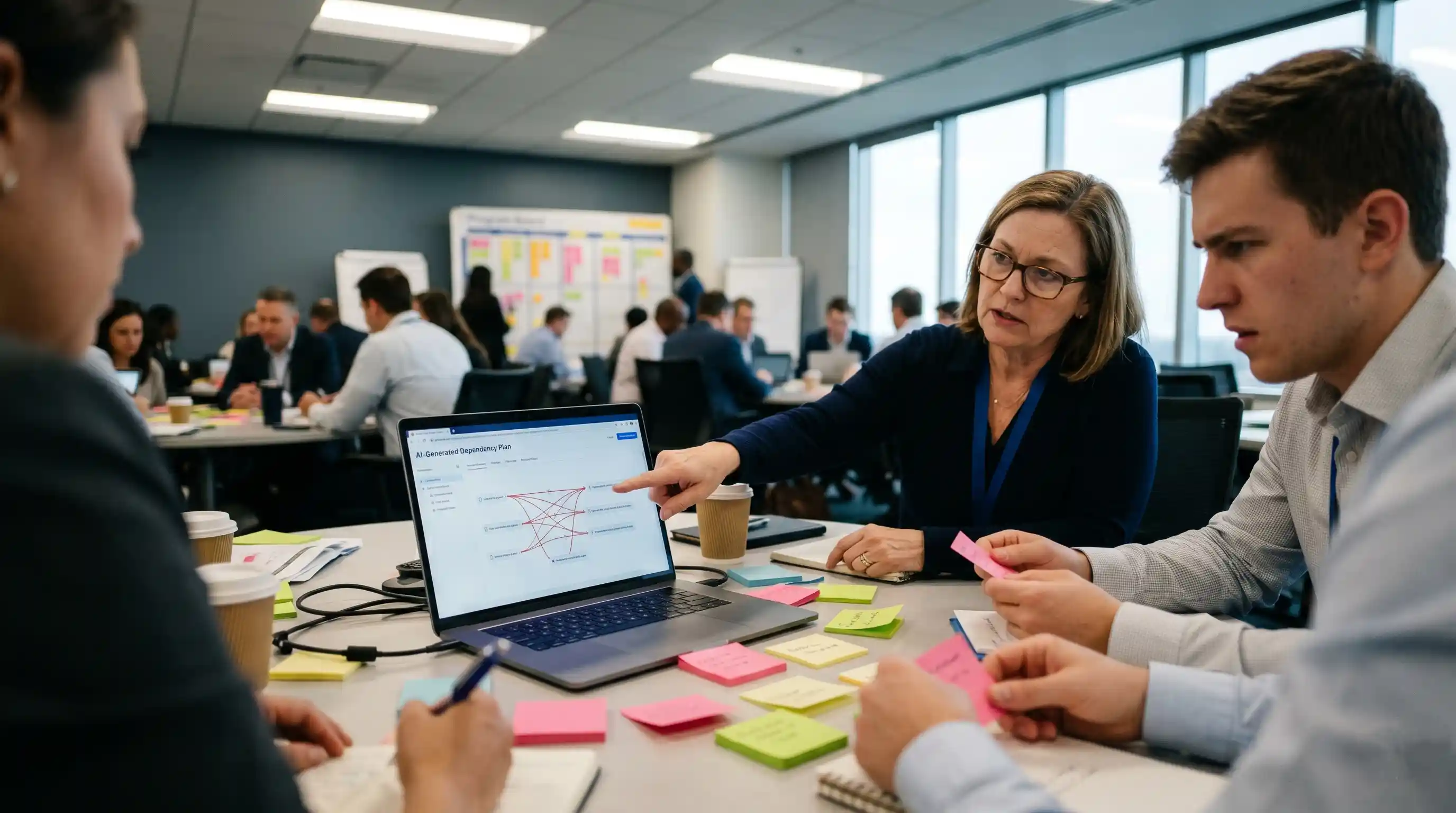
- Automate Preparation, Not Alignment: Use AI to pre-compute historical capacity and draft candidate PI objectives, but never to auto-resolve cross-team dependencies.
- Protect the Confidence Vote: An AI-generated plan that bypasses human friction turns the confidence vote into dangerous theater.
- The 5-Step Facilitation Map: Strictly divide AI's role into Pre-planning (drafting), In-planning (on-demand answers), and Post-planning (monitoring).
- The Facilitator's Evolution: The Release Train Engineer (RTE) shifts from manually chasing status to challenging AI-surfaced risk signals.
Teams bolting AI onto PI Planning in the scaled agile framework wreck capacity math and commitment. The belief that a large language model can synthesize a 10-team Agile Release Train's backlog into a flawless two-day event is the fastest route to "alignment theater."
When a machine drafts the dependencies, human teams stop arguing over them. And when teams stop arguing, the confidence vote is meaningless. To successfully navigate AI in PI Planning, you must separate preparation from negotiation.
If you haven't yet read the core operating model, start with our master guide on SAFe 6.0 + AI Integration: The Practitioner's Survival Guide. AI should accelerate the grueling pre-planning math, not eliminate the human friction required for genuine commitment. Here is exactly how to sequence the event so your train doesn't derail.
The Core Problem: Over-Automating the Scaled Agile Framework
The value of PI Planning was never the physical program board itself. It was the alignment created when humans negotiate dependencies face-to-face.
If an AI agent maps all dependencies for an Agile Release Train beforehand, teams lose the shared context required to execute the work. A model might correctly predict a data-layer bottleneck, but it cannot negotiate a scope reduction with the business owner.
When introducing AI in PI planning scaled agile framework environments, you must treat the AI as an incredibly fast analyst, not the decision-maker.
If your team-level practices are already suffering, trying to scale AI to the PI level will only multiply the chaos. Make sure your fundamental Scrum events are sound first.
The 5-Step AI Facilitation Map for PI Planning
To keep the room aligned and the commitment real, follow this 5-step map. It deliberately caps AI intervention during the live event.
Step 1: Pre-Computing Capacity (The Math Check)
Do not rely on gut-feel capacity. Feed the AI historical velocity, known vacation schedules, and past PI completion metrics.
The AI Task: Generate a realistic capacity forecast per team.
The Human Task: The Scrum Master/Team Coach validates the number and defends it to the room.
Step 2: Drafting Candidate PI Objectives
Instead of staring at blank screens, teams can use AI to synthesize their prioritized features into draft objectives.
The AI Task: Draft candidate PI objectives based on the feature backlog.
The Human Task: The team rewrites these drafts to capture actual business intent and negotiate value with the Business Owners.
Step 3: Human Negotiation on the Program Board
During the core breakouts, turn the AI "off" as a proactive agent.
The AI Task: Stand by as an on-demand querying tool (e.g., "Which other team touched this legacy API last PI?").
The Human Task: Teams physically (or digitally) talk to one another, argue over sequencing, and plot the actual program board.
To see how this connects to the broader execution phase, you must formalize how your trains run day-to-day.
Step 4: Surfacing Hidden Dependencies
Once the draft plan is on the board, turn the AI back on to audit the work.
The AI Task: Scan the proposed features and dependencies to identify missing links or circular dependencies humans overlooked.
The Human Task: The RTE and teams review the flagged risks and adjust the plan if the AI's warning is valid.
Step 5: The Un-Automated Confidence Vote
This is non-negotiable. Do not let AI assess the plan's viability.
The AI Task: None.
The Human Task: The fist-of-five vote remains a purely human psychological commitment to the execution of the plan.
Managing AI-Generated Dependencies
One of the greatest risks is the unchecked propagation of AI-generated dependencies across the program board.
If an AI tool flags 40 potential micro-dependencies, the RTE will drown in noise. You must calibrate your tools to only flag cross-team features that block value delivery.
Every AI-suggested string on the board needs a named human owner who understands why it is there. If no one can explain it, delete it.
Conclusion
Integrating AI into PI Planning is an exercise in restraint. The goal is to maximize the time your engineers and business owners spend talking to each other, not to the machine.
Implement the 5-step facilitation map to automate the toil, and let human friction build the alignment that actually ships software.

Frequently Asked Questions (FAQ)
Use AI strictly for pre-planning preparation and post-planning risk monitoring. AI should draft candidate PI objectives, pre-compute team capacity based on historical data, and audit the draft program board for hidden dependencies, leaving the core negotiation human.
Yes, but only as a baseline. AI excels at crunching historical velocity, holiday schedules, and past completion rates to forecast capacity. However, teams must manually adjust these forecasts for new domain complexities and write the final business-facing objectives themselves.
Platforms integrating with Jira Align, Miro, and custom enterprise LLMs are leading the space. These tools can auto-cluster digital sticky notes, summarize breakout room transcripts into actionable dependencies, and map them directly onto digital program boards in real-time.
If AI drafts the entire plan, it destroys the confidence vote by removing the friction needed for human alignment. The vote must remain a psychological commitment based on human negotiation, not blind trust in an AI-generated capacity model.
Absolutely not. AI handles the mathematical and administrative toil. The Release Train Engineer (RTE) remains crucial for reading the room, facilitating conflict resolution, and ensuring teams aren't just blindly accepting the AI's dependency suggestions without discussion.
Treat AI dependencies as "unverified risks." Every AI-generated dependency must be manually reviewed and accepted by the two interacting teams. If neither team can defend the logic behind the dependency, it must be removed from the program board.
The primary risk is false precision. AI might project a flawless capacity utilization rate that ignores context switching, technical debt discovery, or sudden organizational pivots. This leads to overcommitted Agile Release Trains and immediate bottlenecking in Iteration 1.
Limit AI to drafting candidate data. Force teams to manually edit, refine, and present the objectives. The "Inspect and Adapt" phase and cross-team negotiation must require face-to-face (or camera-to-camera) conversation so shared understanding isn't lost.
AI cannot "run" the event, but it drastically reduces the pain. It can instantly translate breakout room discussions, summarize decisions for teams waking up in different time zones, and detect misaligned dependencies across asynchronous digital boards.
Look at flow predictability and dependency resolution time. If AI is working, teams will spend less time doing capacity math in breakouts and more time discussing risks. The ultimate metric is a higher ratio of met-to-committed PI objectives by the end of the increment.