AI in Your ART: 6 Flows to Cut Sync Time by 35%
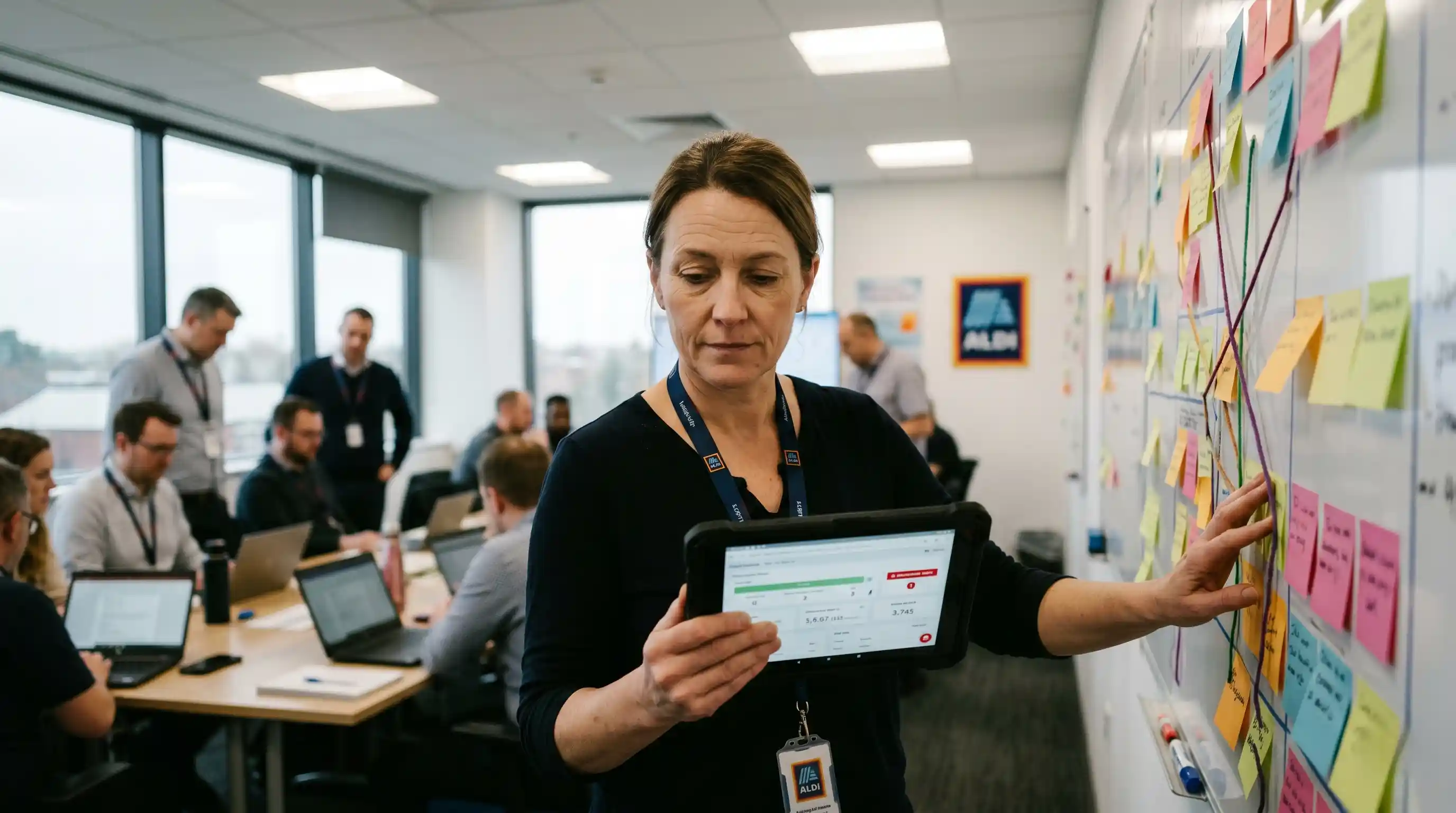
- Target the Toil, Not the Ritual: Apply AI agile release train automation to metrics and dependencies, leaving the System Demo strictly human.
- Empower the RTE: Release Train Engineers shift from data collectors to risk curators, managing flow based on AI-surfaced insights.
- Predictive Dependency Management: Use AI to flag hidden cross-team conflicts before they derail the Iteration.
- Preserve the Cadence: True automation respects the established ART heartbeat rather than disrupting team synchronization.
AI agile release train automation done wrong buries your Release Train Engineer in noise. Most enterprises try to automate everything at once, creating a flood of false-positive dependencies and breaking the synchronization that makes the train work.
The goal isn't to eliminate human conversation; it’s to eliminate the administrative drag that makes cross-team coordination so exhausting. If you haven't established your baseline framework governance yet, you must start with our foundational SAFe 6.0 + AI Integration: The Practitioner's Survival Guide.
By strategically applying AI to specific coordination bottlenecks, you can cut ART sync overhead by 35% without losing your cadence. Here are the six flows that actually work at scale.
The Trap of Automating the Agile Release Train
An Agile Release Train relies on a fixed cadence and synchronized teams to deliver value. When you blindly introduce AI agents into this environment, you risk breaking that rhythm.
If an AI tool auto-updates Jira tickets asynchronously without notifying the dependent teams, trust collapses. Teams start ignoring the tool, and the RTE is forced to revert to manual status-chasing.
To prevent this, automation must be treated as a support layer for the existing flow. For a look at how this impacts individual team rituals, review the AI-Augmented Scrum Guide.
The 6 AI Flow Points to Cut ART Sync Overhead
To cut sync time effectively, you must target the administrative friction points that slow down the train. Implement these six automated flows.
1. Continuous Cross-Team Dependency Detection
Manual dependency tracking is reactive. By the time a red string goes up on the board, the delay has already started.
The Flow: AI continuously scans team backlogs and commit histories.
The Impact: It flags undocumented technical dependencies weeks before the teams collide in the codebase.
2. Automated Flow Metric Aggregation
Building the flow metrics dashboard usually consumes hours of RTE and Scrum Master time before every ART Sync.
The Flow: AI pulls real-time data to calculate Flow Velocity, Flow Time, and Flow Load across all teams.
The Impact: Leaders walk into the sync with accurate, unmanipulated data, ready to make immediate decisions.
3. Early-Warning Signals for Delivery Drift
Features often drift off track slowly, hiding in optimistic status updates until the end of the Program Increment.
The Flow: AI monitors historical completion rates against current feature progress.
The Impact: It triggers an alert if a feature's trajectory deviates significantly from the committed PI objective.
4. Backlog Hygiene Automation
A messy program backlog paralyzes the Product Management team and confuses the teams executing the work.
The Flow: AI scans Epics and Features for missing acceptance criteria, orphaned stories, or misaligned sizing.
The Impact: It enforces structural discipline, ensuring the AI Product Owner role in SAFe functions effectively.
5. ART Sync and Ceremony Summarization
RTEs often double as scribes, frantically documenting action items during critical ART ceremonies.
The Flow: Integrated AI transcribes the ART Sync, auto-extracts action items, and routes them to the correct team backlogs.
The Impact: The RTE can fully engage in active facilitation and problem-solving.
6. Capacity and Load Balancing Insights
Teams frequently overcommit due to localized optimism, leading to severe bottlenecks at the program level.
The Flow: AI analyzes historical team capacity, planned PTO, and current WIP limits.
The Impact: It suggests dynamic load balancing, moving work to teams with actual available capacity before the sprint starts.
The Release Train Engineer (RTE) Evolution
The RTE’s role does not disappear in an AI-automated ART; it elevates. The days of manually polling teams for percentage-complete updates are over.
Instead, the RTE becomes an intelligence curator. They review the early-warning signals and dependency alerts the AI generates.
Their core value shifts to human intervention: challenging the AI's data, facilitating the hard conversations between teams, and removing the complex organizational impediments that models cannot solve.
What Stays Human in an Automated ART
Not everything should be optimized for speed. Certain ART events require human friction to build shared understanding.
The System Demo must remain human. AI can compile the metrics, but only stakeholders can provide the subjective feedback required to pivot the product.
The Inspect & Adapt workshop is sacred. AI can summarize the root causes of failure, but the psychological safety and systemic problem-solving required to fix them relies entirely on human leadership.
Conclusion
Automating your Agile Release Train is not about replacing human judgment; it is about protecting it.
By implementing these six AI flow points, you strip away the administrative drag that exhausts your teams. Stop using your smartest people to chase status updates, and start using them to deliver value.

Frequently Asked Questions (FAQ)
AI automates the heavy administrative lifting. It continuously scans backlogs to detect cross-team dependencies, aggregates flow metrics in real-time, and flags delivery drift. This allows the teams to focus entirely on execution rather than manual status reporting.
You should not automate the ceremonies themselves, but rather the preparation and documentation. AI can pre-compile metrics for the ART Sync, draft candidate PI objectives, and summarize action items from the Scrum of Scrums, leaving the live discussion human.
It only breaks cadence if deployed asynchronously without governance. When configured correctly, AI respects the established heartbeat. It provides continuous insights that align with iteration boundaries, ensuring teams remain synchronized and focused on shared objectives.
AI acts as an advanced early-warning system. It shifts the RTE from reactive status-gathering to proactive risk management by surfacing bottlenecks, predicting capacity issues, and highlighting orphaned dependencies before they impact the broader value stream.
Enterprise solutions heavily leverage Jira Align’s native AI capabilities, alongside custom LLM integrations and platforms like Miro for visual mapping. These tools pull real-time execution data to map dependencies and forecast program-level predictability directly within the ecosystem.
Connect your AI layer directly to your ALM tooling. The AI automatically pulls data to calculate Flow Velocity, Flow Time, and Flow Load across all teams, generating dynamic, unmanipulated dashboards for leadership review prior to every ART Sync.
Yes. By analyzing historical code commits, feature descriptions, and API overlaps, AI can flag probable technical dependencies weeks before teams manually identify them. This prevents late-stage integration failures and iteration bottlenecks.
The core alignment and adaptation events remain strictly human. The System Demo’s subjective feedback loop, the psychological safety of the Inspect and Adapt workshop, and the confidence vote cannot be outsourced to a machine.
Select a high-functioning ART and target a single, high-friction workflow—like dependency mapping or metric aggregation. Run it as an empirical experiment with a baseline, measure the time saved, and scale only if it proves economic value.
A successful implementation should yield a measurable reduction in ART Sync overhead—often up to 35%. Beyond time saved, expect higher flow predictability, shorter lead times, and a significant drop in late-stage integration defects due to early dependency detection.