GraphRAG & Ontologies: The Fix for Hallucinating Agents
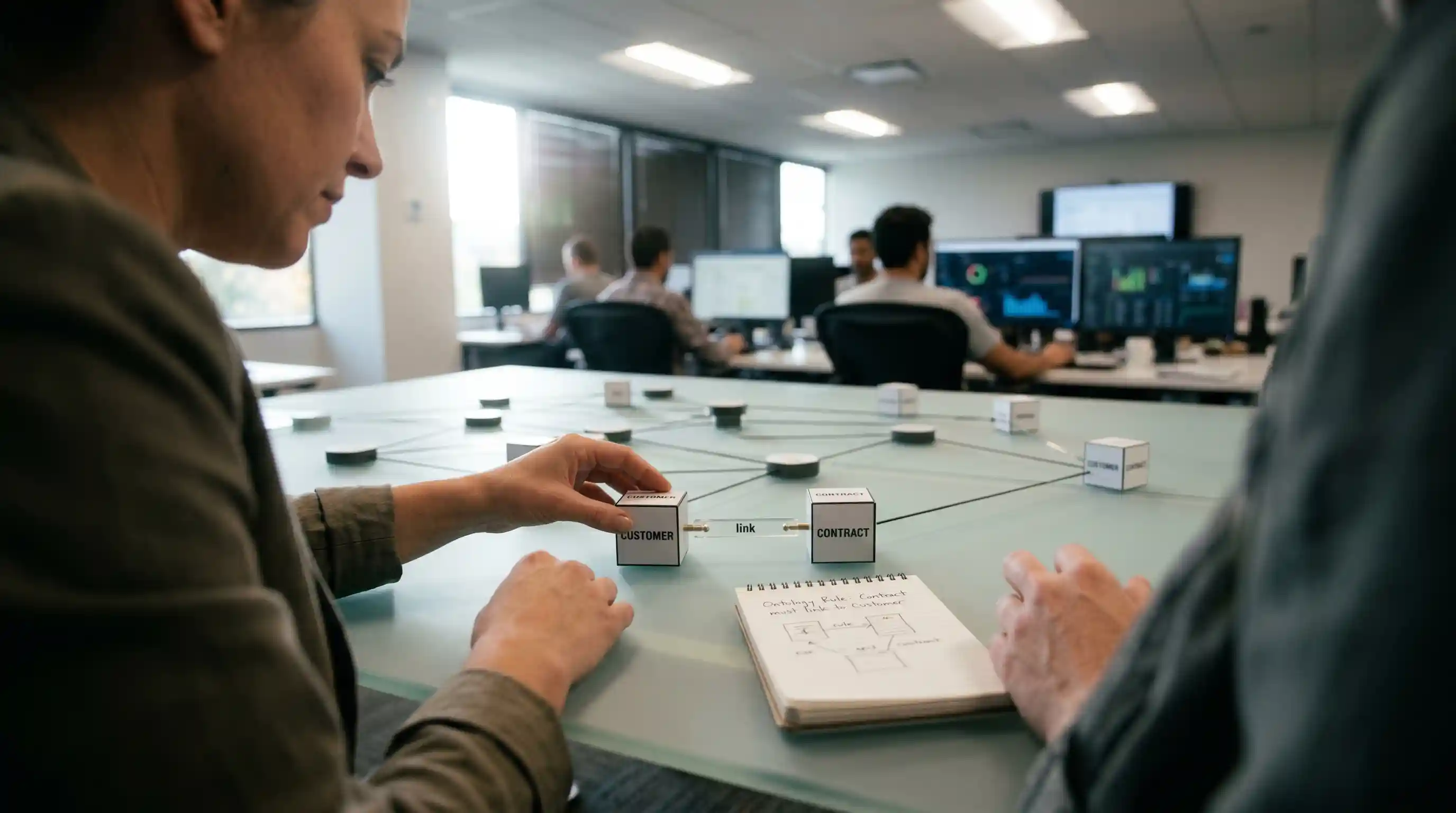
- The Core Advantage: GraphRAG is a retrieval architecture that grounds an LLM in a knowledge graph, preventing hallucination far better than vector RAG by enforcing structural logic.
- The Capability Lift: Adding an ontology layer to GraphRAG offers up to a ~4.2x QA accuracy increase over standard enterprise database querying baselines.
- The Missing Layer: An ontology is the crucial logic layer that catches reasoning mistakes even when the graph stores perfectly connected facts.
- The Strongest Pattern: The strongest production systems utilize a hybrid approach—fusing vector search for fuzzy recall with graph traversal for precise, relationship-aware paths.
- The Roadmap: A 90-day implementation plan involves diagnosing fail patterns, building the graph/ontology, and scaling based strictly on measurement.
Executive Summary
Your agent passed the demo and failed in production. You approved budget for a vector database, watched the hallucinations continue, and now the pilot is stalled while leadership asks why a "done" project still can't be trusted with a customer.
The problem was never the model or the embeddings - it was the missing grounding layer. This guide shows you the GraphRAG-and-ontology architecture that turns a confident guesser into a reliable reasoner.
If you read nothing else, read this. GraphRAG is a retrieval architecture that grounds a large language model in a knowledge graph - structured entities and the relationships between them instead of, or alongside, a vector index.
The agent reasons over verified facts and their connections rather than statistically similar text chunks. The difference is measurable, not theoretical.
| Capability | Vector RAG | GraphRAG | GraphRAG + Ontology |
|---|---|---|---|
| Retrieval unit | Similar text chunks | Entity-relationship subgraph | Subgraph + meaning rules |
| Multi-hop reasoning | Weak | Strong | Strong + validated |
| Explainability | Low (similarity scores) | High (traceable paths) | High + auditable |
| Enterprise QA accuracy* | ~16% baseline | ~54% (≈3x) | up to ≈4.2x |
| Hallucination control | Partial | Strong | Strongest |
| Setup effort | Low | High | Highest |
| Best for | Single-passage lookups | Connected, cross-document questions | Mission-critical, governed workflows |
*Accuracy figures reflect a data.world enterprise SQL question-answering benchmark (Sequeda, Allemang & Jacob), where GPT-4 scored ~16% answering directly over a database and ~54% over a knowledge-graph representation - roughly a 3x gain, rising to ~4.2x once an ontology-based query check was added.
The 5-point grounding checklist
- Diagnose whether your failures are retrieval failures (wrong facts surfaced) or reasoning failures (right facts, wrong connections). GraphRAG fixes the second.
- Build the ontology first - the meaning layer - before you build the graph. This is the step most teams skip and the one that drives the biggest accuracy gain.
- Treat the knowledge graph as the agent's long-term, queryable memory, not a one-time data dump.
- Choose your retrieval store by question type, not vendor hype: graph for relationships, vector for fuzzy recall, hybrid for both.
- Measure grounding with a hallucination-rate metric before and after never ship a graph you can't audit.
What "Agent Grounding" Actually Means (And Why It Fails)
Grounding is the discipline of tying an agent's outputs to verifiable, structured truth instead of to the model's statistical instincts.
An ungrounded agent is a fluent improviser. A grounded agent is a fluent improviser that has to check its claims against a source it cannot fabricate. The reason this matters to a PMO is simple: ungrounded agents don't fail loudly. They fail plausibly - with confident, well-formatted, completely wrong answers that pass casual review and surface weeks later in a customer escalation.
The grounding gap: intent versus execution
There is a layer most architectures leave empty. It sits between what the user intends and what the agent executes, and its job is to encode what business concepts actually mean.
When a user asks for "active high-value accounts," the model has no inherent idea what "active" or "high-value" means in your business. It guesses. The guess is often defensible-sounding and wrong, because the definition lives in tribal knowledge, not in the data the agent can see.
That missing layer is the ontology. We cover it in depth below, and in a dedicated spoke on why the ontology layer reliable agents cannot skip.
Why production agents hallucinate when demos don't
Demos use clean, narrow, hand-picked questions. Production sends the long tail: ambiguous phrasing, multi-step asks, and questions whose answers require connecting three facts that live in three different documents.
Vector retrieval handles the demo because the answer sits in one chunk that is semantically close to the query. It breaks on the long tail because similarity is not the same as relevance, and proximity is not the same as connection.
Our companion analysis of why the overwhelming majority of enterprise AI agents fail in production goes deeper on the organizational causes.
GraphRAG, Explained: Retrieval With a Memory of Relationships
Traditional RAG chops documents into chunks, embeds them as vectors, and at query time retrieves the chunks whose vectors sit closest to the query's vector. It is fast, cheap, and genuinely useful for "find the passage that answers this" tasks.
GraphRAG changes the retrieval unit. Instead of returning loose text chunks, it returns a subgraph - a connected cluster of entities and the labelled relationships between them SO the LLM receives structure it can actually reason across.
How GraphRAG differs from traditional vector RAG
The distinction is retrieval by similarity versus retrieval by relationship. Vector search asks, "what text looks like this query?" Graph traversal asks, "what is connected to this entity, and how?"
That difference compounds on hard questions. Microsoft Research's work on query-focused summarization reported GraphRAG scoring far higher on answer comprehensiveness than baseline RAG on the order of 70-80%+ versus roughly 20-30% - because it can assemble a complete picture across many documents rather than hoping one chunk holds it.
This is why a deep comparison of GraphRAG versus traditional RAG is the first spoke every team should read before committing a stack.
GraphRAG also relates to, but is distinct from, how agents pull tools and context at runtime. If you are weighing retrieval methods against protocols like MCP and function calling, that trade-off has its own breakdown.
The three layers: knowledge graph, ontology, retrieval
Think of GraphRAG as a stack, not a single product.
- The bottom layer is the knowledge graph the facts and their connections.
- The middle layer is the ontology - the rules that say what those facts and connections mean.
- The top layer is graph-aware retrieval - the traversal logic that pulls the right subgraph for a given query.
Skip the middle layer and you have a graph that stores relationships without understanding them. That is the single most common and most expensive - GraphRAG mistake.
The Knowledge Graph: Your Agent's Long-Term Memory
A vector store is recall without structure. A knowledge graph is memory with structure entities your business cares about (customers, contracts, claims, SKUs, teams) and the explicit, labelled relationships that connect them.
This is what lets an agent answer "which customers affected by the Q3 outage also hold an enterprise SLA and have an open renewal?" That question is three hops through connected entities. Vector search cannot reliably make those hops; a graph traverses them by design.
What goes into an enterprise knowledge graph
Start with the entities that recur in your highest-value questions, not with everything you own. A graph is valuable in proportion to how well its relationships mirror the decisions your business actually makes.
Populate it from your systems of record, resolve duplicate entities (the same customer appearing five ways), and keep it in sync with change-data-capture rather than periodic full reloads. A stale graph grounds your agent in yesterday's truth.
The deeper mechanics - schema design, entity resolution, runtime querying are covered in the dedicated spoke on building a knowledge graph that works as agent memory.
How agents query the graph at runtime
At query time the agent links entities in the question to nodes in the graph, traverses a bounded number of hops to gather a supporting subgraph, then ranks and compresses those paths into concise, provenance-tagged facts before generation.
That provenance is the unlock for regulated environments: every answer arrives with a traceable path back to source, which is exactly what an auditor or a nervous CISO wants to see.
The Ontology Layer: The Piece Everyone Skips (And the Real Fix)
Here is the counter-intuitive part, and the most important section of this guide. The industry talks about knowledge graphs as the fix for hallucination. The benchmark evidence says the ontology - the meaning layer on top of the graph - is what drives the largest gains.
In the data.world research, a knowledge graph lifted enterprise question-answering accuracy from roughly 16% to 54%, about 3x. But when the team added an ontology-based query check that validated the agent's reasoning against the rules of the domain and repaired bad queries, accuracy improved to about 4.2x.
The graph stored the facts; the ontology caught the mistakes.
Ontology versus knowledge graph: the distinction that matters
A knowledge graph says "Claim 88 belongs to Policy 12."
An ontology says "a claim must belong to exactly one policy, a policy belongs to one account, and a lapsed policy cannot have an active claim."
The graph is the data. The ontology is the logic that makes the data checkable. Without it, an agent can assemble a perfectly connected subgraph and still reach a conclusion your business rules forbid - and it will state that conclusion with total confidence.
Why the ontology is the real reliability unlock
Reliability is not just retrieving the right facts; it is refusing to combine them in ways that violate domain truth. The ontology is where that refusal lives.
This is why "we added a graph and still got bad answers" is such a common complaint - those teams built the data layer and skipped the logic layer.
GraphRAG vs. Vector RAG: When Each One Wins
Neither approach is universally better. The mature decision is matching retrieval style to question shape - and being honest that GraphRAG buys accuracy with added complexity and cost.
Where vector search quietly breaks
Vector RAG excels when the answer lives in a single passage and the question is a paraphrase of that passage. It degrades on multi-hop questions, comparisons, temporal reasoning, and any query whose answer is implied by relationships rather than stated in one place.
The failure is silent. Vector search always returns its top-k chunks; it never says "I couldn't connect these." So the agent generates from incomplete context and fills the gap with a plausible invention.
The hybrid pattern: graph and vector together
The strongest production systems are usually hybrid. Vector search provides broad recall and fuzzy matching; graph traversal provides precise, relationship-aware paths; a ranking layer fuses the two and resolves conflicts.
The hard part of hybrid is not the retrieval - it's normalising scores from two very different systems and deciding how to weight them per query type. Budget engineering time for that fusion logic; it is where naive implementations leak accuracy.
Choosing Your Stack: Graph DB, Vector DB, or Both
This is the question that turns architecture into a purchase order. It is also where teams overspend, buying two databases to solve a problem that one would have handled.
Neo4j versus a vector database: the architecture call
The real decision is not "Neo4j or Pinecone" - it is "do my hardest questions hinge on relationships or on similarity?" A graph database is built to traverse connections; a vector database is built to find nearest neighbours in embedding space.
They answer different shapes of question. Many modern graph and vector stores now blur the line by supporting both, which makes the architecture decision more important than the vendor decision.
We unpack the full trade-off in the spoke on Neo4j versus a vector database for RAG.
If you have already committed to a vector approach, the selection and cost questions are well-covered in our existing comparisons of the leading vector databases for enterprise RAG and of vector database cost-optimization strategies.
The data-architecture foundation underneath
A graph or vector store is only as good as the data feeding it, which raises the architecture question one level up: how does governed, trustworthy context reach the retrieval layer at all?
That is a data mesh versus data fabric decision, and it directly determines whether your agents get clean, governed grounding or inherit the chaos of ungoverned sources. Our existing breakdown of data mesh versus data fabric for agentic AI is the foundation this entire hub builds on.
The closely related semantic-layer approach - connecting your LLM to business meaning without a full graph rebuild - is covered in the spoke on grounding enterprise AI with a semantic layer.
And for the question of which architecture best feeds reliable grounding, see the spoke on data mesh versus fabric for grounding agents.
The Build Path: From Schema to Grounded Agent
You do not need a moonshot. You need one high-value use case, an ontology, a graph, and a retrieval pipeline - shipped in that order.
Step by step: ontology → graph → GraphRAG pipeline
- First, define the ontology: the entities, relationships, and constraints for one domain.
- Second, build the knowledge graph by mapping your systems of record onto that ontology and resolving entities.
- Third, stand up graph-aware retrieval and wire it into the agent.
- Fourth, add the ontology-based validation that checks answers against your rules.
The full, hands-on blueprint - from schema modelling to the live agent query is the dedicated spoke on building an enterprise ontology your LLM can use.
Team, skills, and timeline reality
This is not a solo data-scientist task. A realistic team blends a domain SME (owns the ontology), a data engineer (owns ingestion and entity resolution), and an ML engineer (owns retrieval and integration).
A focused single-use-case grounding pilot is a quarter, not a year - provided the scope stays narrow. Programs that try to graph the whole enterprise at once routinely miss timelines and lose executive patience.
Measuring the Payoff: Hallucination, Cost, and Trust
If you cannot measure grounding, you cannot defend its budget. Treat this as a program metric, not an engineering footnote.
How to measure hallucination reduction
Build a labelled evaluation set of real questions with verified answers, then track factual-accuracy and unsupported-claim rates before and after grounding.
The knowledge-graph mechanism for cutting these errors is detailed in the spoke on reducing AI hallucination with a knowledge graph. For the broader detection-and-measurement discipline, our framework on production hallucination detection pairs naturally with graph grounding.
And for the upstream view that hallucination is often a context problem before it is a model problem, see our analysis of why your agent's context not the model - does the hallucinating.
The cost question: is GraphRAG worth it?
GraphRAG costs more to build and maintain than vector RAG - there is no honest way around that. The return is accuracy on questions that vector search gets wrong, plus auditability that reduces downstream incident and compliance cost.
The decision rule: if wrong answers are cheap (low-stakes internal search), stay with vector RAG. If wrong answers are expensive (customer-facing, regulated, financial), the grounding investment pays for itself the first time it prevents a confident, costly mistake.
Your 90-Day GraphRAG Grounding Roadmap
- Days 1-30: Diagnose and define. Pull your top production questions, classify them by failure type, run the ontology sprint with SMEs, and pick one high-value, relationship-heavy use case. Deliverable: a written ontology and a labelled eval set.
- Days 31-60: Build and ground. Construct the knowledge graph for that use case, stand up graph-aware (or hybrid) retrieval, and wire ontology-based validation into the answer path. Deliverable: a grounded agent running against the eval set.
- Days 61-90: Measure, govern, scale. Compare hallucination and accuracy rates against the pre-grounding baseline, document the provenance/audit trail for governance, and decide the next use case. Deliverable: a defensible before/after number and a scale plan.
Explore the Cluster
This pillar anchors a full topic cluster. Go deeper on any layer:
- GraphRAG vs. traditional RAG - where vector search quietly fails.
- Knowledge graphs for AI agents - the memory layer agents actually need.
- The ontology layer & agent reliability - the piece reliable agents can't skip.
- Neo4j vs. vector database for RAG - picking the right retrieval brain.
- Semantic layer for enterprise AI grounding - ground your AI in five steps.
- Reduce AI hallucination with a knowledge graph - the relationship-grounding fix.
- Data mesh vs. data fabric for agentic AI - which architecture grounds agents better.
- Build an enterprise ontology your LLM can use - schema to agent query.

Frequently Asked Questions (FAQ)
GraphRAG grounds an LLM in a knowledge graph of entities and relationships, retrieving connected subgraphs instead of loose text chunks. Normal RAG retrieves passages by vector similarity. The difference matters most on multi-hop questions, where GraphRAG follows explicit relationships that similarity search misses.
A knowledge graph forces the agent to answer from verified entities and relationships rather than statistical guesses, and it supplies a traceable evidence path. Paired with an ontology that validates answers against business rules, it catches and repairs conclusions the model would otherwise invent confidently.
Grounding ties an agent's outputs to verifiable, structured truth. It fails in production because demos use clean, single-answer questions while real users ask ambiguous, multi-step questions whose answers span several documents - exactly the conditions where similarity-based retrieval returns incomplete context and the model fills gaps.
You can run GraphRAG without one, but you will leave most of the accuracy on the table. Benchmarks show the ontology - the layer encoding what your data means and which combinations are valid - drives the largest reliability gains by validating reasoning, not just retrieving facts.
Often, yes as a complement, not a replacement. Keep vector search for fuzzy recall and add graph retrieval for relationship-heavy, multi-hop, or high-stakes questions where vector search silently fails. A hybrid pipeline usually outperforms either approach alone on real enterprise workloads.
GraphRAG costs more than vector RAG in engineering time, ontology design, and graph maintenance. The justification is the cost of wrong answers: for low-stakes internal search it rarely pays off, but for customer-facing or regulated workflows it offsets a single costly mistake quickly.
There is no single best; choose by question shape and existing stack. Neo4j is a mature, widely-adopted graph store, but several graph and vector databases now support both paradigms. Decide the architecture - relationship versus similarity retrieval - before you choose a vendor.
Yes, and hybrid is the strongest production pattern. Vector search supplies broad recall; graph traversal supplies precise, relationship-aware paths; a ranking layer fuses and reconciles them. The engineering challenge is normalising scores across the two systems and weighting them appropriately per query type.
A focused, single-use-case knowledge graph and grounding pipeline is realistically a quarter, not a year, if scope stays narrow. Attempts to model the entire enterprise at once routinely overrun timelines. Start with the entities behind your highest-value questions and expand iteratively.
A blended team: a domain SME who owns the ontology and business rules, a data engineer for ingestion and entity resolution, and an ML engineer for retrieval and agent integration. Governance and evaluation skills are equally important for measuring and defending grounding in production.