Knowledge Graphs: The Memory Layer Agents Actually Need
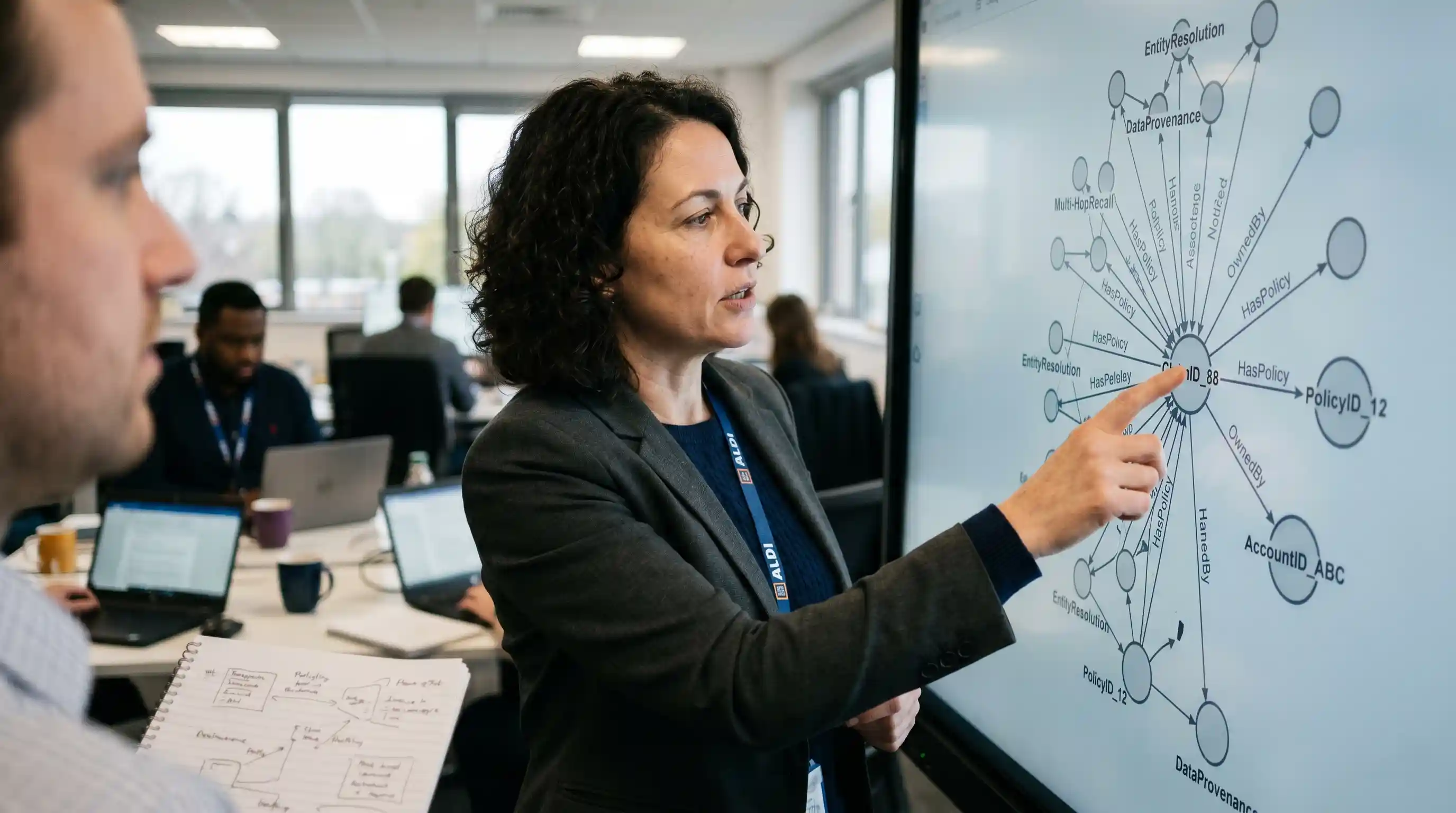
- Memory with Structure: Unlike vector stores that offer recall without structure, a knowledge graph provides structured, long-term memory based on explicit business entities.
- Entity Focus: The most effective enterprise graphs start by mapping entities that recur in your highest-value questions, not by indiscriminately dumping all available data.
- Continuous Synchronization: A graph must be kept in sync using change-data-capture from your systems of record; a stale graph grounds your agent in yesterday’s truth.
- Traceable Provenance: Querying a graph produces provenance-tagged facts, meaning every answer arrives with a fully traceable path back to its source.
A knowledge graph for AI agents is the true grounding layer that most chatbots only fake. While standard agents guess at connections, a properly built graph turns a guessing agent into one that reasons over verified, real-world facts.
Understanding the full GraphRAG architecture is critical for solving agent hallucination, as detailed in our primary overview on GraphRAG and agent grounding. However, the architecture is useless without the right foundational memory.
This deep-dive isolates the knowledge graph itself, exploring exactly how it functions as the long-term, queryable memory layer that enterprise agents actually need.
What is a Knowledge Graph in the Context of AI Agents?
In the context of agentic AI, a knowledge graph acts as the system's structural memory. It is a repository composed of explicit entities—such as customers, contracts, and claims—and the labeled relationships connecting them.
Vector stores rely on semantic similarity to recall text chunks. A knowledge graph, conversely, maps out how your business concepts actually relate to one another.
When an agent needs to answer a multi-layered query, it relies on this graph to trace connections logically. It effectively stops the model from improvising and forces it to traverse a bounded, verifiable path.
What Goes Into an Enterprise Knowledge Graph
A common mistake is treating the knowledge graph as a one-time data dump for every system the company owns. You must start exclusively with the entities that recur in your highest-value, most complex questions.
The graph's ultimate value is directly proportional to how well its mapped relationships mirror actual business decisions.
Entity Resolution and Syncing
You must extract entities directly from your systems of record and perform rigorous entity resolution. This means consolidating duplicates so the same customer does not appear in five different ways.
Furthermore, batch uploads are insufficient for dynamic agents. The knowledge graph must stay continuously synchronized via change-data-capture. If the graph is not live, you are forcing your agent to make decisions based on outdated realities.
This entire data ingestion pipeline relies heavily on your foundational data architecture. Understanding whether to utilize data mesh vs data fabric for agentic AI determines if your graph receives clean, governed context in the first place.
How Agents Query the Graph at Runtime
At runtime, the agent does not perform a simple semantic search; it executes a structured traversal.
First, the agent links the entities mentioned in the user's question directly to the corresponding nodes within the graph. It then traverses a bounded number of hops to gather a supporting sub-graph of connected facts.
Compressing Paths and Provenance
Once the agent pulls this sub-graph, it ranks and compresses those paths into concise facts before generation occurs. Because the agent pulled explicit nodes and edges, the resulting output includes provenance-tagged triples.
This provides a fully traceable evidence path for every answer generated. For regulated environments and nervous CISOs, this auditability is exactly what justifies the build.
Once the graph is in place, the next vital step is validating those facts using business rules. This is why you must understand the ontology layer reliable agents cannot skip.

Frequently Asked Questions (FAQ)
A knowledge graph acts as an agent’s structured, long-term memory. Instead of loose text chunks, it stores specific business entities (like customers or products) and the explicit, labeled relationships between them, giving the AI a factual map to reason across.
It provides memory by storing verifiable connections rather than probabilistic weights. When an agent answers a question, it can query the graph to recall exact historical facts, entity statuses, and multi-hop relationships that persist dependably across different chat sessions.
Use a vector store for fast, single-passage document lookups based on similarity. Use a knowledge graph for complex, relationship-heavy questions requiring logical reasoning. The strongest enterprise architectures actually run in a hybrid pattern, combining both for optimal recall and precision.
An enterprise graph should strictly contain the entities that recur in your most valuable business questions. This includes data extracted from systems of record, meticulously deduplicated through entity resolution, and structured around relationships that mirror how your business operates.
At query time, the agent performs entity linking to match the user's prompt to nodes in the graph. It then executes a k-hop traversal to gather connected nodes, ranking and compressing those paths into provenance-tagged facts before generating the final answer.
No, Neo4j is a prominent and mature graph database, but it is not mandatory. Many modern data stores, including advanced vector databases, are now blurring the lines by supporting hybrid retrieval. The architecture matters more than the specific vendor.
A production-grade knowledge graph should be kept in sync using continuous change-data-capture (CDC) from your underlying systems of record. Relying on periodic batch reloads leads to a stale graph, which grounds the agent in outdated information.
While an LLM can assist in automating entity extraction and relationship mapping from unstructured text, relying on it entirely without human oversight risks embedding hallucinations into the graph itself. Human-in-the-loop validation by domain SMEs remains critical for enterprise accuracy.
It does not need to cover the entire enterprise to be highly useful. A focused graph covering a single, high-stakes use case with 30-50 well-defined business constraints is often enough to drastically reduce hallucinations and prove immediate ROI.
A knowledge graph stores the actual data (e.g., "Claim 88 belongs to Policy 12"). An ontology defines the underlying rules and meaning (e.g., "A claim must belong to exactly one policy, and a lapsed policy cannot have an active claim").