How to Implement Deep Work in Hybrid Teams: Escaping the "Availability Trap"
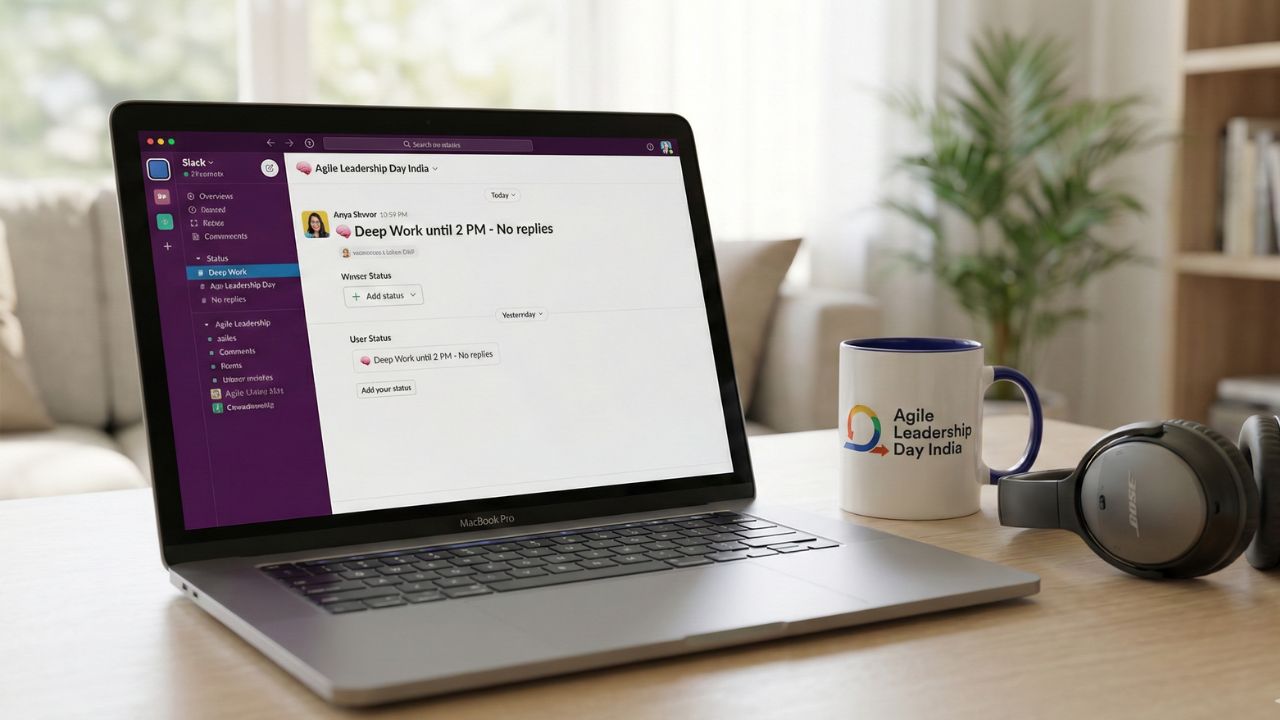
- The "Green Dot" Lie: In hybrid teams, "presence" (that green dot on Slack) is often mistaken for productivity. This destroys focus.
- The 4-Hour Limit: The human brain can only sustain true deep work for about 4 hours a day. The rest is shallow maintenance.
- Maker vs. Manager Schedules: Managers need 30-minute slots; creators (devs, writers) need 4-hour blocks. Don't mix them.
- Async is the Enabler: You cannot have deep work if your culture demands instant replies. You must move to asynchronous defaults.
- Tech Hygiene: "Do Not Disturb" must be a respected signal, not a challenge to be overridden.
The Paradox of Hybrid Productivity
Your team is working longer hours than ever, yet important projects are stalling. Why? Because they are stuck in the "Availability Trap". In an effort to prove they are working while remote, employees obsessively monitor their notifications, fracturing their attention into 10-minute slivers.
To fix this, you must learn how to implement deep work in hybrid teams. It is the only way to shift from "busyness" to "impact." Note: This deep dive is part of our extensive guide on Outcome-First Hybrid Leadership.
Why "Responsiveness" is a Vanity Metric
We have conditioned ourselves to believe that a "good" remote employee replies instantly. This is a disaster for cognitive performance.
"Deep Work"—the state of distraction-free concentration that pushes cognitive capabilities to their limit—requires at least 90 minutes of uninterrupted time to engage. If your team is interrupted every 20 minutes by a Slack ping, they are biologically incapable of deep work.
Strategy 1: The "No-Meeting" Firewall
The easiest way to start is by instituting a "No-Meeting Wednesday". This acts as a firewall for focus. On this day:
- No internal Zoom calls are allowed.
- Slack expectations are lowered to "check twice a day."
- Status updates are banned.
This creates a safe harbor for complex problem-solving. However, this only works if your team feels safe enough to disconnect. If they fear being judged for being offline, you must first address How to Build Psychological Safety in Hybrid Teams.
Strategy 2: Automating the "Shallow Work"
Deep work is expensive energy. Don't waste it on administrative tasks. "Shallow work" (scheduling, status reporting, email routing) should be ruthlessly automated.
By offloading these low-value tasks to software, you buy back hours for high-value thinking. For example, using AI agents to summarize meetings or track sprint progress prevents the "death by 1000 cuts" of micro-management.
Resource: Learn more about this in our guide on Using AI to Manage Hybrid Teams Efficiently.
Strategy 3: The "Snooze" Protocol
You must normalize the use of "Do Not Disturb." In many companies, a snoozed notification is seen as "slacking off." You need to reframe it as "deep working."
The Protocol:
- Emoji Signal: Use a specific emoji (e.g., 🧠) to signal "I am in Deep Work mode."
- The Emergency Back-Channel: Establish a protocol (like a phone call) for true emergencies, so people aren't afraid to silence Slack.
FAQ: Troubleshooting Hybrid Focus
It is the false belief that being constantly available for messages equates to being productive. It leads to "performative responsiveness" at the expense of actual output.
Research suggests the upper limit for intense cognitive focus is about 4 hours per day. Pushing beyond this yields diminishing returns.
Choose a mid-week day (like Wednesday). secure executive buy-in so leaders don't violate the rule, and block calendars centrally.
Measure output (code shipped, words written, tickets resolved) rather than input (hours logged). Check results at the end of the sprint, not the middle of the day.
Tools like Cold Turkey, Freedom, or Forest can block social media and Slack during focus blocks. "Focus mode" on iOS/Android is also essential.
Update your status to "Deep Work until 2 PM - No replies." This sets a clear expectation of when you will return, reducing anxiety for the sender.
Yes. "Makers" (devs/creatives) should be measured on deep work output. "Managers" should be measured on unblocking others and communication.
Batch shallow work. Dedicate a specific "shallow window" (e.g., 9:00-10:00 AM and 4:00-5:00 PM) to clear the inbox, leaving the middle of the day open.
Employees burn out from chaos, not hard work. Deep work provides a sense of progress and mastery, which are key drivers of job satisfaction.
Leaders must model it. If the CEO answers emails at 11 PM, the culture is broken. Leaders must conspicuously "go dark" to work on strategy.
Conclusion
Deep work is the new IQ in the hybrid economy. If you can teach your team how to implement deep work in hybrid teams, you give them the rarest gift in the modern workplace: the ability to focus.
Escape the availability trap. Turn off the notifications, and turn on the productivity.
Next Step: Once your team is focused, ensure they are staying connected to the company's core values. Read our guide on How to Build Remote Company Culture from Scratch.