AI Fundamentals for Scrum Masters & Product Owners: The 2026 Guide
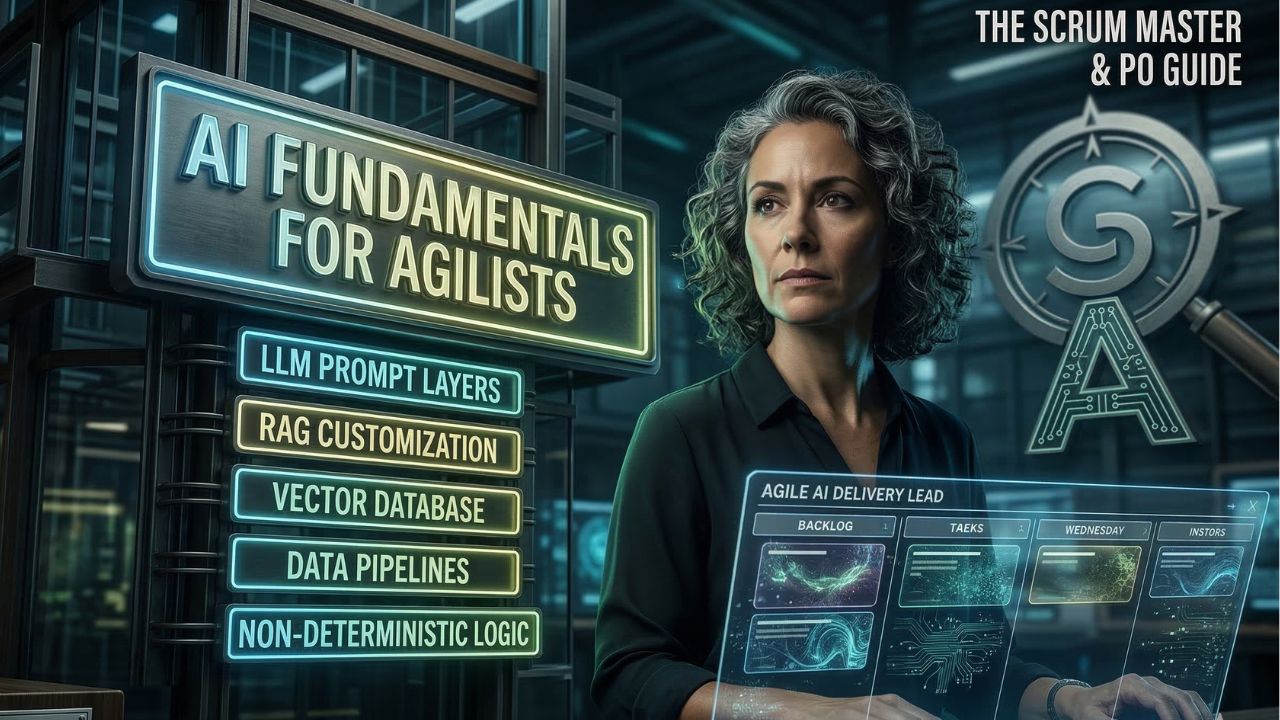
Key Takeaways
- The shift to AI development requires Agile teams to master non-deterministic logic and probabilistic sprint planning.
- Lacking foundational AI knowledge causes misaligned estimates, leading to blown budgets and technical debt.
- Product Owners must critically evaluate underlying architectures, understanding when to deploy LLMs versus utilizing Retrieval-Augmented Generation (RAG) and Vector Databases.
Agile teams are quietly struggling to keep pace with the artificial intelligence revolution.
Lacking AI fundamentals for Scrum Masters and Product Owners creates a dangerous knowledge gap, leading to misaligned sprints, blown budgets, and ultimately, the risk of total product collapse. As competitors rapidly deploy intelligent features, guessing your way through generative AI architecture is no longer an option.
This definitive 2026 guide bridges that gap, providing the exact frameworks and technical fluency you need to confidently manage AI-driven product development and lead your team to success.
Executive Summary: The AI Agile Blueprint
To effectively lead AI initiatives, Agile professionals must grasp a new set of technological paradigms. Traditional software rules no longer apply. Here is the high-level breakdown of what you must master to remain relevant:
- The Intelligence Spectrum: Understand the boundaries between Artificial Narrow Intelligence (ANI), Artificial General Intelligence (AGI), and Generative AI (GenAI).
- The Technology Stack: Differentiate the core layers: Artificial Intelligence (AI), Machine Learning (ML), and Deep Learning (DL).
- Non-Deterministic Planning: AI features do not behave like traditional software; Scrum frameworks must adapt to probabilistic outcomes and robust data spikes.
- Architectural Awareness: Product Owners must understand prompt layers, foundation models, and vector databases to manage hidden technical debt.
- Customization Strategies: Know when to leverage Retrieval-Augmented Generation (RAG) versus full model fine-tuning to protect enterprise data and manage compute costs.
The Evolution: History of AI in Product Development
The history of AI in product development is not a new phenomenon, though the recent generative boom makes it feel sudden to many Agile teams.
For decades, deterministic software ruled the backlog. We wrote specific rules, coded the logic, and the machine followed them flawlessly. In the early 2000s, statistical machine learning began creeping into enterprise products. Recommendation engines and spam filters became the new standard. Product Owners suddenly had to write user stories for algorithms that improved over time rather than functioning perfectly on day one.
Today, the rapid rise of transformer models has shifted the landscape entirely. Generative AI has moved from a research novelty to a core product requirement. For Scrum Masters, this history of AI in Agile means transitioning from managing purely functional increments to managing cognitive, adaptable software increments.
Decoding the Alphabet Soup: AI, ML, DL, and GenAI
What is the difference between AI, ML, DL, and GenAI? This is the most critical foundational knowledge any Agile leader must possess. Conflating these terms leads to disastrously inaccurate sprint estimates and poorly defined acceptance criteria.
Artificial Intelligence (AI) is the overarching concept. It represents any technique that enables computers to mimic human intelligence, using logic, if-then rules, decision trees, or machine learning. If a product feature makes an autonomous decision, it falls under the broad AI umbrella.
Machine Learning (ML) is a specialized subset of AI. Instead of explicitly programming rules, engineers feed massive datasets to an algorithm, allowing it to learn the rules itself. When evaluating an AI vendor's capabilities, Product Owners must ask what specific ML models are driving their feature set.
Deep Learning (DL) is a further subset. It utilizes multi-layered artificial neural networks modeled after the human brain. Why do Agile teams need to understand Deep Learning? Because DL requires massive datasets, significant compute power, and incredibly long feedback loops—directly impacting your sprint velocity, infrastructure costs, and delivery timelines.
Generative AI (GenAI) is the latest breakthrough within deep learning. How does Generative AI differ from standard Machine Learning? Standard ML analyzes data to find patterns or make predictions (e.g., predicting customer churn). GenAI uses those learned patterns to autonomously create entirely new content, such as human-like text, functional code, or high-fidelity images.
Expert Insight: The Acceptance Criteria Trap
The Intelligence Spectrum: ANI, AGI, and Where GenAI Fits
To properly scope product visions, you must understand the broader trajectory of machine intelligence. The debate of AGI vs ANI vs GenAI dictates what is currently possible in your backlog versus what belongs in science fiction.
Artificial Narrow Intelligence (ANI) is what we have today. Also known as "Weak AI," ANI is highly specialized. An ANI system can beat a grandmaster at chess but cannot recommend a good restaurant. Every single AI product feature you currently manage is a form of ANI.
Generative AI (GenAI) currently sits firmly within the ANI category. While an LLM appears to possess general knowledge across subjects, it is narrowly trained on the specific task of predicting the next sequence of tokens. It simulates reasoning but does not genuinely understand the world.
Artificial General Intelligence (AGI) is the theoretical future. AGI would possess human-level cognitive abilities and reasoning across all domains. When will Artificial General Intelligence (AGI) become a reality? Experts are divided, but as Agile leaders, your focus must remain squarely on leveraging current GenAI to solve immediate customer problems, rather than waiting for hypothetical AGI.
The Biggest Mistake Agile Leaders Make: The Non-Deterministic Fallacy
Most organizations miss a critical paradigm shift when transitioning to AI development: they treat machine learning models exactly like traditional software engineering. This is known as the "Non-Deterministic Fallacy."
In standard software development, if a developer writes a specific function, it returns the exact same output every single time. It is perfectly deterministic. Scrum processes were built for this environment. You plan the work, code the rules, test the output, and deploy to production.
AI products, however, are non-deterministic. You do not code the rules; you shape the training data and tweak parameters. The model might give you a slightly different answer each time it receives a prompt. Scrum Masters who try to force deterministic sprint planning onto probabilistic AI models will face constant scope creep, inaccurate velocity tracking, and severe team burnout. To survive, you must heavily utilize "Spikes" in Scrum to allow for data exploration, cleaning, and model testing before committing to a feature delivery.
AI System Architecture: What Product Owners Must Know
You cannot manage a product effectively if you do not understand its foundational building blocks. Product Owners do not need to write Python scripts, but they must comprehend the architecture to prioritize the backlog properly.
If you ignore this, missing key components of a GenAI system creates technical debt that will eventually stall all future development. You must understand the data ingestion pipelines, the vector databases used for long-term AI memory, and the orchestration layers (like LangChain) that connect the user interface to the foundation model.
To avoid architecture flaws that cost teams millions, you must master the prompt layer, which is where much of the application logic now resides in modern GenAI apps.
How Machines Learn: Implications for Sprint Timelines
How long will an AI feature take to build? The answer depends entirely on the learning approach required. Agile product timelines are directly tethered to these data science methodologies.
For instance, supervised learning requires massive amounts of meticulously labeled data. If your Product Owner does not account for the time required to manually label this data, the sprint will instantly fail. Unsupervised learning requires less upfront labeling but demands more rigorous backend testing to ensure the model isn't finding useless or biased patterns.
Choosing the wrong method introduces heavy bias risks into your product. It is vital to explore different AI machine learning approaches to structure your team's workflow correctly.
Expert Insight: The Data Dependency Warning
Unpacking Generative AI Models for the Backlog
Not all generative AI is built the same. When a stakeholder asks for a generic "AI feature," the Product Owner must determine the correct underlying engine. Treating all GenAI systems like a basic LLM will destroy your technical architecture and bloat your cloud compute costs.
If your team is building a conversational agent or text-summarization tool, you need to rely on Large Language Models (LLMs). However, if you are building a tool to generate marketing assets or prototype visual product designs, you must evaluate Diffusion models or Generative Adversarial Networks (GANs).
Before your next sprint planning meeting, clearly define the generative AI model types your product requires. This fundamental choice dictates hardware requirements, talent needs, and delivery speed.
Strategy: RAG vs. Fine-Tuning
One of the most critical, expensive decisions a Product Owner will make involves how to customize a foundational AI model with proprietary enterprise data. If you use an out-of-the-box foundational model, it won't know your company's specific context or internal documentation.
Many novice teams default to full-scale fine-tuning. However, fine-tuning an AI model when you should be using RAG is burning through your compute budget and exposing proprietary data to privacy risks. Fine-tuning is expensive, slow, and permanently alters the model's actual weights, making it incredibly difficult to "unlearn" private data if privacy regulations change.
Instead, Retrieval-Augmented Generation (RAG) acts as a dynamic, external knowledge base. It securely searches your private databases and provides that context to the AI at the exact moment of the user prompt. Mastering the choice between RAG vs. fine-tuning an AI model is the ultimate secret to secure, cost-effective AI customization.
Expert Insight: The Hallucination Mitigation
Day-to-Day AI Responsibilities for Agile Leaders
What are the day-to-day AI responsibilities of a Scrum Master in this new era? Primarily, it is shielding the data science and ML engineering team from traditional, deterministic delivery expectations. Scrum Masters must facilitate complex estimations, constantly reminding stakeholders that training a model is an iterative, highly experimental process. They must also manage the delicate integration points between traditional software engineers (building the UI) and ML engineers (building the backend logic).
For Product Owners, the day-to-day shifts heavily toward data governance, probabilistic acceptance criteria, and ethical AI oversight. POs must curate the training datasets, define strict ethical guardrails for AI behavior, and constantly review user feedback loops to identify model drift (the phenomenon where an AI's accuracy silently degrades over time as real-world data changes).
Frequently Asked Questions (FAQ)
Scrum Masters must deeply understand the non-deterministic nature of AI. They need to facilitate Spikes for data exploration, adapt traditional estimation techniques for probabilistic outcomes, and seamlessly manage the complex dependencies between machine learning model creation and traditional UI/UX software engineering tasks.
Product Owners must master data acquisition strategy, understand the hard limitations of LLMs versus standard ML, and define probabilistic acceptance criteria. They are responsible for evaluating third-party AI vendors, establishing ethical guardrails, and choosing between RAG or fine-tuning infrastructure approaches.
Standard Machine Learning identifies patterns in existing data to make predictions, classify information, or cluster data points. Generative AI leverages those learned patterns to autonomously generate entirely new, original content, such as contextual text, raw code, audio files, and high-fidelity images.
Integration requires splitting AI work into highly distinct phases: data acquisition and cleaning, model training (often utilizing time-boxed Spikes to prevent sprint failure), and final UI integration. Planning must proactively account for model evaluation metrics and include time buffers for the unexpected behaviors inherent in non-deterministic systems.