Mastering AI Machine Learning Approaches to Boost ROI
Key Takeaways
- Choosing the wrong training model introduces heavy, potentially legal bias risks into your enterprise applications.
- Mastering distinct AI machine learning approaches is critical to maximizing your product's return on investment.
- Supervised, unsupervised, and reinforcement learning require vastly different sprint planning and estimation strategies.
- Aligning your ML training lifecycle with Agile practices mitigates technical debt and accelerates intelligent feature deployment.
Choosing the wrong machine learning approach doesn't just waste sprints—it legally bakes bias into your core product.
If your Agile team is treating every AI initiative like a standard software development lifecycle, you are setting your product up for critical failure. Traditional deterministic features—where code directly produces a set outcome—do not map to the probabilistic realities of training a data model.
To prevent this, you must first master The AI Fundamentals for Scrum Masters and Product Owners. Without that foundational baseline, your sprint planning will lack the necessary context to accurately estimate data pipelines, model training, and algorithmic validation.
Today, we are moving beyond the basics to explore exactly how different AI machine learning approaches impact your overall product ROI. By the end of this deep dive, you will understand the three primary frameworks that mitigate enterprise risk and drive measurable business value.
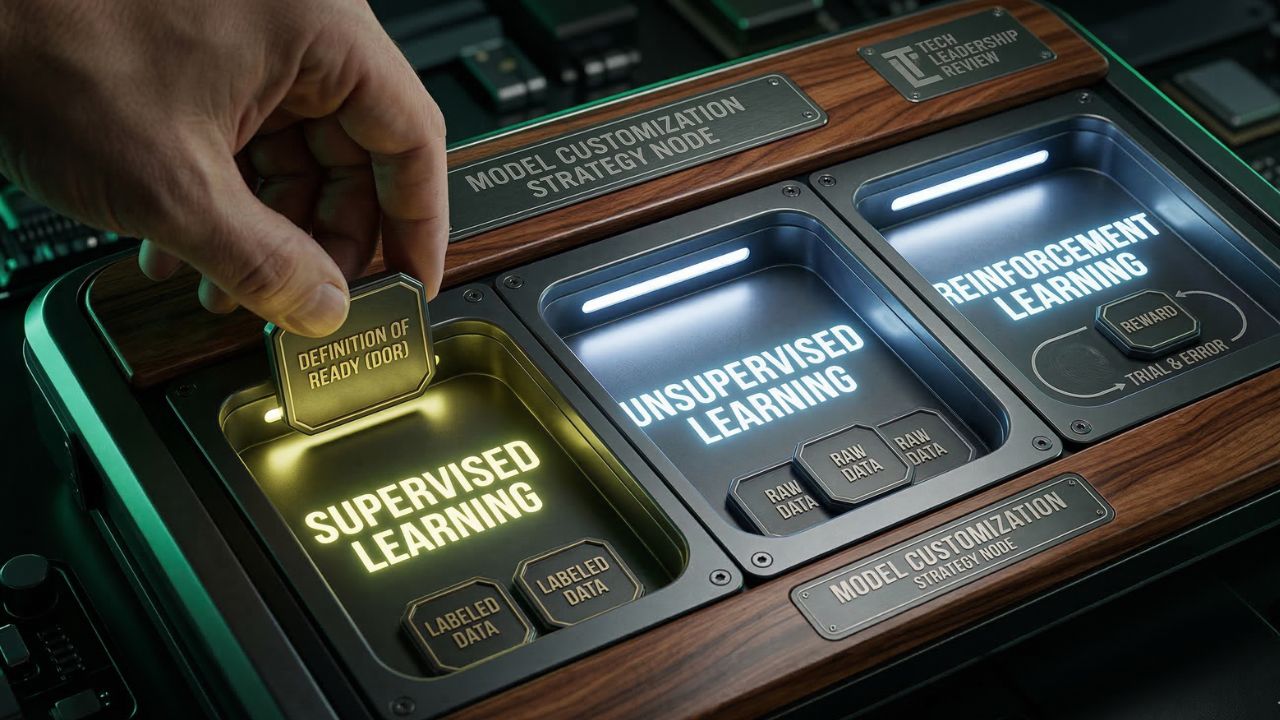
The Three Pillars of Model Training
Understanding what the main AI machine learning approaches are is the first step toward effective sprint planning. You cannot point a user story accurately if you do not understand the underlying mechanics of the algorithm your team is trying to build.
Each approach demands a unique set of resources, distinct data requirements, and entirely different testing parameters. We will break down each framework so Product Owners can align their backlogs with reality.
1. Supervised Learning: The Predictable Engine
Supervised learning is the most common approach used in enterprise AI today. It relies on a heavily structured methodology where the model is trained on labeled datasets.
Core Characteristics of Supervised Learning:
- Data Dependency: Requires massive amounts of meticulously labeled data to function.
- Clear Objectives: The algorithm knows exactly what output it is trying to predict (e.g., classifying an email as spam or not).
- Agile Alignment: Relatively straightforward to estimate in sprints because the end goal and input data are deterministic.
How does data labeling impact supervised learning? It is the ultimate bottleneck. If your Agile team does not allocate sufficient sprint capacity for data annotation, your model will fail to learn accurately. Scrum Masters must treat data labeling as a strict prerequisite for any machine learning story. You cannot sprint on algorithm development if the underlying dataset is full of errors.
2. Unsupervised Learning: Discovering Hidden Patterns
How does supervised learning differ from unsupervised learning? While supervised learning uses neatly categorized data, unsupervised learning is fed raw, unclassified data and tasked with finding its own structure.
Core Characteristics of Unsupervised Learning:
- No Labels Required: Saves significant time and budget on upfront manual data annotation.
- Exploratory Nature: Ideal for clustering customers, anomaly detection (fraud), and finding hidden relationships in vast datasets.
- Estimation Challenges: Highly non-deterministic, making traditional Agile story pointing very difficult.
What are the risks of unsupervised learning in enterprise AI? Extreme unpredictability. Because the model defines its own parameters for success, it can easily generate false positives or irrelevant groupings. Product Owners must establish strict time-boxes (Spikes) when assigning unsupervised learning tasks. Do not let your data scientists wander indefinitely looking for patterns that do not drive direct business value.
3. Reinforcement Learning: The Reward System
When should Scrum Masters or Product Owners choose reinforcement learning? This approach is best reserved for dynamic environments where an agent must make a sequence of decisions, such as robotics, dynamic pricing models, or complex game simulations.
Core Characteristics of Reinforcement Learning:
- Trial and Error: The model learns by taking actions in an environment and receiving positive or negative feedback.
- Reward Functions: Success is dictated by a carefully engineered mathematical reward system.
- Extended Timelines: Requires immense compute power and incredibly long training cycles to achieve mastery.
How do Scrum teams handle reinforcement learning feedback loops? This is where many Agile frameworks break down. Training an RL agent cannot be squeezed into a standard two-week sprint. Instead, Scrum teams must focus their user stories on building the simulated environment and defining the reward function, rather than delivering a fully trained model in a single iteration.
Aligning Machine Learning Approaches with Agile Sprints
Integrating AI into an Agile framework requires a fundamental shift in how you write user stories, define acceptance criteria, and plan your sprints. You are no longer delivering traditional, deterministic software features; you are delivering probabilities. This shift in mindset is critical for maintaining a healthy product backlog and ensuring stakeholders understand the iterative nature of AI development.
Redefining the Agile Lifecycle for ML
What is the Agile lifecycle for training an ML model? It is highly cyclical and demands continuous validation.
A standard ML sprint cycle should look like this:
- Sprint 1: Data Discovery: Locating, cleaning, aggregating, and validating the necessary datasets.
- Sprint 2: Feature Engineering: Transforming raw data into usable metrics and signals for the algorithm.
- Sprint 3: Model Selection & Training: Running initial experiments with different algorithms to find the baseline.
- Sprint 4: Evaluation & Tuning: Testing the model against a holdout dataset and actively adjusting hyperparameters.
How do machine learning approaches affect product timelines? Significantly. A supervised learning project might deliver value in a few sprints, provided the data is clean. Conversely, a reinforcement learning project might require months of environmental setup before a single decision is optimized.
Navigating RAG vs Fine-Tuning
As your product matures, you will inevitably face advanced architectural decisions regarding model customization. You must understand how these foundational ML approaches translate into modern Generative AI techniques.
Before committing your compute budget, you need to deeply evaluate RAG vs. fine-tuning an AI model. Choosing to fine-tune a Large Language Model when you should be using Retrieval-Augmented Generation is a classic symptom of poor architectural planning. It exposes proprietary data and wastes valuable sprint capacity on unnecessary training cycles.
Mitigating Bias and Maximizing ROI
How does model training impact overall product ROI? An inaccurate, biased, or overly complex model will destroy user trust, damage brand reputation, and generate massive operational costs through wasted API usage and excessive compute power.
Your choice of machine learning framework directly dictates your profit margins.
The True Cost of Data Quality
What type of data is needed for supervised machine learning? High-quality, diverse, and ethically sourced data. If your Product Owner cuts corners on data acquisition, you will ingest bias directly into your system's core.
- Garbage In, Garbage Out: Poor data guarantees poor model performance, regardless of the algorithm's sophistication.
- Continuous Monitoring: Models degrade over time as real-world data drifts from training data. Sprints must account for retraining.
- Ethical Audits: Backlogs must include dedicated user stories for bias testing, red-teaming, and fairness validation.
Strategic Product Ownership in AI
Product Owners must act as the ultimate gatekeepers for enterprise AI initiatives. You cannot simply approve a vague "build AI feature" epic and expect your Scrum team to magically deliver a functional product.
You must demand absolute clarity on the specific approach being used. If a data scientist suggests an unsupervised learning clustering algorithm, the Product Owner must immediately ask how that cluster will be monetized or used to demonstrably improve the customer experience.
If there is no clear path to ROI or user value, the task should be aggressively removed from the backlog.
Conclusion
To truly master AI machine learning approaches and boost your ROI, Agile teams must completely abandon the illusion that AI development mirrors traditional deterministic software engineering.
By deeply understanding the core differences between supervised, unsupervised, and reinforcement learning, Product Owners and Scrum Masters can accurately forecast timelines, prevent critical bias risks, and seamlessly align technical execution with overarching business strategy.
Stop guessing with your sprints. Start treating your training data as a primary product increment, and ensure your next Agile cycle delivers measurable, scalable AI value.
Frequently Asked Questions (FAQ)
The three main AI machine learning approaches are supervised learning, unsupervised learning, and reinforcement learning. Each framework requires different data structures, testing parameters, and Agile sprint planning strategies to successfully implement in enterprise software.
Supervised learning requires highly structured, manually labeled datasets to predict specific, deterministic outcomes. Unsupervised learning, conversely, ingests raw, unlabeled data to independently discover hidden patterns, anomalies, and underlying structures without predefined human guidance.
Scrum Masters and Product Owners should opt for reinforcement learning when developing dynamic systems that require sequential decision-making. It is ideal for robotics, dynamic pricing, and complex simulations where an agent learns via trial, error, and programmed reward functions.
The Agile lifecycle for training an ML model requires distinct, highly iterative sprints focused on specific phases: initial data discovery, rigorous feature engineering, iterative model selection, and continuous evaluation and hyperparameter tuning against holdout datasets.
Model training directly impacts overall product ROI by dictating infrastructure costs, latency budgets, and user trust. Utilizing the correct training approach prevents expensive API waste, mitigates legal bias risks, and ensures the final product delivers measurable business value.