Decode Generative AI Model Types: A Guide for Agile Leaders
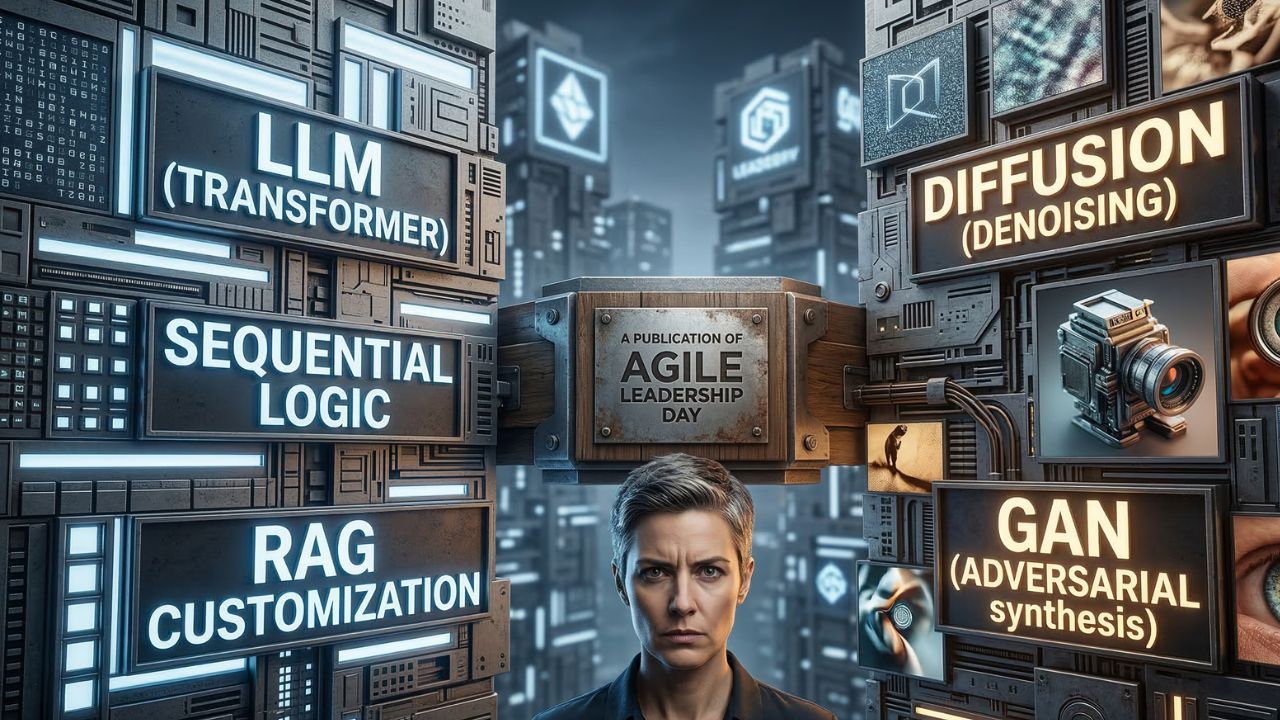
Key Takeaways
- Treating all AI like a generic text engine destroys technical architecture and balloons technical debt.
- Understanding distinct generative AI model types is essential for accurate Agile sprint planning and resource allocation.
- Large Language Models (LLMs) excel at sequential text reasoning but inherently fail at high-fidelity image synthesis.
- Generative Adversarial Networks (GANs) provide lightning-fast realistic outputs but suffer from severe training instability.
- Diffusion models dominate detailed image generation through iterative denoising, requiring significant computational resources.
Product Owners who treat all generative AI systems like a generic Large Language Model (LLM) are actively destroying their technical architecture and accruing massive technical debt.
If your Agile team assumes every artificial intelligence feature requires the exact same infrastructure, hardware, and testing parameters, your upcoming sprints will inevitably derail.
To prevent this catastrophic misalignment, Agile leaders must first master The AI Fundamentals for Scrum Masters and Product Owners. Without that baseline comprehension, you cannot accurately estimate tasks, define acceptance criteria, or allocate technical resources.
Choosing the wrong generative AI model type can force a complete architectural rebuild. You must discover the critical differences between GANs, LLMs, and Diffusion models today. This guide will meticulously dissect these core architectures so your next sprint planning session is grounded in technical reality, rather than hype.
Exploring the Core Generative AI Model Types
Before your Agile team commits to an AI product increment, you must rigorously evaluate the underlying machinery. AI is not a monolith; the specific generative AI model types you select will explicitly dictate your infrastructure costs, data requirements, and deployment timelines.
You cannot seamlessly swap a text-based transformer for an image-based network without completely overhauling your backend pipeline. Scrum teams must aggressively assess these models early in the backlog refinement process to avoid crippling technical blockers.
When you understand the fundamental mechanics of these systems, you can accurately define the components of a GenAI system. Let us break down the three most prominent architectures dominating enterprise AI product development today.
How do Large Language Models (LLMs) actually work?
Large Language Models (LLMs) are the primary engines behind modern conversational AI, code generation, and complex sequential reasoning tasks.
They are built upon the groundbreaking Transformer architecture, which fundamentally changed how machines process and contextualize sequence data.
- Self-Attention Mechanisms: Transformers mathematically weigh the importance of every word in a sentence relative to all others, building deep contextual understanding.
- Context Windows: They maintain structural context over incredibly long inputs, making them ideal for enterprise document summarization.
- Autoregressive Generation: They probabilistically predict and generate output one token (or word fragment) at a time.
How do LLMs impact Agile product backlogs? They introduce entirely unique testing challenges. Because LLMs generate non-deterministic text (meaning outputs vary), traditional pass/fail Definition of Done (DoD) criteria often fail.
Scrum Masters must incorporate rigorous prompt engineering user stories and explicit hallucination testing phases into their sprint plans.
How do Generative Adversarial Networks (GANs) operate?
Generative Adversarial Networks (GANs) operate on a completely different paradigm than LLMs. Instead of predicting the next word in a sequence, GANs pit two separate neural networks against each other in a high-stakes, mathematical game.
The Dual-Network Architecture:
- The Generator: This neural network attempts to autonomously create synthetic data (like human faces or audio clips) from pure random noise.
- The Discriminator: This network acts as an AI detective, constantly trying to distinguish between real data from the training set and the fake data produced by the Generator.
- The Minimax Game: They train simultaneously. The Generator learns to produce increasingly realistic fakes, while the Discriminator sharpens its detection skills until the fakes are indistinguishable from reality.
What are the hardware requirements for training GANs? GANs require significant GPU power, but their primary architectural challenge is training instability. They are highly prone to "mode collapse," where the Generator discovers a single output that successfully fools the Discriminator and repeatedly produces only that one variation.
Product Owners must account for extended, unpredictable experimentation Spikes in their sprints to stabilize GAN training loops.
What is a Diffusion model used for in AI?
While GANs were once the undisputed kings of image generation, Diffusion models have rapidly overtaken them in quality, diversity, and prompt adherence. They are the core architecture powering today's most advanced text-to-image and text-to-video systems.
The Iterative Denoising Process:
- Forward Diffusion: The model systematically destroys a training image by adding Gaussian noise over hundreds of steps until it becomes pure, unrecognizable static.
- Reverse Diffusion: The neural network learns to reverse this exact process, slowly and meticulously removing noise step-by-step.
- Generation: During active inference (user generation), it starts with pure random noise and iteratively "denoises" it into a coherent, high-fidelity image based strictly on the text prompt's guidance.
What are the primary use cases for Diffusion models in business? They excel at marketing asset generation, synthetic data creation for computer vision, and high-end architectural rendering.
However, they are incredibly computationally heavy and significantly slower to generate outputs than GANs. Scrum Masters must factor in higher cloud inference costs and much longer latency budgets when pointing Diffusion-based user stories.
Strategic Model Selection for Agile Teams
Understanding the deep theory behind these models is only half the battle. Product Owners and Scrum Masters must efficiently translate this architectural knowledge into strategic, ROI-driven business decisions.
Choosing the wrong model doesn't just waste a two-week sprint; it can necessitate a complete, millions-of-dollars infrastructure rebuild.
When exactly should a Scrum Master or Product Owner choose an LLM over a GAN? This crucial decision boils down to the fundamental nature of the user problem you are trying to solve. You must tightly align the model's inherent strengths with your product's acceptance criteria.
Choose an LLM when:
- The core value proposition relies on natural language processing, intelligent text summarization, or automated code generation.
- The product requires zero-shot reasoning or complex logical deductions across varied topics.
- You need a fluid, conversational interface for B2B SaaS or customer support applications.
Choose a GAN when:
- You need lightning-fast, real-time image generation (e.g., dynamic video game asset creation or live interactive video filters).
- The application domain is highly specific and visually constrained (like generating synthetic human faces or highly specific industrial textures).
- Application latency is a much stricter product constraint than absolute visual diversity.
Mitigating Technical Debt in Sprint Planning
How do Agile Scrum teams effectively test generative AI model types? Traditional deterministic unit testing is entirely insufficient. Agile teams must implement robust, continuous evaluation pipelines.
- Human-in-the-Loop (HITL): Sprints must explicitly allocate capacity for manual qualitative reviews of generated outputs.
- Automated Benchmarking: Utilize programmatic frameworks to measure precision, recall, and specific AI metrics like Fréchet Inception Distance (FID) for images.
- A/B Shadow Testing: Deploy multiple model types in shadow mode to capture and compare real-world performance metrics before fully committing to one permanent architecture.
If you mistakenly treat a Diffusion model's inherent latency issues like a standard code bug, your team will waste weeks trying to optimize the mathematically un-optimizable. Instead, Product Owners must proactively manage stakeholder expectations regarding generation speeds and focus the engineering team on clever caching strategies or progressive rendering UI solutions.
Conclusion: Empowering Your Sprints with Technical AI Knowledge
Agile leadership in the modern era requires deep, structural comprehension of the highly complex tools at your disposal.
If you do not inherently understand the distinct mechanics, hardware demands, and latency profiles of different generative AI model types, your product roadmaps will quickly become works of fiction, and your budgets will bleed dry.
By accurately identifying whether your next feature requires the sequential reasoning of an LLM, the rapid synthesis of a GAN, or the iterative, high-fidelity detail of a Diffusion model, you safeguard your entire enterprise architecture.
Stop guessing during your backlog refinement sessions. Anchor your sprint planning in hard technical reality, aggressively mitigate your architectural risks, and build intelligent AI products that scale securely and successfully.
Frequently Asked Questions (FAQ)
The most prominent generative AI model types include Large Language Models (LLMs) for text, Generative Adversarial Networks (GANs) for fast image synthesis, and Diffusion models for highly detailed, iterative image generation. Each serves distinct enterprise use cases.
LLMs utilize Transformer architectures to process sequential data. They leverage self-attention mechanisms to understand the context of words within massive datasets, allowing them to predict and generate highly coherent, human-like text or code one token at a time.
A Diffusion model is primarily used for generating high-fidelity images, audio, and video. It works by systematically adding noise to training data and then learning to iteratively reverse that process, ultimately transforming pure random noise into detailed, coherent media.
GANs operate through a competitive framework utilizing two neural networks. A Generator attempts to create synthetic data to fool a Discriminator, which is simultaneously learning to distinguish real data from fakes. This adversarial game drives the Generator to produce highly realistic outputs.
A Scrum Master or Product Owner should choose an LLM when the product requires sequential reasoning, text generation, or natural language understanding. They should avoid LLMs and consider GANs only when the product demands high-speed, real-time visual or audio synthesis.