How to Run Scrum When Half Your Team is AI Agents?
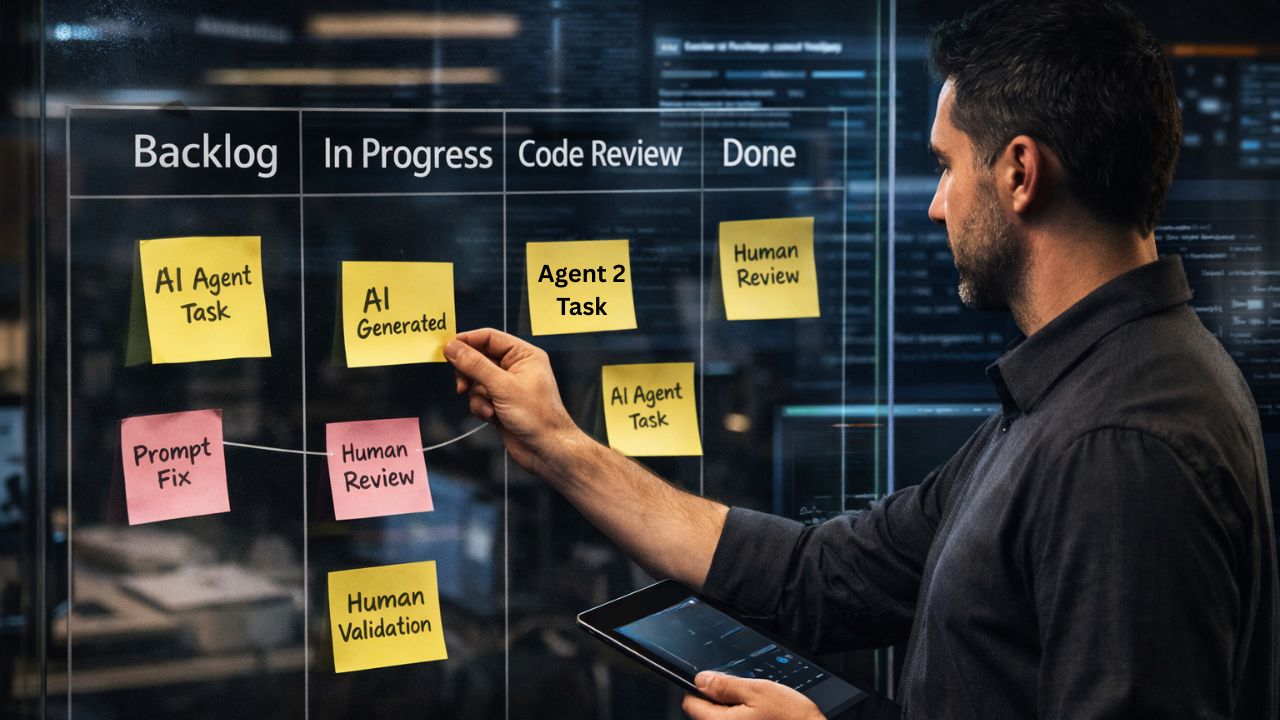
- New Capacity Metrics: Stop using story points for bots. Shift to AI agent capacity planning based on token budgets and compute costs.
- Accountability Evolution: Human Developers pivot from pure execution to architectural oversight and prompt engineering.
- Event Adaptation: Scrum events transition from synchronous to asynchronous deviation management.
- Continuous Tuning: Sprint Retrospectives must systematically debug your agentic workflows rather than just discussing human team morale.
Firing developers isn't AI transformation; orchestrating autonomous agents is. However, attempting to plug 24/7 autonomous bots into traditional Agile frameworks often results in broken workflows, mismatched velocity, and severe technical debt.
This guide reveals the AI augmented scrum framework, showing you how to manage workflows and scale delivery when 50% of your Developers are autonomous bots.
The Dawn of the AI Augmented Scrum Framework
The landscape of software engineering has fundamentally shifted. We are moving rapidly past the era of using generative AI merely as an autocomplete coding assistant.
Today, high-performing enterprise organizations are deploying autonomous Scrum Teams. In these environments, AI agents act as independent contributors, pulling Product Backlog items, writing code, executing tests, and submitting pull requests.
But how does Scrum change when using autonomous AI? It requires a complete paradigm shift in how engineering leaders view teamwork, capacity, and accountability.
When you reach a 50/50 human-AI ratio in Scrum, the traditional rules of the Scrum Guide begin to fracture. You can no longer manage a Scrum Team where half the members do not sleep, do not get burned out by repetitive tasks, but lack fundamental business context.
To survive this shift, organizations must adopt an operating model designed for orchestrated efficiency in Scrum. Scrum is a lightweight framework that helps people, teams and organizations generate value through adaptive solutions for complex problems.
Achieving this with AI requires applying the empirical Scrum pillars of transparency, inspection, and adaptation to non-human intelligence.
Redefining Scrum Accountabilities in a Hybrid Team
What are the new accountabilities in an AI-driven Scrum Team? You can no longer rely on the traditional, rigid breakdown of Product Owner, Scrum Master, and Developers without significant modification.
Scrum defines three specific accountabilities within the Scrum Team. Here is how they evolve in an autonomous ecosystem.
The Developers - Human Developers must elevate their skill sets. They are no longer just writing boilerplate code; they act as "Agent Managers" or "Code Reviewers," tasked with validating the logic generated by their AI counterparts.
The Product Owner - The Product Owner is accountable for maximizing the value of the product resulting from the work of the Scrum Team. Can an AI agent be a Product Owner? The short answer is no.
Product ownership requires deep user empathy, complex stakeholder negotiation, and strategic business alignment, traits that remain exclusively human. Instead, human Product Owners provide the "why" and the "what," while AI agents handle a massive, automated portion of the "how".
The Scrum Master - The Scrum Master is accountable for the Scrum Team's effectiveness. Their accountability also evolves from facilitating human collaboration to monitoring system logs and API rate limits to ensure the bots are unblocked.
They must cause the removal of impediments to the Scrum Team's progress, whether human or algorithmic.
While AI agents can generate thousands of lines of code autonomously, human accountability cannot be delegated. Your senior engineers must transition into code-review and architectural oversight roles. If humans fail to monitor the agents, localized AI optimizations will eventually break the broader system architecture.
The Information Gain: Why Story Points Fail for AI Agents
Most teams make a fundamental rookie mistake when transitioning to hybrid teams: giving an AI agent story points.
The Developers who will be doing the work are responsible for the sizing. Story points were originally designed to measure human effort, cognitive complexity, risk, and uncertainty etc.
AI agents, operating continuously without fatigue, do not experience "effort" in the same way a human Developer does. If you find yourself asking, "how do you measure velocity with AI agents?", the answer lies in abandoning points entirely for non-human workers.
Instead of points, tasks assigned to bots are measured by their compute cost, API token utilization, and the human validation time required. This introduces the concept of agentic capacity.
A highly complex algorithm might take an AI agent three minutes to write, but it might take a human architect three hours to securely review and merge.
If you plan your Sprint purely on the AI's generation speed, you will create a massive, unmanageable bottleneck at the human review stage.
Upgrading the Scrum Events for Hybrid Teams
The Sprint is a container for all other events. To successfully implement a hybrid AI augmented Scrum environment, every standard Scrum event requires a structural overhaul. Here is how you adapt your Sprint lifecycle.
1. Sprint Planning with Autonomous Bots
Sprint Planning initiates the Sprint by laying out the work to be performed for the Sprint. When moving into ai augmented sprint planning, the rules change drastically.
Task attribution in hybrid Scrum becomes the most critical phase of planning. You must clearly separate tasks requiring human creativity from those suitable for automated, repetitive execution.
Furthermore, your “Ready” state or “Definition of Ready” for AI must evolve. You must write technical prompts for your AI team members.
If an agent lacks the correct API documentation or database schema in its initial prompt, the task is not "Ready" for the Sprint.
You must also focus heavily on token budget planning. You need to assign compute budgets alongside human hours to ensure you do not max out your infrastructure costs mid-sprint.
2. The Asynchronous Daily Scrum
The purpose of the Daily Scrum is to inspect progress toward the Sprint Goal and adapt the Sprint Backlog as necessary.
Your AI agents don't need coffee, but they do need strict oversight. In an ai augmented daily scrum, you do not need autonomous bots to speak in a meeting.
Instead, human Developers and autonomous bots share status updates, flag deviations, and handle blockers together through asynchronous digital logs.
The Daily Scrum must evolve to deviation management. Instead of asking "what did you do yesterday," the Human member reviews the AI's automated output logs to see if any bots failed their test suites.
You must learn how to read an AI agent's confidence score. If an agent reports a 40% confidence score on a module, a human must intervene immediately.
A 24/7 AI agent will quickly outpace human reviewers. If you do not plan human capacity for code review, your agents will stack up a massive backlog of unmerged pull requests, stalling your entire continuous integration pipeline and destroying your Sprint predictability.
3. The Co-Presented Sprint Review
The purpose of the Sprint Review is to inspect the outcome of the Sprint and determine future adaptations.
Who demos the product when an AI agent builds it? The answer is co-presentation between the human overseer and the machine log.
During the ai augmented sprint review, stakeholders don't care that an AI wrote the feature; they care who owns the outcome.
A human lead must contextualize and present AI-generated code to stakeholders. The human takes accountability for the security and functionality of the feature.
This is also the exact moment to measure AI agent ROI in a Sprint Review. You must showcase compute efficiency by comparing the token cost of the AI's execution against the traditional human hours saved.
4. Debugging the Agent in the Sprint Retrospective
The purpose of the Sprint Retrospective is to plan ways to increase quality and effectiveness.
A retrospective without analyzing your AI's token logs is just a complaining session. In your ai augmented sprint retrospective, you must systematically debug your agentic workflows.
This event now involves prompt library optimization. If an AI agent failed to deliver a usable component, the team must rewrite the system prompt to prevent the error in the future.
You must also address the human element. Discuss mitigating AI burnout. Reviewing massive amounts of AI-generated code is mentally exhausting, and Scrum Masters must protect their human engineers from cognitive overload.
Once resolved, you apply these tuned prompts directly into your next ai augmented sprint planning session.
Governing the Human-AI Collaboration Loop
Scrum artifacts represent work or value and are designed to maximize transparency of key information.
How do human Developers collaborate with AI agents? They do so through deeply integrated, continuous feedback loops.
Agents are not fire-and-forget tools; they require continuous steering and course correction.
Agile leaders must foster a psychological environment where Developers view agents as highly capable, yet heavily supervised, junior engineers. They must be guided, corrected, and mentored through prompt engineering.
Successful use of Scrum depends on people becoming more proficient in living five values: Commitment, Focus, Openness, Respect, and Courage.
In an AI context, Openness requires visible machine logs, Respect acknowledges the human validation bottleneck, and Courage means rejecting AI Increments that do not meet the Definition of Done.
Generative AI workflow management ensures that while delivery speed scales exponentially, software quality and architectural integrity remain uncompromised.
By embracing this AI augmented scrum framework, engineering teams can transition from legacy execution models into the future of autonomous software delivery.

Frequently Asked Questions (FAQ)
An AI augmented Scrum Team integrates autonomous bots as active members alongside human Developers. This framework leverages AI for rapid code generation, while humans focus on strategy, prompt engineering, and code review to maximize orchestrated efficiency.
You do not simply replace Developers; you elevate them. AI agents assume repetitive coding and boilerplate tasks. Human engineers transition to higher-value accountabilities as reviewers and workflow orchestrators, ensuring the AI's output meets strict enterprise security standards.
No, assigning story points to AI agents is a fundamental mistake. Story points measure human cognitive effort. Instead, agent tasks are measured by compute capacity, API token budgets, and the estimated human time required to validate the output.
Velocity in a hybrid team is measured through orchestrated efficiency. Rather than tracking traditional points, teams track the lead time of features from prompt to production, factoring in the AI's execution speed alongside the human validation bottleneck.
The best agents depend on your specific tech stack. Leading teams utilize custom enterprise agents built on large language models, deploying specific bots for distinct, narrow tasks like legacy refactoring, automated test generation, and database documentation.