How Humans do Daily Scrum with AI Agents
- Your AI agents don't need coffee, but they do need strict oversight; the traditional standup must evolve towards deviation management.
- An AI augmented daily scrum eliminates verbal updates from bots, relying entirely on asynchronous updates and automated log parsing.
- Human developers must transition to active system monitors, constantly evaluating an AI agent's confidence score to prevent pipeline blockers.
- Scrum Masters take on new technical responsibilities, specifically tracking API rate limits and debugging prompts to unblock their non-human team members.
Your AI agents don't need coffee, but they do need strict oversight. If you are leading a modern software team, you already know that the traditional 15-minute morning standup is fundamentally broken when half your contributors are machines.
As we covered in our foundational guide on How to Run Scrum When Half Your Team is AI Agents, integrating autonomous bots requires a complete overhaul of your Agile ceremonies.
When executing an AI augmented daily scrum, you cannot expect a generative AI model to hop on a Zoom call and answer the classic three questions. The AI does not experience blockers the way humans do, nor does it wait for a meeting to report its progress.
Instead, human-in-the-loop standups are necessary to enforce accountability. This guide will dive deep into how human developers and autonomous bots share status updates, flag deviations, and handle blockers together in a hybrid ecosystem.
The Paradigm Shift: From Status to Deviation Management
In a traditional Daily Scrum, the goal is to synchronize the human team. Developers state what they accomplished, what they plan to do, and highlight any impediments.
However, autonomous agent oversight changes the entire goal of this 15-minute timebox. AI agents operate continuously. By the time your 9:00 AM meeting occurs, an agent may have already executed hundreds of automated tests, written thousands of lines of code, and submitted multiple pull requests.
Therefore, the daily standup must evolve from status updates to deviation management.
What is Deviation Detection?
Deviation detection is the process of identifying when an automated worker steps outside its expected behavioral parameters. When humans write code, errors are usually logical or syntax-based.
When an AI writes code, the errors can be systemic hallucinations or infinite execution loops. Deviation detection requires the human team to ask specific questions during the Daily Scrum:
- Did the AI pull the correct Product Backlog Item (PBI)?
- Is the agent generating code that violates our strictly defined negative constraints?
- Has the bot stalled on a single execution loop for more than five minutes?
Instead of asking "what did you do yesterday," the human member reviews the AI's automated output logs to see if any bots failed their test suites.
Reading the Bot: Asynchronous Updates
To make the Daily Scrum efficient, teams must embrace asynchronous updates. Autonomous bots do not speak; they emit data.
To understand how autonomous agents report project status, your team must set up highly visible, automated dashboards that parse the agent's activity overnight. You cannot afford to spend your 15-minute timebox reading raw JSON logs.
Automating Daily Scrum Updates with AI Logs
How to automate Daily Scrum updates with AI logs? You must integrate your agentic workflows directly into your project management tools (like Jira or Azure DevOps).
When an agent completes a task, it should automatically move the ticket across the digital Scrum board and append a summary of its actions. This summary must include the exact files modified, the libraries imported, and the tests executed.
These daily logs form the basis of your ai augmented sprint review, providing an immutable audit trail of the machine's contributions.
How to Read an AI Agent's Confidence Score
One of the most critical new metrics for human developers to understand is AI confidence score reporting. How to read an AI agent's confidence score?
When an advanced agent generates a complex block of code, it assigns a mathematical probability to the accuracy and safety of that code. During the AI augmented daily scrum, human developers must scan these scores.
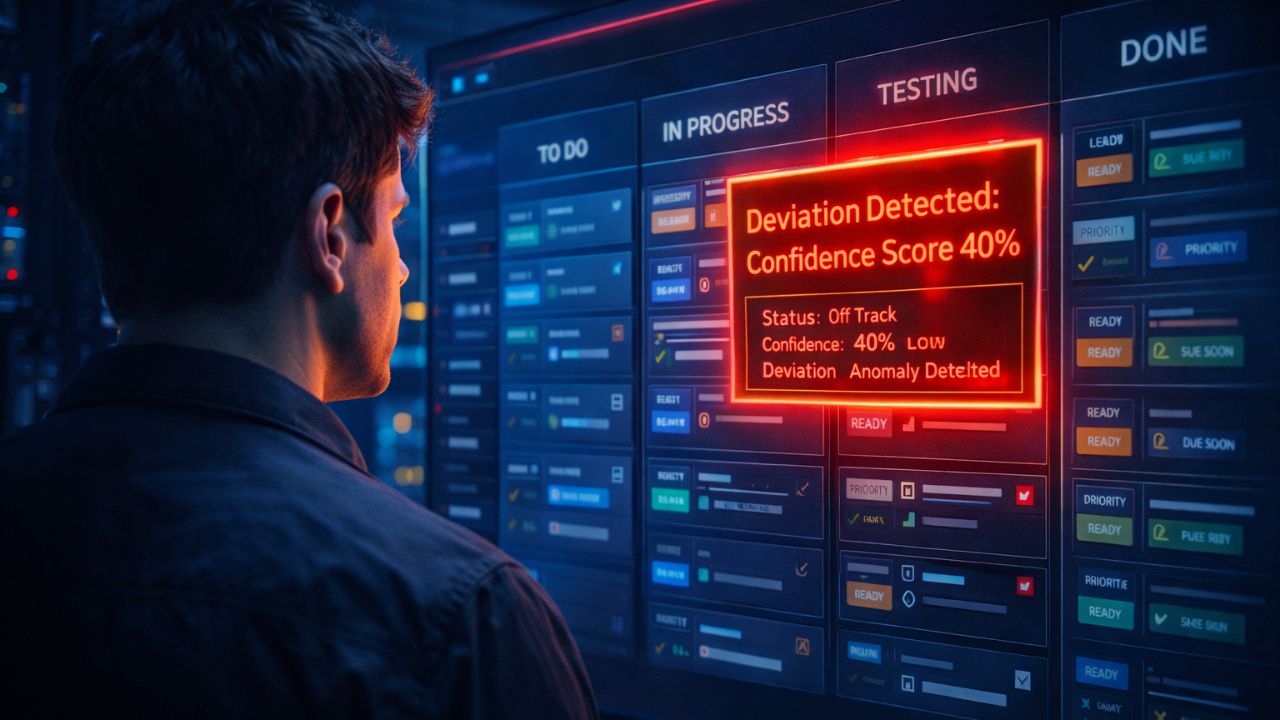
If an agent reports a 98% confidence score on a routine CSS update, the human can quickly approve it. However, if an agent reports a 40% confidence score on a module, a human must intervene immediately.
This low score is a blazing red flag that the prompt lacked necessary context or that the architectural logic is fundamentally flawed.
The New Role of the Scrum Master: Unblocking Machines
The Scrum Master is accountable for the Scrum Team's effectiveness, and that now includes removing impediments for non-human workers.
An AI agent does not experience human impediments like missing a requirement from a stakeholder. Instead, it experiences rigid, technical blockers.
Tracking API Rate Limits During a Sprint
How to track API rate limits during a sprint? This is a brand-new accountability for the hybrid Scrum Master.
Every time an autonomous agent reads a repository or generates code, it consumes API tokens. If you do not actively monitor these limits, your cloud provider will throttle or shut down your agent entirely.
During the Daily Scrum, the Scrum Master must report on the current token burn rate. If the team has burned through 80% of their API budget by day three of a two-week sprint, the Scrum Master must immediately halt the agents and re-evaluate the technical prompts driving up the compute costs.
How Does a Scrum Master Unblock an AI Agent?
If an agent is blocked, how does a Scrum Master unblock an AI agent? Unblocking an AI involves systemic debugging rather than emotional support.
The Scrum Master must work with the Developers to determine why the bot stalled.
- The Context Window: Did the agent run out of memory? The team must truncate the files being fed into the prompt.
- The Rate Limit: Did the agent hit an infrastructure wall? The Scrum Master must procure a higher API limit or throttle the agent's parallel processing.
- The Infinite Loop: Is the bot stuck trying to fix its own hallucinated errors? The Scrum Master must orchestrate a prompt rewrite, pulling the ticket back to a "Prompt Fix" state for human refinement.
Fostering a Human-in-the-Loop Culture
The ultimate success of an AI augmented daily scrum relies on the psychological safety of the human team.
Developers must not view the AI as a replacement, but as a junior developer requiring constant, diligent supervision. Human-in-the-loop standups are necessary because an AI lacks the business context to know if its perfectly functional code actually solves the customer's core problem.
By turning the Daily Scrum into a metrics-driven deviation detection meeting, your human engineers remain in total control of the sprint cadence, ensuring that autonomous speed never compromises architectural integrity.

Frequently Asked Questions (FAQ)
No, AI agents do not participate verbally or synchronously in the Daily Scrum. Instead, human developers review asynchronous agile updates, parsing automated logs and dashboards to evaluate what the agents accomplished overnight and identify any systemic deviations.
Autonomous agents report project status through automated workflows integrated into agile boards. They move tickets to designated 'AI Generated' columns, attach structured execution logs, and generate automated pull requests complete with integrated confidence scores for human review.
Deviation detection in Agile is the proactive monitoring of autonomous agents to ensure they haven't hallucinated or entered infinite execution loops. During the Daily Scrum, humans identify these deviations by analyzing failed test suites and reviewing the bot's system logs.
You read an AI agent's confidence score by evaluating the probability matrix attached to its generated output. If the score falls below a set threshold (e.g., a 40% confidence score on a module), a human developer must immediately intervene to review the logic.
A Scrum Master unblocks an AI agent by identifying and resolving technical impediments rather than human ones. This includes expanding API token budgets, resolving rate limit throttling, or coordinating with developers to rewrite flawed technical prompts that stalled the machine.
Conclusion
The evolution to an AI augmented daily scrum represents a massive shift in engineering culture. By letting go of verbal status updates and embracing rigorous deviation management, your team can safely harness the massive parallel output of autonomous bots.
Remember, your AI agents don't need coffee, but they do need strict oversight. Equip your human developers with the right dashboards, train your Scrum Masters to monitor token limits, and treat every automated log as a crucial piece of your daily inspection and adaptation loop.