How to do Sprint Planning for AI Agents
- Discover how AI augmented sprint planning works by completely shifting from traditional story points to strict compute budgets.
- Giving an AI agent story points is a fundamental rookie mistake.
- Learn how to break down backlog items and explicitly assign compute budgets to your non-human team members to prevent cost overruns.
- Master writing technical prompts as a core part of your “Ready” state for AI to prevent execution loops.
- Learn how to allocate compute-based tasks and safeguard your sprint planning against human review bottlenecks.
Welcome to the next major evolution of Scrum framework in the AI era. If your organization is learning How to Run Scrum When Half Your Team is AI Agents, the very first event you must radically overhaul is your planning session.
Mastering AI augmented sprint planning requires a complete structural shift in how your team views capacity, effort, and backlog readiness. Traditional scrum teams rely heavily on human-centric metrics to estimate work.
However, these human metrics fail catastrophically when applied to autonomous bots. In fact, giving an AI agent story points is a fundamental rookie mistake.
To successfully orchestrate a hybrid team, you must learn how to break down backlog items, assign compute budgets, and write technical prompts for your AI team members. This deep-dive guide will show you exactly how to allocate compute-based tasks and safeguard your sprint planning for the future of work.
The Core Shift in AI Augmented Sprint Planning
When you integrate autonomous bots into your Scrum team, the traditional sizing models instantly break. During AI augmented sprint planning, you cannot simply ask an AI developer how "complex" a specific task feels.
This leads to a critical question: Do AI agents use story points in Scrum?
The answer is definitively no. Story points were originally designed to measure human effort, uncertainty, risk, and cognitive load. Autonomous agents do not get tired, they do not experience cognitive fatigue, and they run 24 hours a day.
Therefore, attempting to assign them a Fibonacci number is entirely useless. Instead of human effort, you must transition to measuring agentic capacity.
Agentic capacity evaluates how much parallel compute power your bots can utilize safely. Crucially, it measures this output against the human team's ability to review and merge the generated code without creating a massive pipeline bottleneck.
Rebuilding the Scrum Board
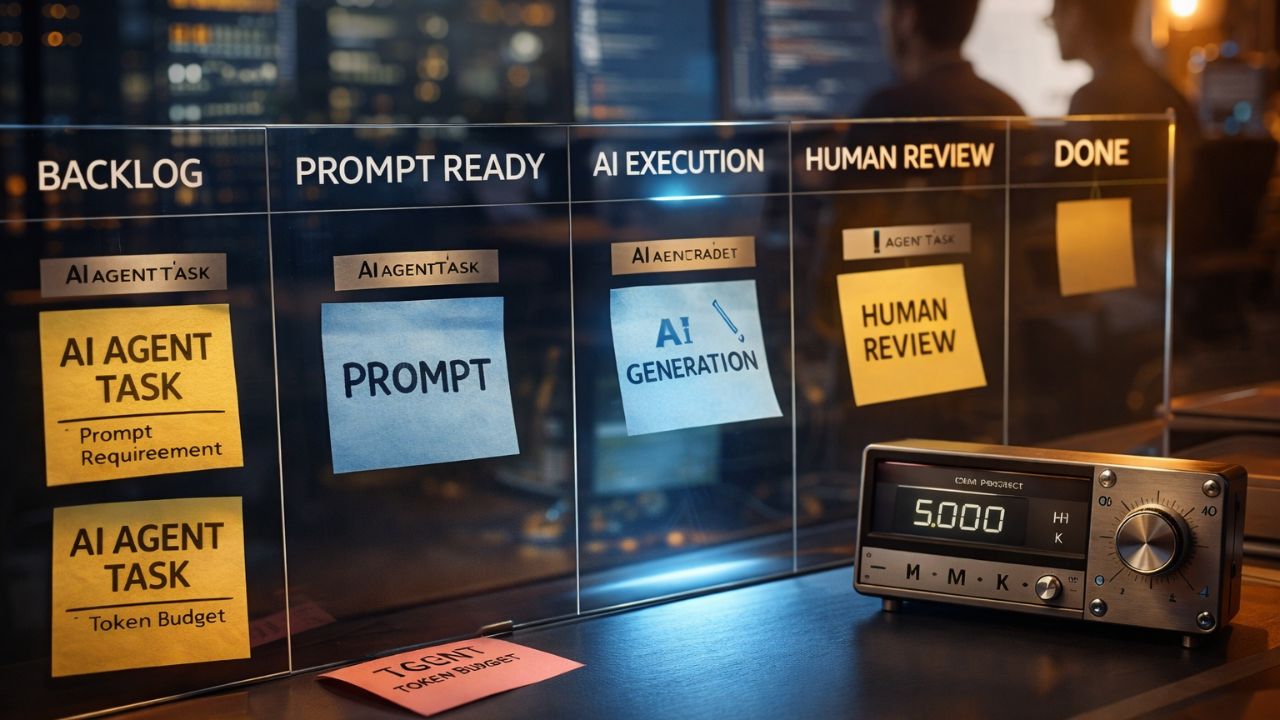
To visualize this new workflow, hybrid teams must restructure their physical or digital boards. You will no longer just have "To Do" and "Done".
You must introduce specific states to track the hand-offs between human and machine. You will see sticky notes and tickets explicitly labeled as "AI Agent Task" moving into columns designated for "AI Generated" output.
Because humans must verify the bot's work, the "Code Review" column becomes heavily populated with "Human Review" and "Human Validation" tasks. If the bot fails, the ticket cycles back into a "Prompt Fix" state for the human developer to refine.
Step 1: Product Backlog Items (PBI) or User Story decomposition for AI
The first mechanical step in your new planning session is mastering product backlog items decomposition for AI. This process is fundamentally different from breaking down a traditional user story for a human engineer.
You must ask your team: what is task attribution in hybrid Scrum? Task attribution means deliberately routing the decomposed work based on the specific entity's strengths.
Humans are exceptional at handling high-ambiguity, highly creative, and highly empathetic problem-solving. AI agents, conversely, excel at high-volume, strictly structured, and predictable coding or testing loops.
During planning, the Product Owner and Developers must slice the Product Backlog items into these two distinct categories.
What Backlog Items (User Stories) Should You Never Assign to an AI Agent?
When assigning work, it is equally important to know what to withhold. What tasks should you never assign to an AI agent?
You should never assign architectural decision-making, final security sign-offs, or complex stakeholder negotiations to an autonomous bot. AI agents are powerful execution engines, not strategic engineers. You must keep the "Why" and the "What" strictly human.
Delegate only the repetitive, well-documented "How" to the agents.
Step 2: The Prompt as a Requirement
Once tasks are attributed to the bots, the format of the work itself must change. How do you assign Jira tickets to AI agents?
You do not assign them a standard user story formatted as "As a user, I want..." Instead, you must adapt your ticketing system to treat the prompt as requirement.
Autonomous bots require deterministic, highly structured input to succeed. The traditional user story must be translated into an actionable, technical system prompt.
This prompt must include strict coding boundaries, exact API documentation references, and explicit negative constraints dictating what the bot should not do.
Updating the “Ready” state or Definition of Ready for AI
This shift drastically alters backlog refinement. How to make an item "Ready" for AI? A ticket is only considered "Ready" to be pulled into a sprint by an agent if the prompt contains zero ambiguity.
Human developers must ask: How do you review an AI agent's prompt requirements? During the planning event, the human technical leads must review the agent's proposed prompt to ensure all necessary context windows, repository access, and data schemas are attached.
If the prompt lacks technical specificity, the agent will inevitably hallucinate code. Therefore, the Definition of Ready must strictly mandate that the prompt is fully defined and technically sound before the sprint begins.
Step 3: Token Budget Planning
Once the backlog items are rigorously decomposed and the prompts are written, the Scrum Team must tackle the financial aspect of the sprint. How do you plan capacity for a 24/7 AI agent? You plan it by measuring and limiting compute costs.
Budgeting API Token Costs
How to budget API token costs in a Sprint? Every single time an autonomous agent runs, reads a repository, or generates code, it consumes API tokens.
Therefore, token budget planning is the new capacity planning. The team must forecast how many tokens a complex refactoring loop or a massive test generation suite will require.
If you arbitrarily assign too many complex Jira tickets to your agents without doing the math, you will rapidly exhaust your enterprise API budget mid-sprint. The Scrum Master and the Developers must align the ambitious sprint goals with the actual financial token budget allocated to the team.
Step 4: Anticipating the Human-in-the-Loop Bottleneck
Another major factor in your planning session is estimating execution time. Can AI estimate software development time?
An AI model can accurately estimate its own generation time, which is usually measured in seconds or minutes. However, true software development time includes the mandatory human review phase.
What Happens if an AI Agent is Blocked by a Human?
This question highlights the most critical operational risk in hybrid team planning: What happens if an AI agent is blocked by a human?
An autonomous agent can easily generate 10,000 lines of functional code overnight. If your human developers only have the daily capacity to securely review 1,000 lines, the agent becomes immediately blocked.
The pipeline stalls, and technical debt accrues instantly in the form of unmerged pull requests. During planning, you must strictly limit the total agentic capacity to match the human code review capacity.
Do not let the bots outpace your human quality assurance capabilities. Once planned, you must monitor them in the ai augmented daily scrum.

Frequently Asked Questions (FAQ)
You assign Jira tickets to AI agents by completely replacing traditional user stories with highly structured technical prompts. These complex prompts act as strict technical requirements, detailing exactly what the agent must execute, including API references and negative constraints.
No, giving an AI agent story points is a fundamental rookie mistake. Story points measure human cognitive effort and uncertainty. Instead, agent tasks are measured by compute capacity limits and strict token budget planning.
A Definition of Ready for AI requires that the prompt as a requirement is fully defined and documented. The ticket must explicitly include all necessary data schemas, context windows, and clear coding boundaries before the agent can begin work.
You plan agentic capacity by matching the bot's token budget and rapid execution speed against the human team's availability to review the generated code. You must ensure the agent is never blocked by a human review bottleneck.
You should never assign highly ambiguous, strategic, or high-level architectural decisions to an AI agent. Autonomous bots are execution engines; humans must retain absolute control over core product vision and final security validations.
Conclusion
Transitioning to a hybrid human-AI workforce requires abandoning legacy estimation metrics. Successful AI augmented sprint planning relies on rigorous prompt engineering, strict token budgets, and realistic human-review forecasting.
By mastering product backlog items decomposition for AI and formally recognizing the prompt as a requirement, your team can scale delivery exponentially without breaking the system architecture. Always remember: firing developers isn't scaling; orchestrating autonomous agents is.