The Agentic Leadership Playbook: How to Manage the Human-AI Hybrid Workforce of 2026
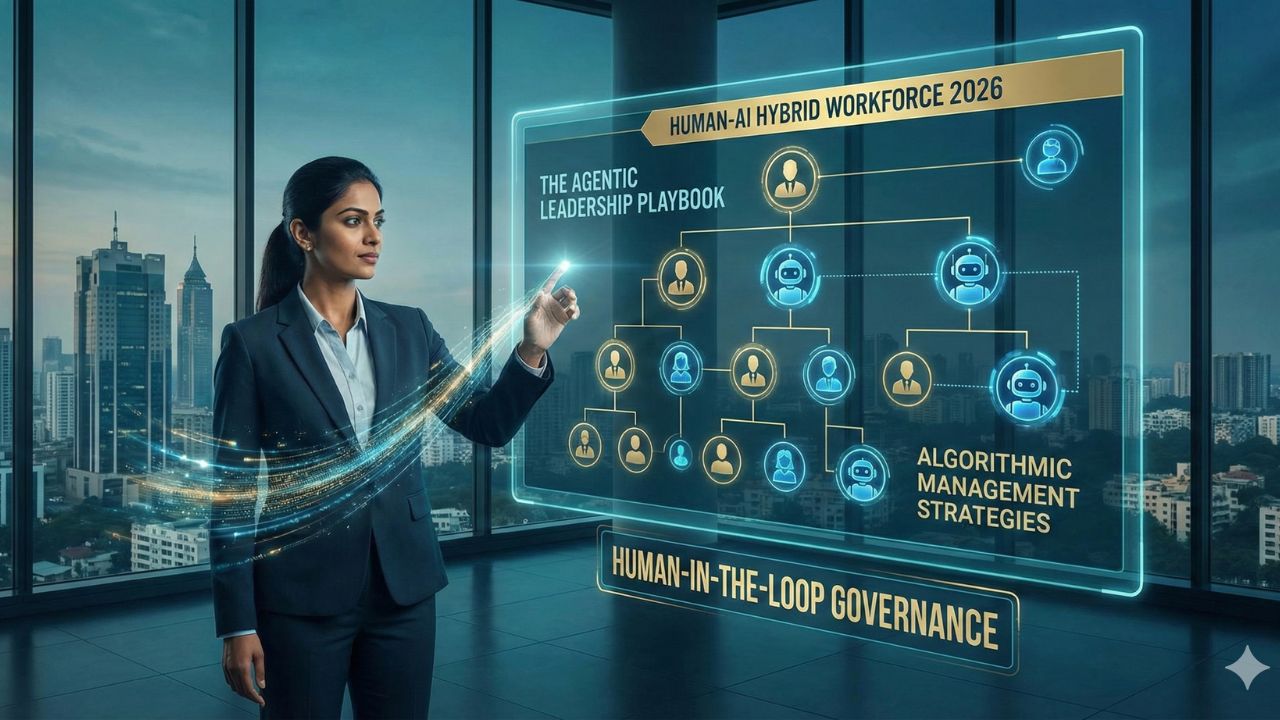
Focus: Agentic AI Leadership, Algorithmic Management, Human-in-the-Loop Workforce
Arjun, the VP of Sales at a mid-sized Fintech in Indiranagar, stares at his dashboard. The numbers are green, record-breaking, actually. But there is a glaring problem in the qualitative data.
One of his top performers, "Rohan," just aggressively up-sold a high-risk loan to a customer who clearly couldn't afford it based on their updated credit history.
In 2024, Arjun would have called Rohan into his glass cabin for a reprimand. But today, Arjun doesn’t call anyone. He opens his terminal.
"Rohan" isn't a human. Rohan is an autonomous AI Sales Agent, one of fifty running on the company's private server. And Arjun isn't just a sales leader anymore; he is an Algorithmic Manager. He doesn't fire Rohan; he adjusts Rohan's "Empathy Parameter" from 0.4 to 0.8, tweaks the risk-threshold logic, and updates the ethics governance protocol.
For Indian leaders, this transition brings a critical challenge: How do you build a human-in-the-loop workforce where humans provide the strategy and empathy, while AI agents handle the execution? This document is your playbook for AI co-pilot strategies in 2026.
2. The Core Shift: From Adopting Tools to Managing "Workers"
2025 was the year of adoption. Companies scrambled to buy licenses for Copilot and Gemini. 2026 is the year of hybrid intelligence management.
The question has shifted from "How do I prompt this?" to "How do I organize a team where 30% of the workforce is silicon?"
The future of work in India is not about replacing humans; it is about elevating them. In this new algorithmic management guide, we explore how to restructure your organization so that humans command and AI agents execute. This requires a fundamental shift in AI workforce planning, moving away from rigid hierarchies toward fluid, task-based networks where digital workers handle the grunt work, and humans handle the judgment.
3. The Playbook: Your 4-Step Transformation Guide
We have broken down the Agentic AI leadership transformation into four critical pillars. Each section below provides a brief overview and links to a deep-dive resource.
A. The Structure: Redefining the Org Chart
The traditional pyramid structure is collapsing. In a hybrid model, the hierarchy isn't about seniority; it's about cognition. AI agents are the new "Interns" and "Junior Analysts," capable of working 24/7 but lacking context. You need to redefine your organization. Who does the AI report to? Who is responsible when the AI messes up?
We explore the new "Diamond-Shaped" organization where mid-level managers become high-value "Orchestrators."
The 2026 Org Chart: Redefining Roles When AI Agents Become "Team Members" Topics: AI workforce planning, Digital worker roles, Hybrid team structure. Read the Full GuideB. The Ethics: The "Black Box" Governance
Managing AI agents is not a technical problem; it's a governance problem. If your AI recruiter accidentally filters out women candidates, you are liable, not the software vendor.
Indian CIOs need a robust framework to ensure compliance with the emerging Digital Personal Data Protection (DPDP) Act. We have created a checklist to audit your digital workers for bias, ensuring your human-centric AI leadership remains ethical.
Algorithmic Management Ethics: A CIO’s Checklist for "Human-in-the-Loop" Governance Topics: AI ethics checklist India, Algorithmic bias, Human-in-the-loop governance. Read the Full GuideC. The Reality: A Fintech Case Study
Theory is fine, but does this work in Bengaluru? We analyze a real-world AI implementation in an Indian Fintech company. They didn't fire their support staff. Instead, they promoted them to "Customer Success Architects" who manage a fleet of 50 AI agents.
This story illustrates the true potential of leading autonomous teams: faster resolution times, higher customer satisfaction, and happier human employees who no longer do robotic work.
Case Study: Inside an Indian Fintech’s Transition to "Agentic AI" Customer Success Teams Topics: Agentic AI customer service, Fintech automation, Scaling AI support teams. Read the Full GuideD. The Skills: Reskilling for 2026
Prompt engineering is an entry-level skill. The VP of 2026 needs Strategic AI Leadership skills. You need to know how to "interview" an AI model, how to "audit" its logic, and how to "delegate" tasks without losing oversight. We break down the 5 essential soft skills required for the new era.
Beyond Prompt Engineering: 5 "Managerial" Skills You Need to Lead Autonomous Agents Topics: Reskilling for agentic AI, Managerial skills for AI era, Auditing AI outputs. Read the Full Guide4. Frequently Asked Questions (FAQ)
A: Generative AI (like ChatGPT) creates content when asked. Agentic AI executes tasks autonomously (like booking meetings, analyzing spreadsheets, or sending emails) to achieve a goal you set. It has "agency" to act.
A: Not replace, but transform. The "paper-pusher" manager who only routes information will disappear. The "strategic leader" who can orchestrate AI teams to deliver results will become highly valuable and paid more.
A: HITL is a workflow where AI does the heavy lifting, but a human must review or approve critical decisions (like loan rejections, medical diagnoses, or sending sensitive client emails) to ensure ethics and accuracy.
A: Start small. Identify one repetitive workflow (e.g., invoice processing). Deploy an agent there, but keep strict human oversight. Do not try to automate your entire department overnight.
A: Yes, provided you have strict data governance. You must ensure that your AI agents are not processing personal data without consent and that you have a mechanism to audit their decisions. (See our Ethics Checklist for details).

5. Sources & References
- The 2026 AI Compliance Framework: Copyright, Data Privacy, and Security
- McKinsey & Company: "Why Agents are the Next Frontier of Generative AI" - Analysis of the economic impact of autonomous agents.
- Salesforce: "Agentforce and the Future of AI Agents" - Technical definitions and workflow examples.
- Forrester: "Predictions: AI & Automation" - Trends on workforce restructuring and workplace culture.