Beyond Prompt Engineering: 5 "Managerial" Skills You Need to Lead Autonomous Agents
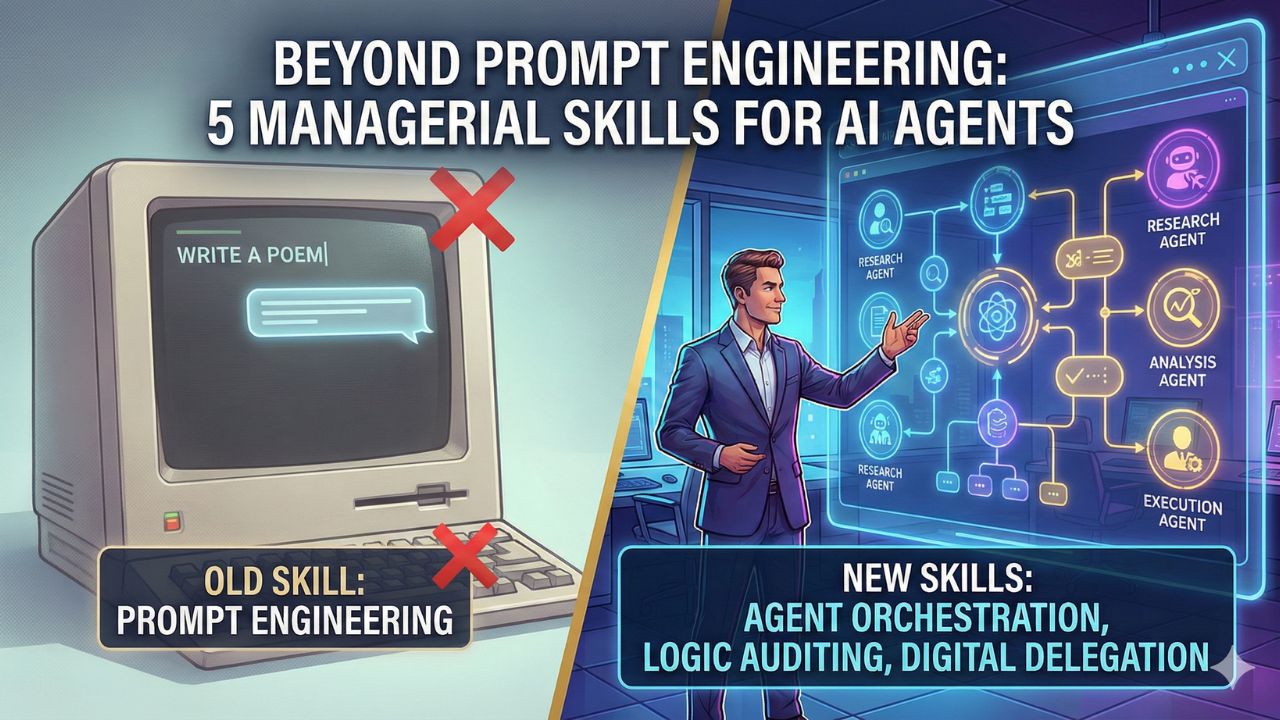
In 2023, the hottest skill on LinkedIn was "Prompt Engineering" - the art of writing the perfect sentence to get a chatbot to write a poem or a python script. By 2026, that skill will be as basic as typing.
As we shift toward Agentic AI, the paradigm is changing. You will no longer sit in front of a chat box asking an AI to write for you. You will sit in front of a dashboard assigning goals to autonomous agents who will go off, use tools, browse the web, and execute tasks without your constant supervision.
This shift creates a massive skill gap. The managers who thrive in the next decade won't be the ones who can write the best prompts; they will be the ones with the best managerial skills for the AI era.
Here are the 5 critical skills you need to master to future-proof career skills in India and lead the hybrid workforce of tomorrow.
Skill 1: Agent Orchestration (Workflow Architecture)
- The Old Skill: Knowing how to ask ChatGPT to "Write a sales email".
- The New Skill: Designing a workflow where Agent A finds the lead, Agent B researches them, and Agent C writes the email.
Agent orchestration skills are about systems thinking. You are no longer an individual contributor; you are an architect. You need to visualize a business process, like "Invoice Processing", break it down into atomic steps, and assign those steps to specific AI agents based on their capabilities.
Skill 2: Logic Auditing (Critical Thinking)
- The Old Skill: Fact-checking an AI's text output.
- The New Skill: Evaluating AI decision-making and troubleshooting its logic.
When an autonomous agent makes a decision, for example, approving a loan of ₹5 Lakhs or denying a refund, it follows a chain of reasoning. If it makes a mistake, you cannot just say "Try again." You must act like a detective. You need to look at the agent's "Thought Trace" (logs) to understand why it made that decision.
The "Reskilling for Agentic AI" Challenge: Moving from "editing text" to "debugging logic".
Skill 3: The Art of "Digital Delegation"
- The Old Skill: Doing the work yourself because "it's faster".
- The New Skill: Knowing exactly what to give to the AI and what to keep for humans.
AI delegating skills are harder than they look. If you give an agent a vague goal like "Increase sales," it might hallucinate or spam your customers. If you give it too much restriction, it becomes useless.
Effective leaders must identify tasks that are high-volume/low-risk for agents, while jealously guarding high-empathy/high-risk tasks for humans. This is the core of leading AI teams training.
Skill 4: "Digital" Emotional Intelligence (EQ)
- The Old Skill: Managing human conflict.
- The New Skill: Managing the brand impact of robotic interactions.
An AI agent never gets tired, but it also never "reads the room". It might send a payment reminder to a customer whose business just burned down.
Soft skills for AI leadership involve being the "Human-in-the-Loop" who instills empathy into the system. You must define the "Tone of Voice" guidelines and set up "Sentiment Guardrails" so the agent knows when to shut up and escalate the ticket to a human.
Context: This is crucial for AI literacy for managers in India, where cultural context and relationship-building are vital for business.
Skill 5: Algorithmic Accountability & Ethics
- The Old Skill: Following compliance rules.
- The New Skill: Auditing AI outputs for bias and hallucination.
If your AI agent denies insurance claims for a specific demographic 10% more often than others, you are responsible, not the software provider. Managers must develop a "Trust but Verify" mindset. This involves setting up regular spot-checks and stress-testing your agents against "Red Team" scenarios (deliberately trying to trick the agent) to ensure they remain compliant with Indian data privacy laws and company ethics.
Conclusion: The "Blue Collar" to "White Collar" Shift for AI
We are witnessing a profound shift in the upskilling of the Indian workforce for 2026.
- Phase 1 (2023): AI as a Tool (like a Calculator). Skill = Operation.
- Phase 2 (2026): AI as a Coworker (like an Intern). Skill = Management.
To survive this transition, stop focusing on "Prompt Engineering" cheatsheets. Start focusing on your ability to think clearly, structure work logically, and manage outcomes. The AI can do the work; only you can provide the wisdom.

Frequently Asked Questions (FAQ)
A: It is becoming a basic skill like typing. The new focus is on agent orchestration and logic auditing.
A: It is the ability to design workflows where multiple AI agents collaborate to complete complex business processes, moving beyond simple one-off prompts.
A: No, but they need "Logic Auditing" skills to understand why an AI made a decision and how to fix its reasoning without necessarily writing code.
Sources & References
- NITI Aayog (2025): "Roadmap for Job Creation in the AI Economy" – Defining the reskilling needs for India's 9 million tech workers.
- Harvard Business Review via Digital Journal: "AI agents are coming. Are you ready to lead them?" – Concepts of Agentic Leadership.
- Forbes (2025): "Six Emerging Leadership Shifts for 2026" – AI fluency and delegation skills.
- Academy of Management Annals: "Managing with Artificial Intelligence" – Frameworks for human-AI collaboration.
Next Step
Are your managers ready for this shift? Assess your team's readiness for the Agentic Era.
Download Readiness Checklist