The 2026 Org Chart: Redefining Roles When AI Agents Become "Team Members"
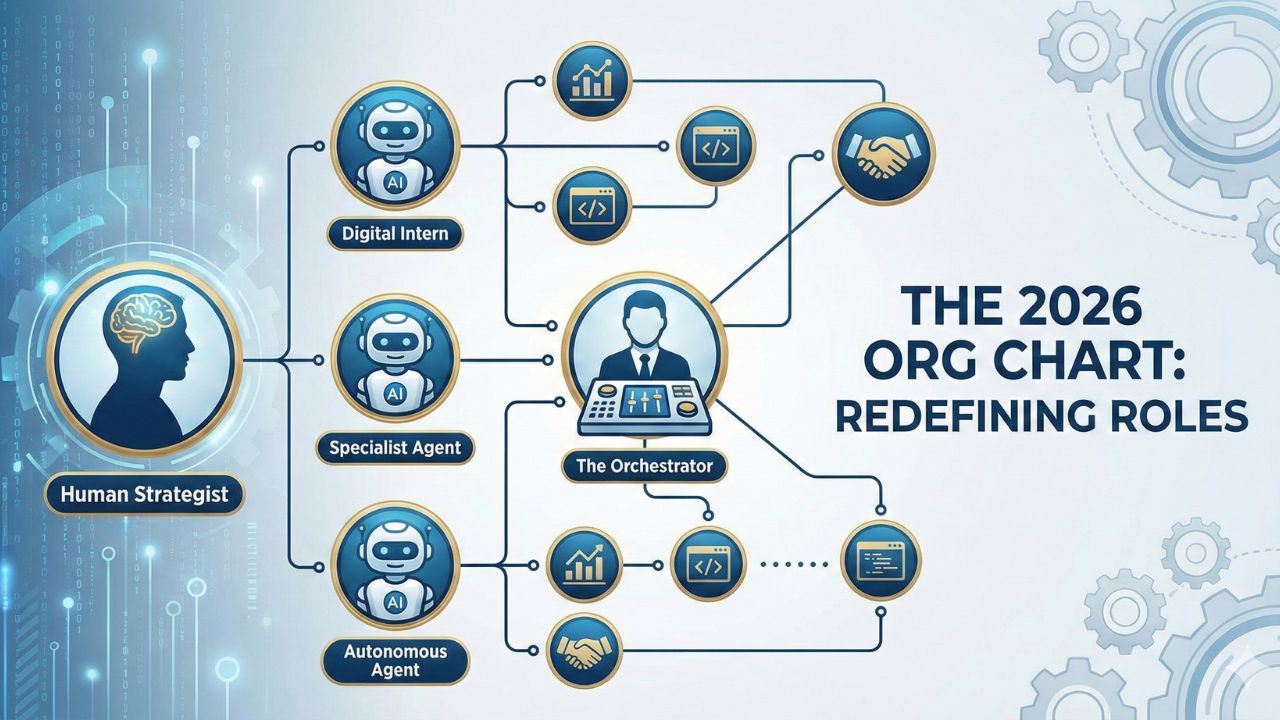
Target Audience: HR Leaders, COOs, and Team Managers
In 2024, you bought software licenses. In 2026, you are "hiring" software.
This is the fundamental shift in AI workforce planning. When an AI agent can autonomously research a market, draft a report, and email it to a stakeholder, it is no longer just a tool—it is a "Digital Employee."
But where does this digital employee sit in your hierarchy? Does it report to IT? Does it report to the Sales Manager? Who writes its performance review?
If you are still using a traditional pyramid org chart, you are unprepared for the hybrid team structure of 2026. This guide explains how to restructure your teams to integrate digital worker roles effectively.
Back to the Hub: For the strategic overview of managing these teams, read the Agentic Leadership Playbook. Read the Full Playbook2. The Shape Shift: From Pyramid to Diamond
The traditional corporate hierarchy is a pyramid: a massive base of junior execution staff, a middle layer of management, and a small tip of leadership.
The new workforce architecture 2026 resembles a Diamond:
- The Base (Automated): AI Agents handle the high-volume, repetitive "grunt work" (L1 Support, Data Entry, Basic Coding).
- The Middle (Expanded): The "Human Layer" expands. Junior employees move up to become "Orchestrators" and "Exception Handlers."
- The Top (Strategic): Leaders focus on vision and empathy.
3. Defining the "Digital Workers": What is Their Job Description?
To integrate AI successfully, you must define where AI agents sit in the org chart. Treat them as specific roles, not vague "tech."
Role A: The "Digital Intern" (The Doer)
Capabilities: Data entry, scheduling, summarizing meeting notes, L1 customer support.
Autonomy Level: Low. Needs 100% review.
Reporting Line: Reports to a Junior Human Manager.
Role B: The "Specialist Agent" (The Expert)
Capabilities: Writing Python scripts, drafting legal contracts, analyzing financial variances, initial code reviews.
Autonomy Level: Medium. Can execute tasks but needs "Human-in-the-Loop" for final approval.
Reporting Line: Reports to a Department Head or Subject Matter Expert (SME).
Role C: The "Autonomous Agent" (The Negotiator)
Capabilities: Negotiating vendor pricing (within limits), outbound sales prospecting, dynamic pricing adjustments.
Autonomy Level: High. Operates within pre-set guardrails (e.g., "Do not offer more than 10% discount").
Reporting Line: Reports directly to the P&L Owner.
4. Redefining Human Roles: The "Human-in-the-Loop"
If AI does the execution, what do the humans do? The AI manager job description changes from "supervising people" to "orchestrating outcomes."
1. The "Orchestrator" (Formerly the Manager)
Old Role: Assigning tasks to people and checking if they are done.
New Role: Designing the workflow for 5-10 AI agents. Spot-checking quality. Optimizing the "prompts" and logic flows.
Key Skill: Systems Thinking & Logic Auditing.
2. The "Empath" (Formerly Customer Service/Sales)
Old Role: Answering FAQs and processing orders.
New Role: Handling the emotional escalation. When a customer is angry, the AI hands off to the Empath. When a high-value deal needs a handshake, the Empath steps in.
Key Skill: Emotional Intelligence (EQ) & Negotiation.
3. The "Ethical Auditor" (New Role)
Role: Monitoring autonomous agent supervision models. Ensuring the AI isn't hallucinating, being biased, or breaking compliance laws.
Key Skill: Risk Management & Critical Thinking.
5. Reporting Lines & Supervision Models
How do you structure the reporting lines for AI agents? We recommend the "2-Key Authentication" Model for high-risk industries (Finance, Healthcare).
| Task Risk Level | Supervision Model | Ratio (Human : AI) |
|---|---|---|
| Low Risk (e.g., Scheduling) |
"Post-Action Audit" AI acts instantly. Human reviews a weekly sample. |
1 : 50 |
| Medium Risk (e.g., Drafting Emails) |
"Pre-Send Approval" AI drafts the email. Human must click "Approve" to send. |
1 : 10 |
| High Risk (e.g., Loan Approval) |
"Co-Pilot Mode" Human makes the decision; AI provides the data and paperwork. |
1 : 1 |
6. Actionable Steps for HR Leaders
- Audit Your Roles: Identify which current job descriptions are 80% "execution" and mark them for AI augmentation (not necessarily replacement, but restructuring).
- Create "Digital IDs": Give your AI agents specific identities in your workflow system (e.g., "Support-Bot-01"). This allows you to track their performance metrics just like human employees.
- Update "Span of Control": A single human manager can effectively supervise 3-5 humans. But they can supervise 20+ AI agents if the reporting dashboards are good. Adjust your ratio of humans to AI agents accordingly.
7. Frequently Asked Questions (FAQ)
A: Yes, functionally. They should be visualized in workflow diagrams so everyone knows who is responsible for a task. However, they obviously do not have payroll or benefits.
A: The "Human-in-the-Loop" who supervises that agent is responsible. If the error is systemic, the "Orchestrator" (Manager) is responsible. Accountability always rests with a human.
A: It leads to role consolidation. Instead of hiring 10 junior analysts, you might hire 2 Senior Analysts who manage a fleet of AI tools. The entry-level role is the most at risk, meaning companies must invest heavily in integrating AI employees with upskilling programs.

8. Sources & References
Next Step
Now that you have the structure, how do you ensure these agents are behaving ethically?
Read the Ethics Checklist