Algorithmic Management Ethics: A CIO’s Checklist for "Human-in-the-Loop" Governance
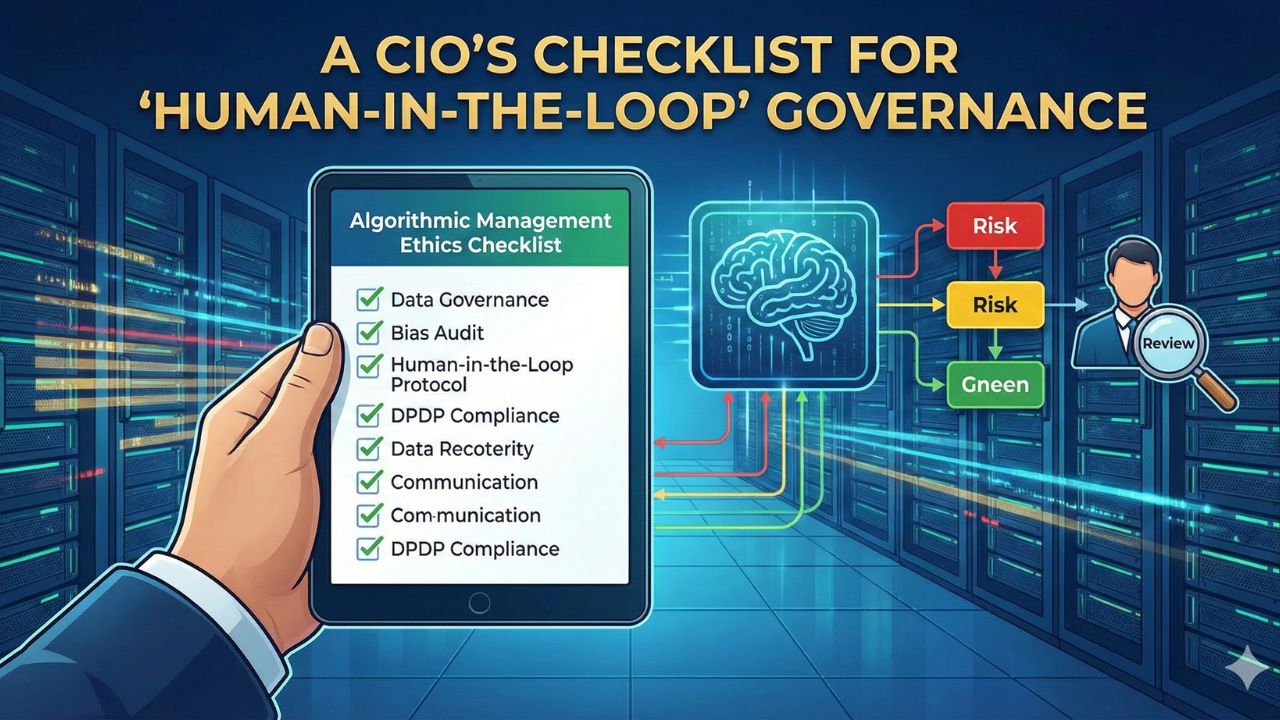
Target Audience: CIOs, CROs (Chief Risk Officers), and Legal Heads in India
In traditional management, if a human manager discriminates against a job applicant, you fire the manager. In Agentic AI management, if your autonomous hiring agent discriminates against 5,000 applicants because of a biased dataset, you don’t just have a personnel issue—you have a class-action lawsuit and a violation of India’s Digital Personal Data Protection (DPDP) Act.
As we shift to 2026, managing AI risks in decision-making is no longer optional. It is the primary responsibility of the Indian CIO.
This guide provides a practical, printable framework for human-in-the-loop governance. It ensures your digital workers operate with the same ethical standards as your human ones.
Back to the Hub: To see how these ethical agents fit into your team structure, read the Org Chart Guide. Read the Org Chart Guide2. The Core Principle: "Human-in-the-Loop" (HITL)
Human-in-the-Loop (HITL) is a governance protocol where AI models cannot finalize high-stakes decisions without human review.
When is HITL Mandatory?
Not every task needs a human. Use this "Traffic Light" system to decide:
- Red Zone (Mandatory HITL): Decisions affecting life, livelihood, or liberty.
Examples: Loan rejections, hiring/firing recommendations, medical diagnosis, insurance claim denials. - Yellow Zone (Audit Required): Decisions affecting customer experience or minor financial allocations.
Examples: Dynamic pricing, marketing segmentation, L1 support responses. - Green Zone (Fully Autonomous): Low-risk, reversible operational tasks.
Examples: Scheduling meetings, data entry, summarizing emails.
3. The CIO’s Checklist for 2026
Indian executives can use this algorithmic accountability checklist before deploying any Agentic AI workflow.
Phase 1: Data & Input Governance
Phase 2: The "Decision Logic" Audit
Phase 3: The Human Handoff Protocol
4. Specific Use Cases: Algorithmic Bias in HR & Finance
Case A: Algorithmic Bias in HR (Hiring Agents)
The Risk: An AI agent trained on 10 years of resumes filters out candidates with career gaps (often women returning to work) or candidates from non-premium colleges.
The Fix:
- Blind Resume Processing: Program the agent to ignore names, genders, and locations during the initial screening.
- Outcome Monitoring: Weekly reports comparing the demographic mix of applicants vs. shortlists.
Case B: Lending Bias (Fintech Agents)
The Risk: An agent charges higher interest rates to pincodes associated with lower-income demographics, creating a "digital redlining" effect.
The Fix:
- Proxy Variable Removal: Ensure the model isn't using "Pincode" as a proxy for "Creditworthiness."
- Fairness Metrics: Use metrics like "Demographic Parity" to audit approval rates across different user segments.
5. Governance Structure: The AI Ethics Board
By 2026, mature Indian organizations will establish an internal AI Ethics Board.
- Who sits on it? CIO, Head of HR, Chief Legal Officer, and an external Ethics Consultant.
- What do they do? They review "Red Zone" AI deployments. No high-risk agent goes live without their sign-off.
- Frequency: Quarterly audits of all live AI agents.
6. Frequently Asked Questions (FAQ)
A: Yes. If you are processing the data of Indian citizens, you (the Data Fiduciary) are responsible for compliance, regardless of where the AI model (Data Processor) is hosted.
A: Maintain a "Model Card" for every agent. This document lists: Who built it, what data was used, its intended purpose, its known limitations, and the date of its last bias audit.
A: Absolutely. Under Indian law, the legal entity deploying the technology holds liability. "The algorithm did it" is not a valid legal defense.

7. Sources & References
- The 2026 AI Compliance Framework: Copyright, Data Privacy, and Security
- Reserve Bank of India (RBI): "Regulatory Framework for Digital Lending" – Guidelines on algorithmic lending.
- NASSCOM: "Responsible AI for India" – Frameworks for ethical AI adoption in Indian IT.
- IBM Policy Lab: "Precision Regulation for Artificial Intelligence" – Concepts on risk-based regulation (Red/Yellow/Green zones).
- Harvard Business Review: "A Leader’s Guide to AI Ethics" – Best practices for creating AI ethics boards.