Case Study: Inside an Indian Fintech’s Transition to "Agentic AI" Customer Success Teams
Target Audience: Fintech Leaders, Customer Success Managers, and AI Implementation Teams
In the high-stakes world of Indian fintech, customer support can make or break a brand. This case study moves beyond theoretical discussions to document the real-world shift from traditional support centers to Agentic AI customer service.
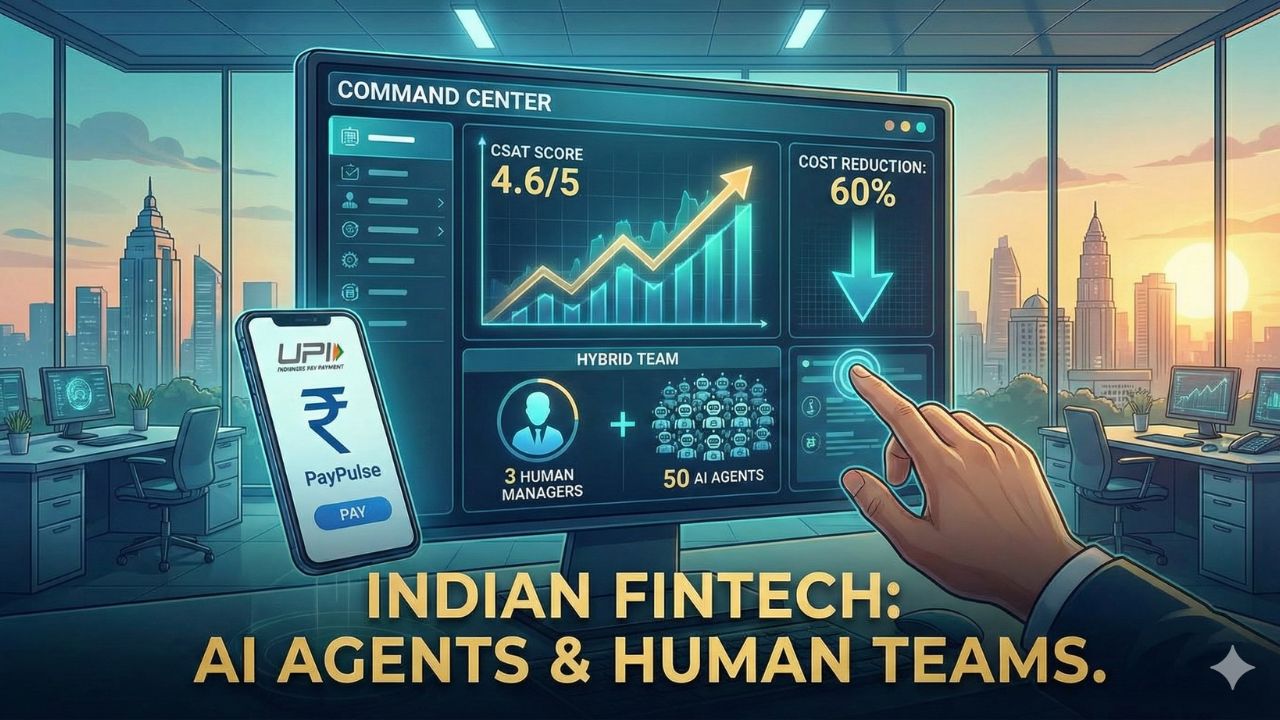
We follow "Rohan," a Customer Success Manager at a rapidly scaling Bangalore-based payment gateway, who now manages a hybrid workforce. By transitioning from a team of 20 humans to a squad of 3 humans and 50 autonomous AI agents, his department reduced support costs by 60% while hitting record-high CSAT scores. This is how they did it.
Back to the Hub: For the strategic overview of managing these teams, read the Agentic Leadership Playbook. Read the Full PlaybookThe Problem: The "Burnout" Bottleneck
Two years ago, the customer support floor at PayPulse (pseudonym for privacy) was a place of high decibels and higher stress.
- Ticket Volume: 15,000+ per week.
- Primary Issues: Failed UPI transactions, KYC delays, and merchant settlement disputes.
- The Team: 20 human agents, overwhelmed by repetitive queries.
- The Result: High churn among staff and a CSAT score stuck at a mediocre 3.8/5.
The leadership team realized that traditional chatbots—which merely spat out FAQ links—were insufficient. They needed AI agents in Indian banking contexts that could actually do things: verify documents, reverse transactions within limits, and navigate the app UI. They needed Agentic AI.
A Day in the Life: Managing the Hybrid Workforce
09:00 AM: The "Silent" Stand-up
Rohan starts his day not by checking emails, but by opening his "Agent Command Center." Unlike managing humans, managing AI support staff requires monitoring "health," not morale. His dashboard shows that his 50 AI agents (built on a custom LLM architecture) have been working through the night.
- Overnight resolution rate: 92%.
- Escalation queue: 14 tickets waiting for human review.
11:00 AM: The UPI Surge
It is the start of the "Big Billion Days" sale. Traffic spikes. In the old days, this was "all hands on deck." Today, Rohan sips his coffee.
As ticket volume triples, the AI implementation case study comes to life. The system automatically spins up 20 additional instances of "Agent Veda" (the Tier-1 support bot).
- Agent Action: The AI detects a pattern of failed transactions from a specific bank API.
- Agentic Decision: Instead of answering every user individually, the Agent proactively drafts a status banner for the app and asks Rohan for one-click approval to publish it.
- Outcome: 4,000 potential tickets deflected instantly.
02:00 PM: The Human-Agent Handoff
This is where the human-agent handoff examples become critical. An AI agent is stuck. A merchant is furious about a frozen settlement of ₹50 Lakhs. The sentiment analysis detects hostility.
- The Trigger: The Agent recognizes the complexity exceeds its ₹50k autonomy limit.
- The Summary: The Agent drafts a concise "context note" for the human: “Merchant angry due to T+2 delay. KYC re-verification triggered erroneously. I have paused the KYC check. Please intervene.”
- The Human Action: One of Rohan's 3 senior human specialists steps in. Because the AI did the investigative grunt work, the human spends their time solely on empathy and complex problem-solving.
04:00 PM: Training the "New Hires"
Rohan spends his afternoon doing fintech workflow automation reviews. He looks at the 8% of tickets the AI failed to resolve.
He doesn't write code; he writes instructions. He highlights a conversation where the AI was too robotic regarding a fraud alert. He updates the "Tone of Voice" guidelines in the system prompt to be more reassuring. This is the new face of Agentic AI use cases in India—continuous teaching rather than continuous coding.
The Results: By the Numbers
Implementing real-world AI agent implementation strategies yielded the following metrics over 6 months:
| Metric | Pre-AI Era (Humans Only) | Agentic AI Era (Hybrid) | Impact |
|---|---|---|---|
| Avg Response Time | 4 Hours | 12 Seconds | Instant Resolution |
| Cost Per Ticket | ₹120 | ₹8 | 93% Reduction |
| Resolution Rate | 70% First Touch | 85% First Touch | Higher Efficiency |
| CSAT Score | 3.8 / 5.0 | 4.6 / 5.0 | Improved Trust |
| Staff Churn | 40% Annually | 5% Annually | Happier Humans |
Key Takeaways for Indian Fintechs
- Don't Replace, Elevate: Reducing support costs with AI in India isn't just about firing staff. It’s about moving humans to high-value "Tier 3" support while AI handles Tiers 1 and 2.
- Cultural Context Matters: The AI was trained specifically on "Hinglish" (Hindi-English blend) nuances common in Indian chat support, drastically improving AI-driven customer experience in India.
- The "Agentic" Difference: Standard chatbots read text; Agentic AI takes action. Granting the AI read/write access to the backend (with strict guardrails) was the key to fintech customer success automation.
Conclusion
The transition at PayPulse proves that the future of customer success isn't human or AI—it is human plus AI. By embracing Agentic AI, Indian fintechs can finally solve the impossible equation: scaling personalized service to millions of users without bankrupting the company.
Rohan’s team is smaller now, but they are no longer putting out fires. They are building fireproof systems.

Frequently Asked Questions (FAQ)
A: In this case study, the Indian Fintech 'PayPulse' reduced their cost per ticket by 93%, dropping from ₹120 to ₹8, and reduced overall support costs by roughly 60%.
A: Standard chatbots primarily read text and provide links. Agentic AI takes action; it can verify documents, reverse transactions within limits, and navigate app interfaces autonomously.
A: No, it elevates them. The goal is to move humans to high-value 'Tier 3' support (empathy and complex problem solving) while AI handles high-volume Tier 1 and 2 queries.
Sources & References
Next Step
Ready to build your own Agentic team? Download our ethics checklist to ensure your AI agents operate safely.
Read the Ethics Checklist