Top 7 AI Project Management Tools for Indian GCCs (2026)
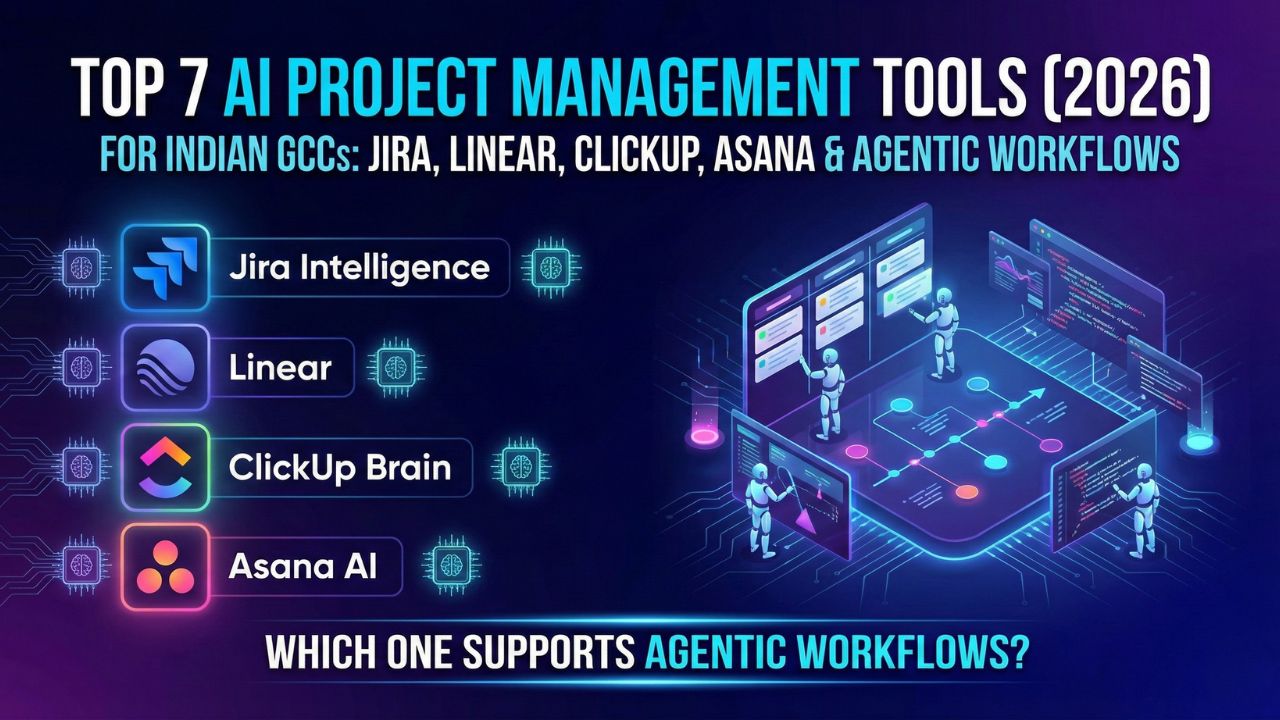
By 2026, every project management tool has a "Chat with AI" button. Most of them are useless.
For an Indian GCC managing 5,000+ developers, having a chatbot that can "summarize a ticket" is a parlor trick. It saves 30 seconds. What you need is Agentic AI, tools that can autonomously plan sprints, assign tasks based on developer availability, and predict delivery slippages before they happen.
We tested the top contenders in the market to answer one question: Which tool allows an AI Orchestrator to actually run a fleet of digital agents?
Back to Hub: The Agentic Agile Project Office Explore all guides, tools, and strategies for the future of delivery.1. Jira Intelligence + Atlassian Rovo (The Enterprise Heavyweight)
Best For: Large-scale GCCs requiring strict compliance and deep integration.
Jira is no longer just a ticketing system; with the launch of Rovo, it has become a knowledge graph.
The Agentic Edge
In 2026, Jira Agents don't just "suggest" assignees. They analyze the git commit history of every developer in your GCC hub to automatically route bugs to the person who wrote the code 6 months ago.
Jira Intelligence vs Linear for Enterprise Agile: While Linear wins on speed (see below), Jira wins on governance. Its "AI Guardrails" feature allows you to prevent agents from moving tickets to "Done" without meeting specific compliance criteria (e.g., Security Scan Passed).
Pricing in India: Atlassian has aggressive enterprise tiering for India, often bundling Rovo for GCCs with >1,000 seats.
2. Linear (The Developer's Cult Favorite)
Best For: High-velocity product teams and "skunkworks" innovation units.
If Jira is a factory, Linear is a Formula 1 car. It is the preferred tool for startups, but increasingly, GCC innovation hubs are adopting it to escape "Jira Fatigue."
The Agentic Edge
Linear’s "Triage Agents" are best-in-class. They autonomously read incoming bug reports, deduplicate them against existing tickets, and even draft a reproduction script for the engineer.
Why it matters: It reduces the "Noise to Signal" ratio for developers by roughly 40%.
3. ClickUp Brain (The "All-in-One" Knowledge Hub)
Best For: Mixed teams (Engineering + Marketing + HR) working in a single hub.
ClickUp Brain connects tasks, docs, and people. It excels at "Context Retrieval."
The Agentic Edge
"AI Project Manager" is a feature that creates sub-tasks automatically. If you create a task "Launch Mobile App v2.0," ClickUp Brain will autonomously generate the 45 sub-tasks required (QA, UAT, App Store Submission) based on your previous launch history.
ClickUp Brain vs Asana AI Features Review: ClickUp is more aggressive in generating content (writing the PRD for you), whereas Asana focuses on routing the work.
4. Asana Intelligence (The Workflow Architect)
Best For: Strategic Portfolio Management and Cross-Functional orchestration.
Asana’s "Smart Status" is a lifesaver for managers who hate writing reports.
The Agentic Edge
"Smart Rules" allow you to build complex "If-This-Then-That" agentic flows without code.
Example: "If the Risk Score on Project A goes above 'High', autonomously schedule a meeting between the Project Lead and the Risk Officer and draft the agenda based on the flagged risks."
5. Microsoft Azure DevOps + Copilot (The Default Choice)
Best For: GCCs deeply embedded in the Microsoft ecosystem.
You cannot talk about Indian IT without mentioning Microsoft. Azure Boards integrated with GitHub Copilot creates a seamless "Code-to-Customer" agentic loop.
The Agentic Edge
The integration is deep. An agent can fail a build in Azure Pipelines, open a bug in Azure Boards, and suggest the code fix in GitHub Copilot simultaneously.
6. Height.app (The "Autonomous" Wildcard)
Best For: Teams who want to automate the entire project management layer.
Height is built on the premise: "What if the project manager was software?"
The Agentic Edge
Height autonomously detects scope creep. If a conversation in the comments section implies new requirements, Height’s agent will interrupt and ask: "This sounds like a new feature. Should I create a new Epic or update the current specs?"
7. Tara.ai (The Engineering Intelligence Platform)
Best For: Engineering Directors who need visibility into "True Effort."
Tara focuses on Predictive Analytics.
The Agentic Edge
Instead of asking devs "How long will this take?", Tara analyzes the codebase complexity and historical velocity to predict the timeline. It acts as an unbiased estimator, often more accurate than human story points (See: Why Story Points are Dead).
Comparison: Choosing the Right Tool for Your GCC
| Feature | Jira Intelligence | Linear | ClickUp Brain | Asana AI |
|---|---|---|---|---|
| Primary Strength | Governance & Scale | Speed & UX | Unified Knowledge | Strategic Workflows |
| Agent Autonomy | Medium (Requires Config) | High (Out of Box) | High (Content Gen) | Medium (Routing) |
| Best For | Traditional GCCs | R&D Labs | Shared Services | PMO Leaders |
| Learning Curve | Steep | Zero | Moderate | Moderate |
FAQ: AI Project Management in 2026
A: Yes. Enterprise tiers (Jira Enterprise, Azure DevOps) offer "Zero Data Retention" guarantees, ensuring your data is not used to train public LLMs. This is a non-negotiable requirement for compliance in Banking and Insurance GCCs.
A: Yes. Tools like Unito or Synced allow "Two-Way Sync." Your innovation team in Bangalore can run on Linear for speed, while the data syncs back to Jira for HQ reporting.
A: ClickUp and Jira are tied here because of their strong time-tracking and documentation features, which are critical for async collaboration (See: Case Study on Async Agile).

Sources & References
- Gartner Magic Quadrant (2025): "Enterprise Agile Planning Tools" – Highlights the rise of AI-driven portfolio management.
- Forrester Wave: "Collaborative Work Management Tools, Q4 2025" – Ranks Asana and ClickUp as leaders in AI workflow automation.
- Atlassian "State of Teams" Report: Data on how Rovo is reducing search time by 20% in large enterprises.
- Linear Blog: "The End of the Ticket" – A manifesto on how autonomous agents will replace manual ticket creation.