How an Indian Fintech Scaled Agile with Agents (and Killed the "Timezone Tax")
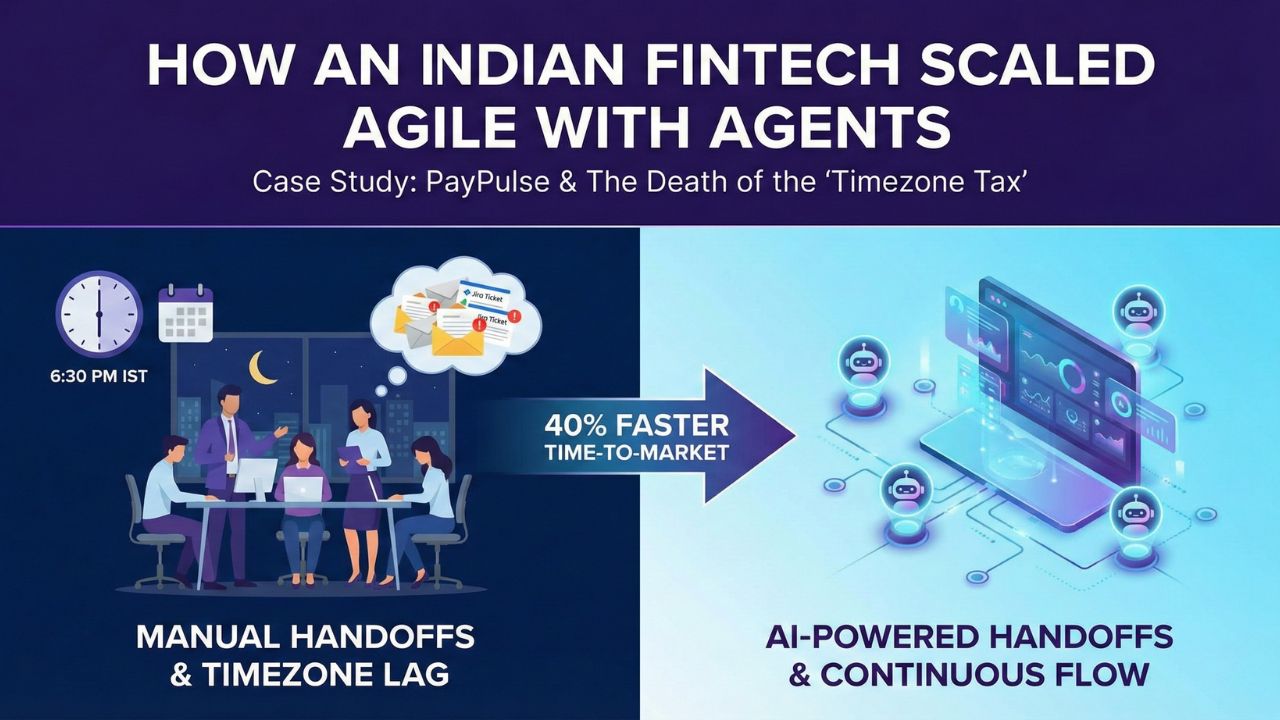
Global Capability Centers (GCCs) in India have long battled the "Timezone Tax" - the inevitable delay caused by the 13.5-hour gap between Bangalore and New York. When the Indian team finishes, the US team is just waking up. Traditionally, this meant work stalled for 12+ hours every day.
This case study examines "PayPulse" (a pseudonym for a Bangalore-based payments unicorn), which deployed an Agentic Agile model in late 2025. By replacing human status meetings with AI Agents that manage handovers, they achieved a 40% reduction in Time-to-Market and enabled a true 24/7 delivery cycle.
Back to Hub: The Agentic Agile Project Office Explore all guides, tools, and strategies for the future of delivery.1. The Challenge: The "Context Leaky Bucket"
Before their transformation, PayPulse operated on a standard Scrum model. Despite having talented engineers in Bangalore and product leads in New York, their velocity was plateauing.
An internal audit revealed the root cause was not code quality, but Context Friction:
- The Handover Gap: Developers in India would leave complex code reviews for US leads at 6:00 PM IST.
- The Context Loss: By the time the US lead opened the Pull Request (PR) at 9:00 AM EST (6:30 PM IST), the Indian developer had logged off. If the US lead had a question, they had to wait another 12 hours for a reply.
- The Cost: A simple bug fix took 3 days (due to ping-pong delays) instead of 3 hours.
— VP of Engineering, PayPulse
2. The Solution: Moving to "Async Agentic Agile"
PayPulse decided against hiring more "middle managers" to bridge the gap. Instead, they redesigned their workflow using AI Orchestrators and Async agile communication tools.
They deployed three specific AI Agents to bridge the ocean.
Agent A: The "Context Sentry" (The Handoff Manager)
This agent solves the "What happened yesterday?" problem. It does not just summarize Jira tickets; it monitors Slack channels, Zoom transcripts, and Git comments.
- Trigger: 6:30 PM IST (End of India Day).
- Action: The agent compiles a "Warm Handoff" Brief for the US Product Manager.
- The Prompt Logic: "Analyze today's commits. Identify any decisions made by the India team that deviate from the original acceptance criteria. Highlight these risks for the US Product Owner immediately."
- Result: The US team starts their day reviewing decisions, not searching for status updates.
Agent B: The "Synthetic QA" (The Night Shift)
Previously, QA happened the next day. Now, when Indian devs push code, a Synthetic User Agent (powered by LLMs) autonomously navigates the staging environment.
- Trigger: On every Pull Request (PR).
- Action: The agent mimics user behavior (e.g., "Log in as a premium user and try to fail a transaction").
- Result: By the time the US team logs on, the "Testing" column is already cleared or flagged with specific logs.
3. The Implementation: Managing Offshore Teams with AI
The transition required a shift in mindset from "Synchronous Meetings" to "Asynchronous Documentation."
Phase 1: The Pilot (Month 1-2)
PayPulse selected one "Squad" (Payments Gateway Team). They mandated that no status meetings could be held between India and the US. All updates had to flow through the AI Dashboard.
Outcome: Initial friction. Developers felt "unheard." The prompt logic for the agents was tuned to be more empathetic and detailed.
Phase 2: The Scale-Up (Month 3-6)
Once the agents achieved an Agent Efficiency Score (AES) of >80 (see Metric Article), the model was rolled out to 15 squads.
Outcome: The "Timezone Tax" effectively vanished. Work continued 24/7.
4. The Results: Quantifiable Impact
After 6 months of running the Agentic Agile model, PayPulse reported the following metrics to their board:
| Metric | Before Agents (2024) | After Agents (2026) | Impact |
|---|---|---|---|
| Time-to-Market | 14 Days | 8.5 Days | 40% Faster |
| Deployment Freq | Bi-weekly | On-Demand (Daily) | Continuous Flow |
| Defect Rejection | 18% | 6% | Quality Up |
| Meeting Load | 12 hrs/week | 2 hrs/week | Focus Time Up |
5. Strategic Takeaways for Indian GCC Leaders
If you are managing an offshore team, here is the playbook to replicate PayPulse’s success:
- Don't Automate Tasks, Automate Decisions: Do not just auto-move Jira tickets. Build an agent that can decide who needs to see the ticket based on the code complexity.
- Invest in "Async" Infrastructure: You cannot have AI agents if your communication is hidden in private WhatsApp chats. Tools like Linear, Loom, and Otter.ai are prerequisites. The AI needs a data stream to "read."
- Redefine the "Scrum Master": The Scrum Master role at PayPulse evolved into an "Agent Architect" who tweaks the prompts for the Handoff Agent to ensure the US team gets the right level of detail.
FAQ: Agents in Offshore Teams
A: Initially, yes. But once they realized the AI saved them from attending 9:00 PM calls with the US team, they embraced it. The AI bought them their evenings back.
A: Yes. The "Context Sentry" concept applies to Marketing and HR shared services just as well as Engineering.
A: PayPulse estimated the compute cost (API tokens) was roughly $50 per developer per month—a fraction of the cost of the "wait time" they eliminated.

Sources & References
- Google Cloud Blog (2025): "Real-world gen AI use cases: 4X improvement in efficiency."
- Endava (2025): "Agile Meets Agentic: The AI Shift in Financial Services."
- NESL-IT (2025): "Tools That Help with Time Zone Management in Offshore Teams."
- Microsoft Cloud Blog (2025): "Reducing time to market by 40% using AI-powered workflows."