The Rise of the "AI Orchestrator": Why the Project Manager Role is Dying (and What Comes Next)
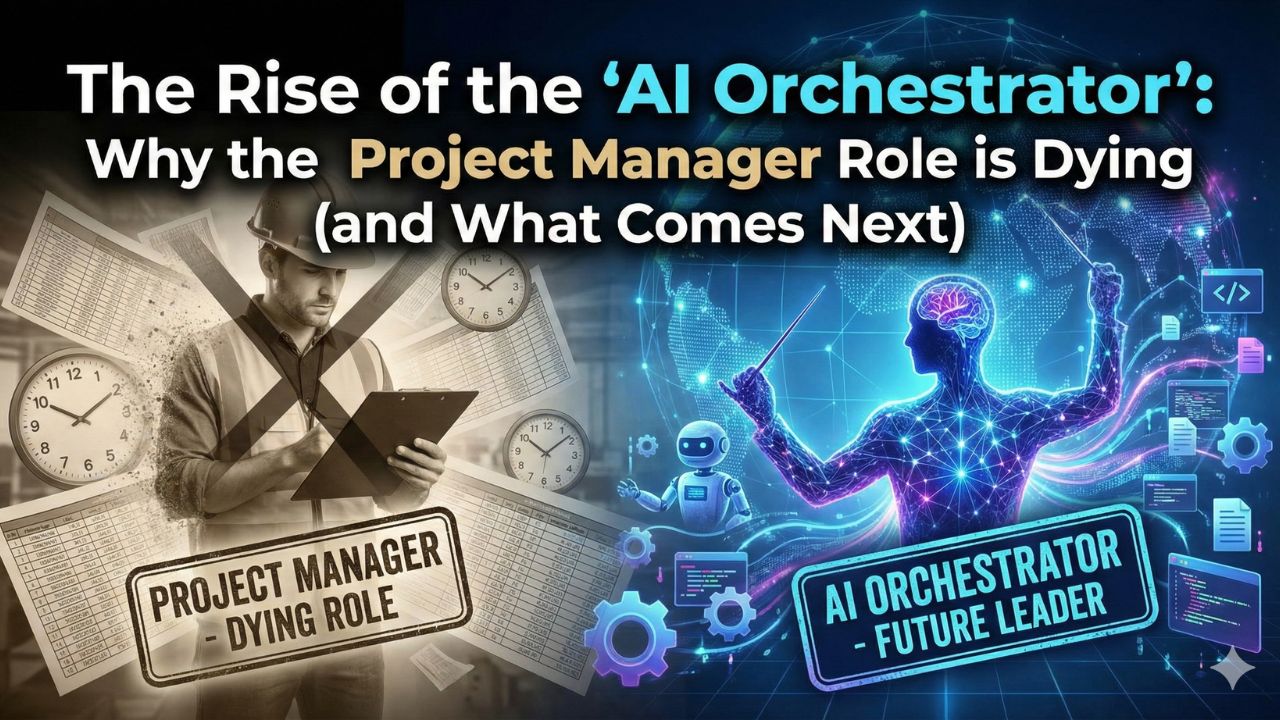
It is 2026. If your primary value as a Project Manager is scheduling meetings, chasing status updates, or manually moving Jira tickets, you are obsolete.
In the Indian GCC ecosystem, a quiet revolution has taken place. The "Project Manager" title is disappearing from job descriptions, replaced by a new, higher-value role: the AI Orchestrator.
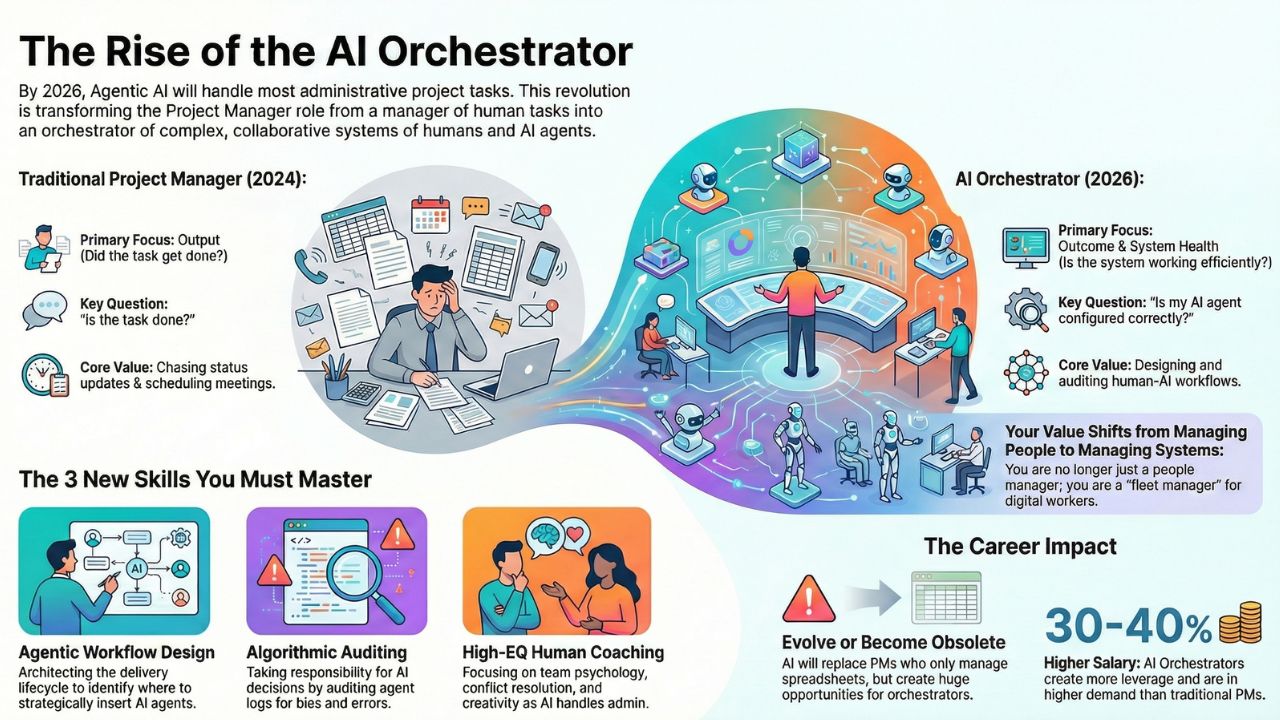
Why? Because Agentic AI now handles the administration. The role of the human leader has shifted from managing tasks to designing systems where humans and digital agents collaborate.
This guide explains the skills you need to survive this transition and why the "AI Orchestrator" will be the highest-paid role in the delivery ecosystem.
Back to Hub: The Agentic Agile Project Office Explore all guides, tools, and strategies for the future of delivery.1. What is an AI Orchestrator?
An AI Orchestrator does not manage people; they manage workflows.
In the old world (2024), a Project Manager asked: "Rohan, is the API integration done?"
In the new world (2026), an AI Orchestrator asks: "Is my 'Code-Review Agent' correctly configured to validate Rohan's code and update the dashboard automatically?"
The Core Difference
- Project Manager: Focuses on Output (Did the task get done?).
- AI Orchestrator: Focuses on Outcome & System Health (Is the team of humans and agents working efficiently?).
2. The 3 New Skills You Need (That PMP Won't Teach You)
To upgrade your career from PM to Orchestrator, you must master three specific domains.
Skill 1: Agentic Workflow Design (Technical)
You don't need to be a coder, but you must be an Architect of Work. You need to visualize the software delivery lifecycle and identify where to insert AI agents.
- The Task: instead of setting up a recurring meeting for "Backlog Refinement," you configure a workflow where an AI Agent pre-reads the requirements and drafts user stories.
- Deep Dive: Unsure how this differs from basic automation? Read our guide: Agentic AI vs. Automation in Agile.
Skill 2: Algorithmic Auditing (Governance)
When an AI agent makes a decision (e.g., "This bug is low priority"), who is responsible if it's wrong? You are.
- The Task: You must regularly "audit" your agents. You need the skills to look at agent logs, identify bias or hallucination, and retune the "temperature" or prompt logic.
- Commercial Angle: This is why "AI Risk Management Certification" is becoming a high-CPC keyword. Companies are terrified of autonomous agents going rogue.
- Learn More: See our Risk Management Guide.
Skill 3: High-EQ Human Coaching (Psychological)
When AI takes over the admin, what is left for the humans? Complex problem solving and creativity.
- The Task: Your human developers will be stressed about AI replacing them. The AI Orchestrator acts as a psychological stabilizer, focusing 100% of their "human time" on coaching, conflict resolution, and career growth for their team.
3. The Tooling Stack: What You Will Use
You are likely familiar with Jira and Excel. The AI Orchestrator uses a different stack. Advertisers for these tools are bidding heavily for your attention right now.
- Orchestration Platforms: Tools like Jira Intelligence, Linear, or Asana AI that allow you to assign tasks to "bots" as if they were users.
- Agent Marketplaces: Platforms (like the GPT Store or internal Enterprise Hubs) where you "hire" specific agents for specific tasks (e.g., "I need a Python Unit Test Agent").
- Observability Dashboards: You won't look at Burn-down charts. You will look at "Agent Efficiency Scores".
View the New Metrics Dashboard to see what these KPIs look like.
4. Career Outlook: Salary & Demand in India
The shift is already visible in Bengaluru and Hyderabad.
- Traditional Project Manager: Salary stagnation. Supply exceeds demand as entry-level PM tasks are automated.
- AI Orchestrator: High demand. This role bridges the gap between Business Strategy and AI Execution.
- Estimated Salary Premium: 30-40% higher than traditional PM roles in GCCs (Source: 2025 Tech Salary Surveys).
Why the Jump? Because an AI Orchestrator creates leverage. A traditional PM manages 10 people. An AI Orchestrator manages 10 people and 50 agents, delivering the output of a 30-person team.
5. How to Start: Your Monday Morning Plan
You cannot become an AI Orchestrator overnight, but you can start shifting your mindset today.
- Audit Your Calendar: Identify every meeting where the sole purpose is "Information Exchange" (Status updates).
- Deploy a Pilot: Use a tool like Otter.ai or Jira Intelligence to automate the summary of that meeting.
- Rename Your Role: On LinkedIn, start highlighting skills like "Workflow Automation," "Human-AI Collaboration," and "System Design."
You get to stop doing the boring work and start designing the machine that builds the future.
Are you ready to build your first agent?
👉 Next Step: From Velocity to "Agent Efficiency" Read about New Agile MetricsThe Manager is Dead, Long Live the Orchestrator
The fear that "AI will replace Project Managers" is partially true. AI will replace the "Project Manager" who only updates spreadsheets.
But for the leader who steps up to become an AI Orchestrator, the future is bright. You get to stop doing the boring work and start designing the machine that builds the future.

Sources & References
- Harvard Business Review (2025): "How AI Will Transform Project Management" – Discusses the shift from administration to strategic orchestration.
- Project Management Institute (PMI): "AI Innovation in Project Management" – Highlights the new "Power Skills" required for PMs in the AI era.
- Gartner: "Market Guide for AI-Enabled Project Management" – Validates the rise of "Orchestrator" functionalities in enterprise software.
- NASSCOM: "Future of Work in Indian GCCs 2026" – Data on salary trends for AI-enabled leadership roles.