Agentic AI vs. Automation in Agile: The 2026 Guide for Indian GCCs
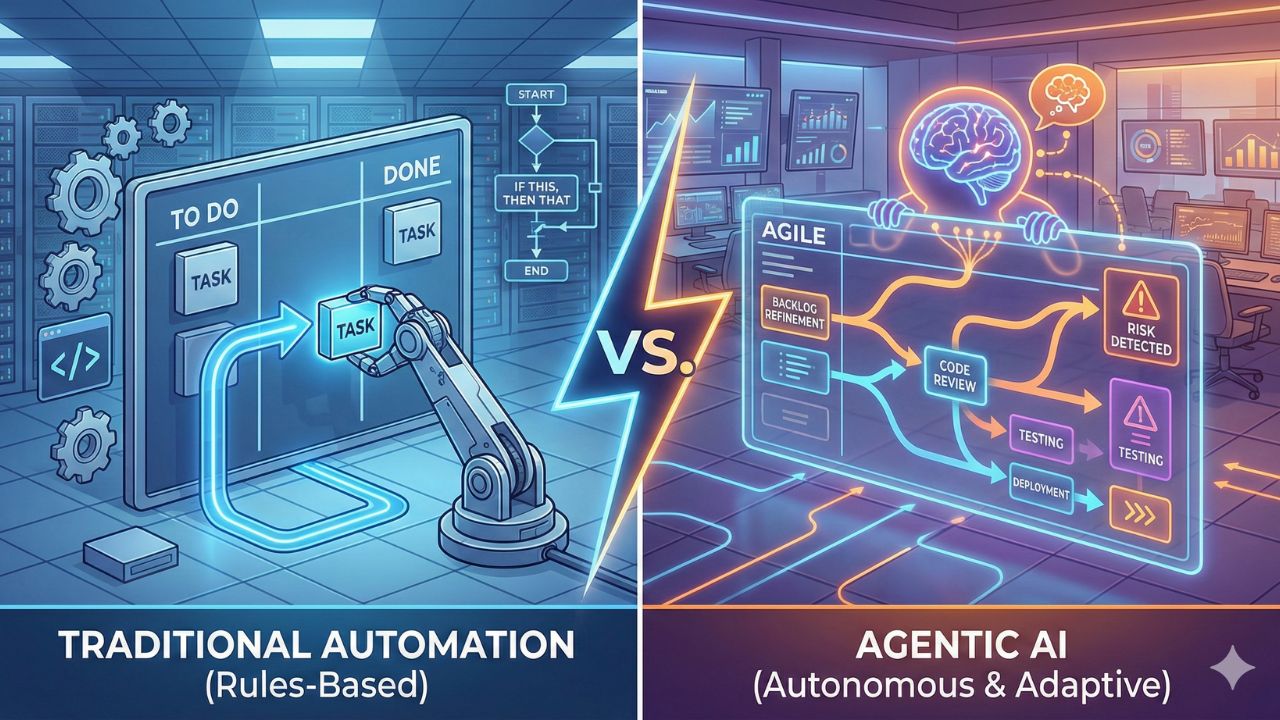
It is a common scenario in Bengaluru's tech parks: A Delivery Head proudly claims their Agile process is "AI-driven" because a Jira automation moves a ticket to "Done" when a GitHub PR is merged. That is not AI. That is just a script.
As we move toward 2026, a fundamental confusion exists in the Indian tech ecosystem between Traditional Automation and Agentic AI. Understanding this difference is not just semantics; it is the difference between saving clicks and saving cognitive load.
This guide dissects the shift from "Doing Agile" with automation to "Orchestrating Agile" with Agentic AI, specifically tailored for the high-scale environment of Indian GCCs.
Back to Hub: The Agentic Agile Project Office Explore all guides, tools, and strategies for the future of delivery.1. The Core Distinction: "If-This-Then-That" vs. "Observe-Think-Act"
To upgrade your Project Office, you must first distinguish between the tool that follows orders and the worker that takes initiative.
Automation (The Old Way)
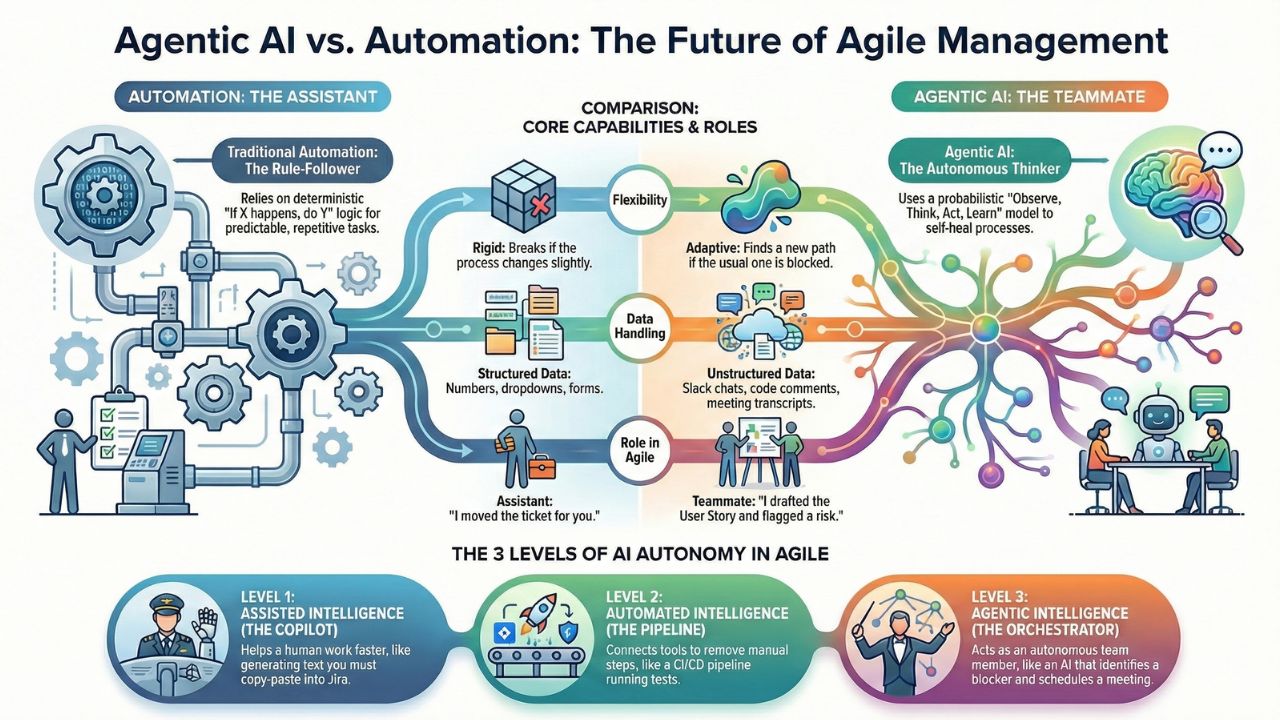
Automation is deterministic. It relies on rigid, pre-defined rules. It is excellent for repetitive, high-volume tasks where the inputs and outputs are predictable.
- The Logic: "If X happens, do Y."
- Example: "If a developer updates the status to 'Testing', send an email to the QA Lead."
- Limitation: If the QA Lead is on leave, the automation fails to adapt. The email sits unread. The process stalls.
Agentic AI (The Future)
Agentic AI is probabilistic and autonomous. It uses Large Language Models (LLMs) to understand context, reason through ambiguity, and make decisions to achieve a broader goal.
- The Logic: "Observe the environment. Analyze the goal. Determine the best path. Execute. Learn."
- Example: "Observe that the ticket moved to 'Testing'. Check the calendar. See the QA Lead is on leave. Analyze the team roster. Identify the backup QA. Assign the ticket to them and post a Slack summary of the specific testing requirements based on the code changes."
- The Value: The process self-heals without human intervention.
2. Comparison Table: Automation vs. Agentic AI
This table is designed to help you decide which technology your GCC needs.
| Feature | Traditional Automation (RPA/Scripts) | Agentic AI (The 2026 Standard) |
|---|---|---|
| Primary Trigger | Explicit manual input or simple event (Status Change). | Contextual awareness (e.g., "Sprint velocity is dropping"). |
| Flexibility | Rigid: Breaks if the process changes slightly. | Adaptive: Figures out a new path if the usual one is blocked. |
| Data Handling | Structured Data only (Numbers, Dropdowns). | Unstructured Data (Slack chats, Zoom transcripts, Code comments). |
| Learning | Static: Does not improve over time. | Dynamic: Learns from feedback (e.g., "Don't assign high-priority bugs to Junior Devs"). |
| Role in Agile | Assistant: "I moved the ticket for you." | Teammate: "I drafted the User Story and flagged a dependency risk." |
| Typical Tool | Jira Automation, Zapier (Standard). | Jira Intelligence, Devin, AutoGen, Microsoft Copilot Agents. |
3. The 3 Levels of AI Autonomy in Agile Projects
Just as self-driving cars have levels of autonomy, so does your Agile Project Office. Most Indian GCCs are currently stuck at Level 1.
Level 1: Assisted Intelligence (The Copilot)
What it does: Helps a human work faster.
Example: You ask ChatGPT to "Write a user story for a login page." It generates text, but you must copy-paste it into Jira.
Status: Commodity. Every junior developer has this.
Level 2: Automated Intelligence (The Pipeline)
What it does: Connects tools to remove manual handoffs.
Example: CI/CD pipelines that automatically run tests and deploy code when a commit is made.
Status: Standard Practice in mature Agile teams.
Level 3: Agentic Intelligence (The Orchestrator)
What it does: Acts as an autonomous team member with a specific role.
Example: An "AI Scrum Master" agent that joins the daily standup (via listening to the Zoom audio), updates the board in real-time, identifies a blocker mentioned by a developer, and autonomously schedules a follow-up meeting with the relevant architect to resolve it.
Status: Emerging Competitive Advantage.
4. Real-World Use Cases: Transforming the Daily Grind
How does this difference play out in the actual ceremonies of Scrum?
Use Case 1: Backlog Refinement
- Automation: Can auto-assign a "Priority" label based on keywords in the title.
- Agentic AI: Reads the 50-page Product Requirements Document (PRD). It breaks the PRD down into 20 distinct User Stories. It checks the codebase to see which stories require API changes. It flags a contradiction between the PRD and the existing database schema.
- Result: The Product Owner skips the 3-hour "writing" session and moves straight to "reviewing."
Use Case 2: Sprint Planning & Capacity
- Automation: Calculates capacity by subtracting holidays from total hours.
- Agentic AI: Analyzes the past 6 sprints. It notices that "Developer A" always underestimates complex API tasks by 30%. It proactively suggests increasing the story points for a specific ticket assigned to Developer A, citing historical data.
- Result: A realistic Sprint Goal that the team actually hits.
5. The Business Case: Why Indian GCCs Are Switching
For leaders in India, the shift to Agentic AI is driven by three key factors:
- Cost of Context Switching: Developers lose 20-30% of their time updating tools. Agentic AI removes this "shadow work."
- The "Black Box" Problem: Global HQs often feel disconnected from offshore teams. Agentic AI provides transparent, real-time intelligence, not just sanitized status reports.
- Talent Retention: Top engineers hate admin work. Giving them an "AI Agent" to handle the boring stuff increases job satisfaction.
For GCC leaders, the mandate is clear: Stop building more scripts. Start hiring (and training) your first fleet of AI Agents.
6. Frequently Asked Questions (FAQ)
A: No. Generative AI (like GPT-4) creates content. Agentic AI uses Generative AI to reason, but adds the ability to use tools (like accessing your calendar or database) to perform actions.
A: The market is shifting rapidly. Leaders are moving toward platforms like Jira Intelligence, ClickUp Brain, and Linear, which are integrating agentic capabilities. Specialized tools for code-to-project agents like Cognition (Devin) are also rising.
A: They will replace the administrative functions of an Agile Coach (metrics, board hygiene). They cannot replace the psychological functions (conflict resolution, team bonding).

Sources & References
- Gartner (August 2025): "Predicts 40% of Enterprise Apps Will Feature Task-Specific AI Agents by 2026"
- McKinsey & Company (November 2025): "The State of AI in 2025: Agents, Innovation, and Transformation"
- Scrum.org: "The Product Owner as Orchestrator: A Seventh Stance for the Age of AI"
- Atlassian (Jira Intelligence): "How Atlassian Intelligence Works"
- Cloudera (April 2025): "96% of Enterprises are Expanding Use of AI Agents"