Jira Intelligence Guide: Configuring Your First "Agent"
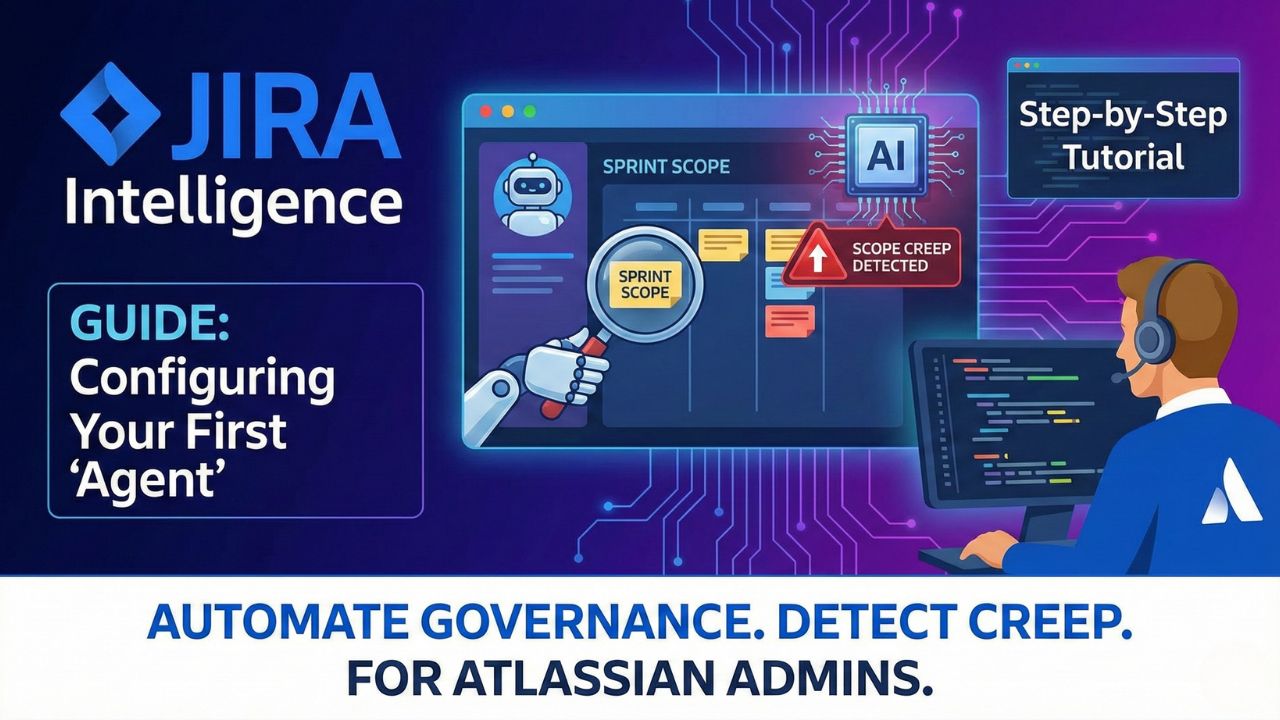
A step-by-step tutorial for Atlassian admins. How to set up an agent that automatically detects "scope creep" in your sprints.
For the last decade, you have used Jira Automation to handle simple logic: If a ticket is moved to "Done," Then send an email. This is useful, but it is dumb. It cannot read the content of the ticket to tell you if a developer is secretly building a feature that wasn't in the requirements.
In 2026, we have Atlassian Rovo Agents. Unlike simple automation rules, these agents have "Brains" (LLMs) and "Context" (your entire Confluence knowledge base).
In this tutorial, we will configure a "Scope Creep Warden". This agent will autonomously audit every new ticket added to an active sprint and flag it if it deviates from the approved Epic goals.
Back to Tools: Top 7 AI Tools Return to the previous article on AI Tools.Prerequisites
Before you start, ensure your Indian GCC instance meets these requirements:
- Edition: Jira Cloud Premium or Enterprise.
- Permissions: You must be an Organization Admin or have "Rovo Admin" permissions.
- Enabled Features: "Atlassian Intelligence" and "Rovo" must be activated in the admin console.
Step 1: Create the Agent's Identity (The "Brain")
We need to create the agent in Rovo Studio before we connect it to a project.
- Navigate to Apps > Rovo > Studio.
- Click Create Agent.
- Name: Scope Creep Warden
- Description: "Audits new issues for alignment with Epic goals and flags unauthorized scope expansion."
- Knowledge Base: Select the Confluence Space where your Product Requirements Documents (PRDs) and Project Scope Statements are stored.
This is critical—the agent needs to know what 'In Scope' looks like to detect what is 'Out'.
Step 2: Write the System Instructions (The "Prompt")
This is where you program the AI. In the Instructions field, paste the following prompt. We have optimized this for Indian GCC contexts where requirements often drift due to "quick calls" between US and India teams.
Step 3: Connect to Jira Automation (The "Trigger")
Now we need to wake the agent up whenever a specific event happens.
- Go to Project Settings > Automation > Create Rule.
- Trigger: Select "Issue Created".
- Condition: Select "JQL Condition".
(This ensures the agent only checks tickets added to a Sprint that has already started).
- Action: Search for "Use Rovo Agent" (Note: In 2024, this was separate; in 2026, it is native).
- Select Agent: Choose Scope Creep Warden.
- Input: Pass the
{{issue.description}}and{{issue.epic.summary}}as context.
Step 4: Configure the Response (The "Action")
Finally, tell Jira what to do with the Agent's opinion.
- Add Component: Branch on / Smart Values.
- Condition:
{{agentResponse.flagged}}equals true. - Action 1: "Comment on Issue".
Body: ⚠️ **Scope Alert:** The Scope Creep Warden detected this issue adds new functionality not aligned with Epic '{{issue.epic.summary}}'. @ProductOwner, please approve or remove.
- Action 2: "Transition Issue".
Move status to "Flagged" or "On Hold".
Step 5: Test and Refine
Do not roll this out to 5,000 users immediately.
- Create a "Sandbox Project."
- Start a dummy sprint.
- Add a ticket that is clearly out of scope (e.g., "Add Generative AI to Login Page" when the Epic is "Fix Login Database").
- Verify: Did the Agent comment on it within 30 seconds?
- Refine: If the agent is too strict, adjust the "Temperature" in Rovo Studio settings to allow for minor tasks.
FAQ: Jira Intelligence & Rovo
A: Jira Automation follows rigid rules (If A, Then B). Rovo Agents use reasoning (Read A, Understand Context, Decide if B or C is better). Use Automation for process; use Agents for decisions.
A: Rovo is typically an add-on cost per user, though it is often bundled in Jira Cloud Enterprise licenses common in large Indian GCCs.
A: No. The agent runs asynchronously. The developer can create the ticket, and the agent will post its comment 10-20 seconds later.
A: Yes, if you connect Bitbucket or GitHub to Atlassian Rovo. This allows the agent to see if the code changes match the ticket description.

Sources & References
- Atlassian Support: "Create and Edit Rovo Agents" – The official documentation for configuring agent identities.
- Atlassian Automation: "Automating Rovo Agents" – Guide on connecting Agents to Jira Automation triggers.
- Luna AI Blog: "AI Jira Sprint Summaries & Scope Creep" – Insights on how AI analyzes sprint data risks.
- ResearchGate: "AI-Based Prediction of Scope Creep in Agile Projects" – Academic basis for using NLP to detect requirements drift.