How to Start AI Transformation for Organization
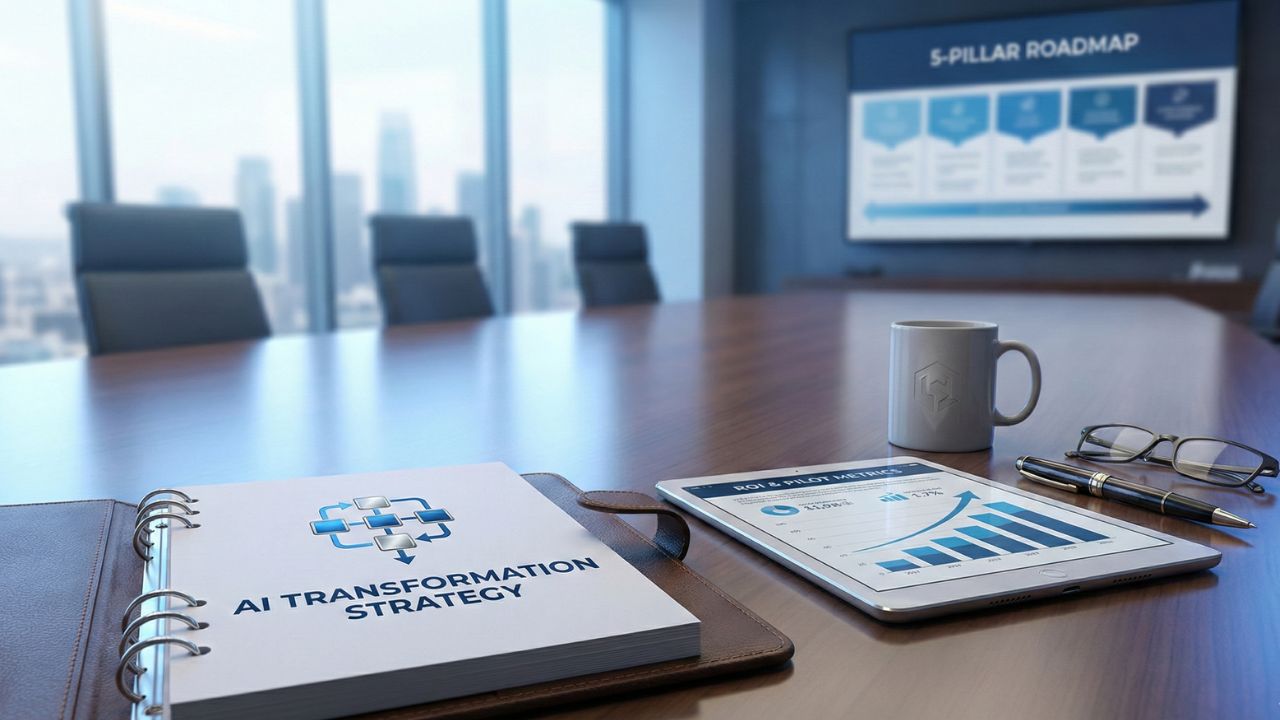
- Strategy First: AI transformation is a business strategy problem, not a technical one.
- Cultural Readiness: Success depends on reskilling your workforce and managing change effectively.
- Data is the Foundation: Your AI outputs are only as reliable as your data architecture.
- Ethical Guardrails: Governance must be established early to protect brand integrity.
- Iterative Success: Start with high-ROI pilot projects before scaling across the enterprise.
Most leaders feel the crushing weight of the AI revolution, fearing that one wrong move will lead to wasted millions or a lost competitive edge. You are likely standing at a crossroads, balancing the pressure to innovate with the critical need for security and tangible ROI.
To understand how to start AI transformation for organization success, you must move past the hype.
Phase 1: Defining Your Enterprise AI Implementation Strategy
A true enterprise AI implementation strategy for leaders begins by identifying specific business bottlenecks that machine learning or generative AI can actually solve.
Instead of aiming for a total overhaul, leaders should focus on ai pilot project selection for businesses to demonstrate immediate value.
By picking "low-hanging fruit"—tasks with high impact but low technical complexity—you build the internal momentum necessary for larger shifts.
Phase 2: Building the Infrastructure and Governance
A robust framework for ai transformation in business requires more than just a software subscription. It demands a deep look at your "engine room".
Preparing enterprise data for AI transformation is the most overlooked step in the roadmap. Without clean, structured, and accessible data, even the most expensive models will fail to produce actionable insights.
Simultaneously, you must protect your organization by establishing a clear ai ethics policy for corporations. This ensures data privacy, mitigates bias, and keeps your company compliant with evolving global regulations.
Phase 3: The Human Element and Change Management
Leading AI change management in companies is a psychological challenge as much as an operational one. Employees often fear displacement, which can lead to quiet resistance or decreased productivity.
The solution lies in reskilling employees for ai. By investing in literacy programs, you transition your team from fearing automation to mastering human-AI collaboration.
When deciding on your tech stack, leaders often face the build vs buy ai software for enterprise dilemma. Whether you develop custom tools or integrate existing SaaS solutions, ensure your team is trained to handle the specific tools you deploy.
Phase 4: Financial Oversight and Scaling
Your roadmap for corporate ai integration must be fiscally responsible. Calculating ROI on AI transformation is notoriously difficult, but essential for maintaining board-level support.
Focus on the Total Cost of Ownership (TCO), including hidden costs like API tokens, data cleaning, and ongoing maintenance. Once the financial model is proven through your initial pilots, you can begin the broad-scale integration that defines a truly AI-first organization.
Frequently Asked Questions (FAQ)
The first steps involve defining clear business objectives, conducting an AI readiness assessment of your current data and talent, and identifying a single, high-impact use case for a pilot project.
Start by aligning AI capabilities with your core business goals. Build a cross-functional team, establish data governance, and create a roadmap that balances short-term wins with long-term infrastructure goals.
Costs vary wildly based on scale, but include software licensing, data infrastructure upgrades, talent hiring or reskilling, and ongoing operational costs like model fine-tuning and tokens.
Primary risks include data privacy breaches, algorithmic bias, lack of clear ROI, employee resistance, and the legal implications of using generative models on proprietary data.
ROI should be measured through efficiency gains (hours saved), cost reductions in operations, revenue growth from new AI-powered products, and improvements in customer satisfaction metrics.
Key roles include a Chief AI Officer or Lead, data scientists, data architects, AI ethics officers, and change management specialists within HR.
A pilot project may take 3-6 months, while a full-scale enterprise transformation typically takes 18 to 36 months to reach maturity.
Identify existing KPIs that are underperforming and determine if AI can optimize those specific areas, such as customer churn, supply chain efficiency, or content production.
Digital transformation focuses on moving processes to the cloud and digitizing workflows. AI transformation focuses on using that data to automate decision-making and generate new insights.
Evaluate vendors based on their data security standards, ease of integration with your current systems, scalability, and the transparency of their pricing models.
Sources and References
By following this roadmap for corporate ai integration, you ensure that your journey is structured, ethical, and, most importantly, profitable. Knowing how to start AI transformation for organization success is the first step toward future-proofing your leadership legacy.