Build vs Buy AI Software for Enterprise: Why You Shouldn’t Reinvent the Wheel (But Might Have To)
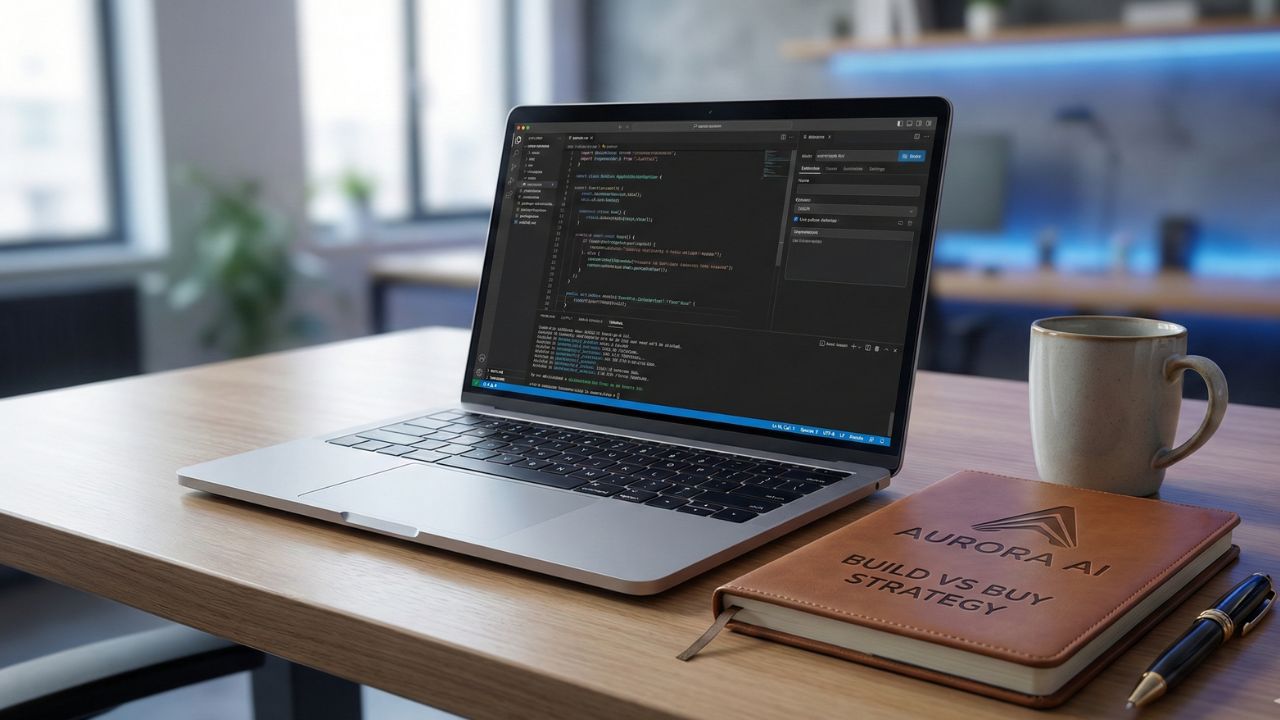
- Speed vs. Control: Buying (SaaS) is faster and cheaper upfront; Building (Custom) offers long-term control and IP protection.
- Avoid "Wrappers": Be wary of vendors who are just reselling GPT-4 with a different logo; you can often build these yourself cheaply.
- The Data Rule: If your competitive advantage is unique proprietary data, you likely need to build (or fine-tune) to protect it.
- Vendor Lock-in: Renting AI creates dependency. Always have an exit strategy for your data.
- The Hybrid Future: The smartest enterprises "rent" the model but "own" the fine-tuning weights.
The Multi-Million Dollar Question
In the rush to modernize, leaders face a paralyzing fork in the road. Do you subscribe to an off-the-shelf tool (like Microsoft Copilot or Jasper) and get started today? Or do you hire a team of engineers to build a custom model that belongs solely to you?
The decision of build vs buy ai software for enterprise defines your future technical debt, your security posture, and your competitive moat. Get it wrong, and you either bleed cash on unnecessary R&D or hand your sensitive data over to a third party.
This deep dive is part of our extensive guide on How to Start AI Transformation for Organization: The No-Regrets Roadmap for Modern Leaders. If you haven't defined your broader strategy, start there.
Option 1: The "Buy" Strategy (SaaS & APIs)
For 80% of use cases, buying is the correct choice. If you are trying to solve a solved problem—like summarizing meetings, generating marketing copy, or processing invoices—do not build it.
Pros of Buying:
- Speed to Value: Deploy in days, not months.
- Lower Initial Risk: No need to hire expensive Machine Learning engineers.
- Maintenance: The vendor handles the updates and server uptime.
The Hidden Risk: "AI Wrappers"
Many "AI Startups" are simply "wrappers" around OpenAI’s API. They add a thin layer of interface but possess no proprietary tech. Before signing a contract, ask: "Could my internal dev team build this in a weekend?" If the answer is yes, don't sign a multi-year contract.
Option 2: The "Build" Strategy (Custom & Open Source)
Building doesn't always mean training a model from scratch (which costs millions). Today, "Building" usually means taking an open-source model (like Llama 3 or Mistral) and hosting it on your own private servers.
When to Build:
- Data Sovereignty: You have highly sensitive data (legal, medical, defense) that cannot leave your firewall.
- Unique Workflows: Your process is so niche that no SaaS tool supports it.
- Cost at Scale: If you are processing millions of transactions, paying per-token API fees becomes unsustainable.
This approach requires significant upfront investment. You must consult your finance team to accurately model the calculating roi on ai transformation to see if the CAPEX of building outweighs the OPEX of buying.
The Decision Matrix: How to Choose
Don't guess. Use this simple framework to make the call.
- 1. Is this a core competency? If you are a logistics company, buy your HR chatbot. Build your route-optimization AI.
- 2. Is the data unique? If you are using public data, buy. If you are using proprietary trade secrets, build (or privately host).
- 3. Is the data ready? You cannot build a custom model without clean, structured data. If your data is messy, you are not ready to build. See our guide on preparing enterprise data for ai transformation before hiring developers.
Frequently Asked Questions (FAQ)
Here are the answers to the most critical technical questions regarding your stack:
Almost certainly no. Training a "Foundation Model" from scratch costs millions. Instead, you should "fine-tune" an existing open-source model with your specific data.
Initially, yes. Buying SaaS has low upfront costs. However, at high volume, API fees can become more expensive than hosting your own model.
If a vendor changes their pricing, shuts down, or alters their model, your business disrupts. Mitigate this by ensuring you can export your data and switch models easily.
Ask for their "Model Card." Ask if they train on your data (they shouldn't). Ask if they own the underlying IP or if they are just dependent on OpenAI.
It makes sense when you need a competitive advantage that a standard tool cannot provide, or when regulatory requirements forbid data from entering public clouds.
An application that relies entirely on a third-party API (like GPT-4) for its intelligence, adding only a user interface on top. They are risky investments as they have no "moat."
Demand a "No Training" clause (ensuring they don't use your data to train their models) and an SLA (Service Level Agreement) regarding uptime and latency.
Use an "API Gateway." This middleware sits between your old on-prem database and the modern AI tool, translating data securely without exposing your core infrastructure.
Control and Privacy. You own the code. You can run it offline. No one can pull the plug on your access.
Maintain a "Golden Record" of your data internally. Never let the vendor be the only place your data exists. Use standard formats (JSON/CSV) for easy migration.
Conclusion
There is no badge of honor for writing custom code that already exists. Your default stance should be to buy speed and utility. Only shift to build when the software needs to do something that no vendor on the market can offer, or when the data is too precious to trust to a stranger.
Mastering the nuance of build vs buy ai software for enterprise is the hallmark of a mature digital leader. It allows you to move fast on the commodities while doubling down on the differentiators.