Reskilling Employees for AI Transformation: How to Turn Job Fear into Human-AI Collaboration
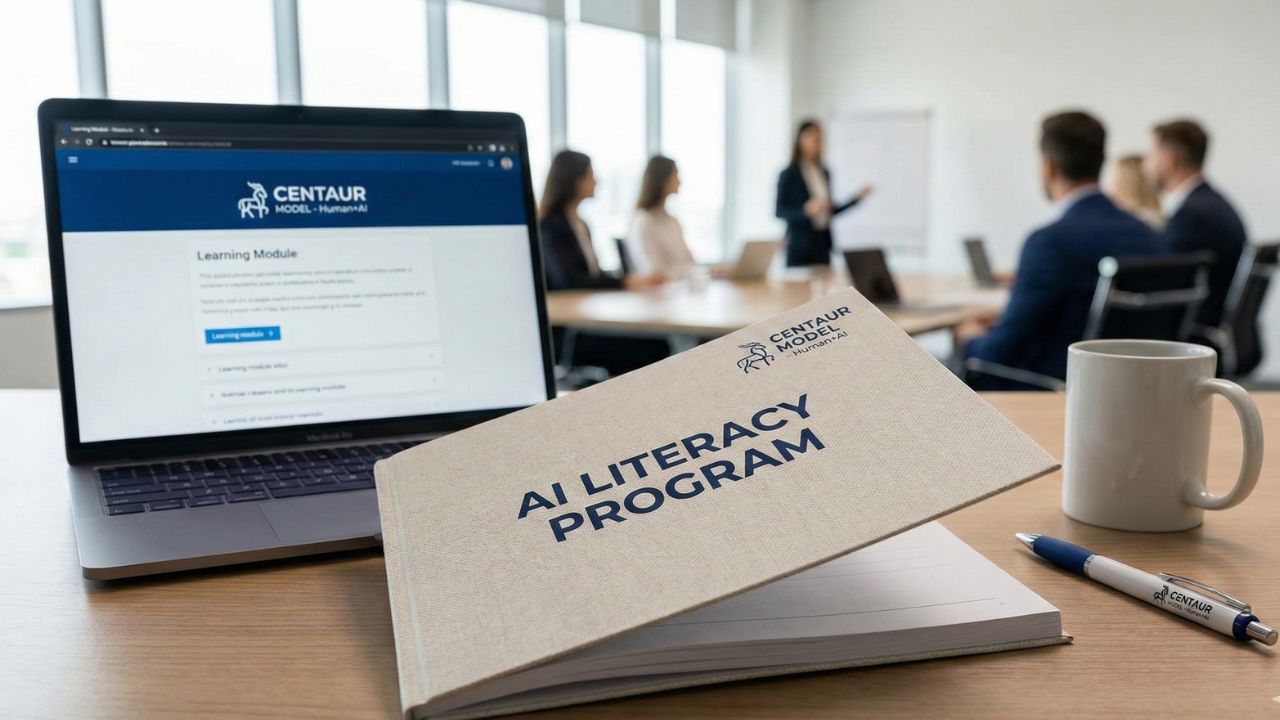
- Fear Kills Innovation: The biggest barrier to AI isn't technology; it's the fear of replacement. You must address this first.
- Everyone Needs Skills: Reskilling employees for ai transformation is not just for developers—it’s for marketing, HR, and finance too.
- The "Centaur" Model: Teach your team that the goal is Human + AI, not AI replacing Human.
- Incentivize Curiosity: Create safe spaces (sandboxes) where staff can experiment with tools without fear of breaking anything.
- HR is Strategy: Your HR department is now your most critical R&D partner.
The "Replacement" Panic
When you announce an AI initiative, your employees don't hear "efficiency." They hear "layoffs." If you ignore this emotional reaction, your expensive technology will sit unused.
To succeed, you must flip the narrative from "replacement" to "augmentation." Reskilling employees for ai transformation is the only bridge between a stagnant workforce and a high-performance future.
It is about equipping your people with the confidence to command the algorithms, rather than being commanded by them.
This deep dive is part of our extensive guide on how to start ai transformation for organization. If you are looking for the broader roadmap, start there.
Step 1: Managing AI Anxiety in the Workplace
Before you schedule a single training session, you must stabilize the culture. Silence breeds paranoia. If leadership is secretive about AI plans, the rumor mill will take over.
Actionable Steps to Reduce Fear:
- Be Radical with Transparency: Admit that roles will change, but emphasize that the goal is growth, not headcount reduction.
- Show, Don't Just Tell: Demonstrate how AI removes the "boring robot work" (like data entry) so humans can do "human work" (like strategy).
- Define "Human-in-the-loop": Make it company policy that AI is a tool requiring human oversight, ensuring your team feels they are still the pilots.
Step 2: Designing an AI Literacy Program
You cannot simply buy a Udemy subscription and hope for the best. You need a structured tier system. Not everyone needs to be a prompt engineer, but everyone needs to be "AI Literate."
Tier 1: General AI Literacy (All Staff)
Goal: Demystification.
Content: What is GenAI? How does it hallucinate? What are the security risks?
Note: This is a great place to introduce your ai ethics policy for corporations to ensure staff understands the boundaries of safe use.
Tier 2: Functional Power Users (Managers & Creatives)
Goal: Workflow integration.
Content: Advanced prompting, workflow automation, and tool-specific training (e.g., Copilot for Excel).
Tier 3: Technical Architects (IT & Data)
Goal: Building and maintaining.
Content: Fine-tuning models, Python for AI, and API integrations.
Step 3: Incentivizing the Shift
Learning a new way of working is hard. You need to make it rewarding. Many companies fail here because they treat AI training as "extra homework."
How to Drive Adoption:
- Gamification: Create "Prompt Battles" or innovation challenges where teams compete to solve a problem using AI.
- The "Super-User" Network: Identify early adopters in every department and give them a badge/title. Let them teach their peers.
- Career Mapping: Show explicitly how reskilling employees for ai transformation leads to promotion and higher salary bands.
Once your team is upskilled, they will likely start identifying the best use cases for you. This ground-up feedback is invaluable for ai pilot project selection for businesses, as your frontline workers know exactly where the inefficiencies lie.
Frequently Asked Questions (FAQ)
Here are the answers to the most common questions regarding the talent shift:
Be honest and early. Frame AI as a "productivity engine" that eliminates drudgery. Explicitly state that the company's priority is upskilling the current workforce, not replacing it.
Beyond technical skills, the most valuable traits are "AI aptitude": critical thinking (to verify AI output), curiosity, data literacy, and the ability to formulate precise questions (prompt engineering).
Involve them in the process. When employees help choose the tools and define the workflows, they feel ownership rather than victimization.
It is a company-wide educational initiative designed to ensure every employee, from the janitor to the CEO, understands the basics of how AI works, its limitations, and its safe application.
Industry benchmarks suggest allocating 1-3% of your total payroll budget toward upskilling during a major digital transformation.
Roles involving repetitive cognitive tasks (data entry, basic coding, basic copywriting) are most impacted. However, these roles often evolve into "editor" or "manager" roles over the AI output.
Tie AI usage to KPIs. If a sales rep uses AI to double their outreach, reward the result. Innovative "fail-safe" environments where experimentation is praised also help.
Absolutely. Generative AI uses natural language (English, Spanish, etc.) as its programming language. Good communicators often make better prompt engineers than pure coders.
Stop looking for just "experience." Look for "agility." Ask candidates how they have used new tools to solve old problems. Test their ability to learn live during the interview.
HR is the architect of the transition. They must redesign job descriptions, create learning pathways, and manage the emotional fallout of the change.
Conclusion
Technology is easy; people are hard. You can have the most advanced data infrastructure in the world, but if your culture is resistant, your ROI will be zero.
Mastering reskilling employees for ai transformation is the defining leadership challenge of this decade. It requires empathy, clear communication, and a genuine investment in your human capital.
When you get this right, you don't just get a faster company—you get a smarter, happier, and more loyal one.