The CIO’s Guide to Quantum Readiness: Surviving the "Q-Day" Shock
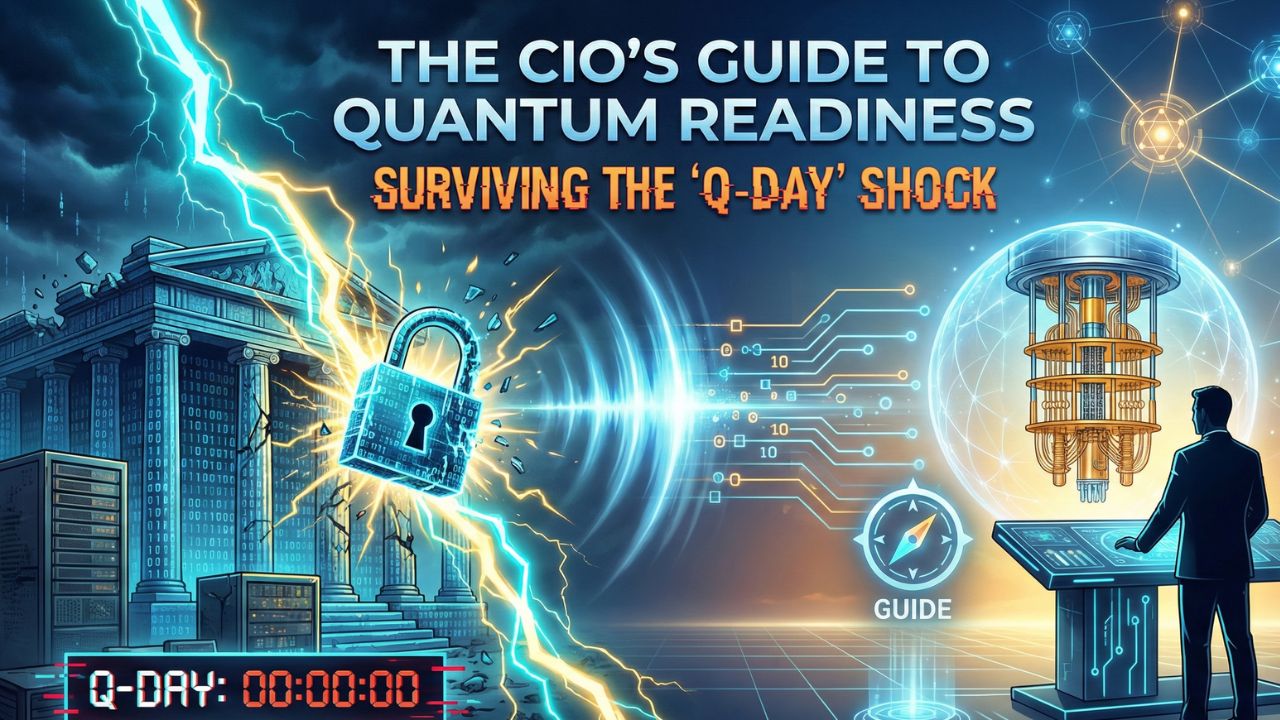
The convergence of Agentic AI and Quantum Computing creates a new volatility vector for the modern enterprise. While autonomous agents drive unprecedented speed, emerging quantum capabilities threaten the cryptographic fabric that secures them.
This guide provides a strategic roadmap for CIOs to secure "Agent Swarms" against the "Harvest Now, Decrypt Later" threat and capitalize on Quantum-as-a-Service infrastructure.
1. The Convergence: Why Agentic AI + Quantum is the Next Volatility Vector
For the last five years, digital transformation has been defined by the move to the cloud. For 2026 and beyond, it will be defined by the collision of two massive forces: Autonomous Agentic AI and Quantum Computing.
These technologies are not separate swimlanes on your roadmap; they are inextricably linked by a single vulnerability: Identity.
- The Agentic Expansion: You are likely deploying thousands of autonomous agents (Non-Human Identities) to execute transactions, move data, and interact with customers. These agents rely on digital signatures (OAuth, JWTs) to prove they are authorized.
- The Quantum Threat: Simultaneously, adversaries are racing toward "Q-Day"—the moment a cryptographically relevant quantum computer (CRQC) can execute Shor's Algorithm to break standard public-key encryption (RSA and ECC).
The risk is specific and existential: If an attacker uses quantum capability to forge an agent's digital signature, they do not just breach a server; they hijack your autonomous workforce. They can command your agents to exfiltrate funds, delete backups, or poison data lakes, all while appearing perfectly authenticated.
2. The Timeline: Hype vs. Reality
When is Q-Day? This is the most common question in the boardroom. While hype cycles suggest immediate doom, realistic estimates place the arrival of a fault-tolerant quantum computer capable of breaking 2048-bit RSA between 2030 and 2035.
However, for the CIO, the timeline for action is now. This is due to the "Harvest Now, Decrypt Later" (HNDL) threat.
The "Harvest Now, Decrypt Later" Threat
State-sponsored actors are currently exfiltrating massive amounts of encrypted data—intellectual property, genomic data, long-term strategic plans, and government secrets. They cannot read this data today. They are storing it, waiting for the hardware to mature. Once Q-Day arrives, they will retroactively decrypt this harvested data.
For strategic plans, health records, and banking infrastructure, the time to migrate to quantum-safe encryption is immediate.
3. The 3-Step Readiness Roadmap for 2026
To secure the Agentic Enterprise, leaders must move from "monitoring the science" to "architecting the defense."
Step 1: The "Crypto-Census" (Assess)
You cannot replace what you cannot find. Most enterprises do not have a clear inventory of where cryptography is used.
- Action: Deploy automated discovery tools to map every instance of encryption in your stack.
- Focus: Identify hard-coded keys in legacy apps and "Non-Human Identities" (NHI) used by your AI agents.
Step 2: Migrating to PQC (NIST Standards)
The National Institute of Standards and Technology (NIST) has finalized the first set of Post-Quantum Cryptography (PQC) standards.
- The New Standard: You must begin upgrading your authentication protocols to support algorithms like CRYSTALS-Kyber (for key encapsulation) and Dilithium (for digital signatures).
Step 3: Agile Crypto-Agility
The "hard-shell" security model is dead. In a quantum world, encryption standards may be broken and replaced rapidly.
- Action: Architect your systems for "Crypto-Agility"—the ability to swap out encryption algorithms without rewriting code or causing downtime.
4. Strategic Pillars of the Quantum Enterprise
To navigate this transition, we have broken down the strategy into three core domains. Explore the deep-dive guides below:
A. Security & Encryption (The "Fear" Angle) Focus: Protecting Agent Identities and Authentication. Key Insight: Why OAuth is insufficient for the quantum era and how to implement NIST PQC standards today. Read Guide: Q-Day Prep & Agentic Auth B. Infrastructure & Compute (The "Opportunity" Angle) Focus: High-Performance Computing (HPC) and Optimization. Key Insight: A cost-benefit analysis of renting Quantum Processor Units (QPUs) via cloud providers like Azure Quantum vs. sticking with NVIDIA H100 clusters. Read Guide: Quantum-as-a-Service vs. GPU Clusters C. Strategic Leadership (The "People" Angle) Focus: Governance, Skills, and Ethics. Key Insight: How to build a "Quantum Center of Excellence" (CoE) using your existing Agile teams and upskilling software engineers into quantum literacy. Read Guide: Building the Quantum CoE
Frequently Asked Questions (FAQ)
A: Q-Day refers to the hypothetical future date when a quantum computer becomes powerful enough (cryptographically relevant) to break the public-key encryption algorithms (like RSA and ECC) that currently secure the internet and digital identities.
A: PQC refers to a new generation of cryptographic algorithms (such as NIST's ML-KEM/Kyber) that are designed to be resistant to attacks from both classical and quantum computers. Implementing PQC is the primary defense against the quantum threat.
A: For most general computing tasks, no. However, for specific optimization problems in logistics, finance, and materials science, "Quantum-as-a-Service" (renting access via the cloud) is becoming a viable option for competitive advantage.
A: The primary impact is on identity and authentication. AI agents use digital signatures to verify who they are. If quantum computers break the encryption behind these signatures, attackers can forge agent identities, leading to a complete loss of control over the autonomous system.

Sources & References
- National Institute of Standards and Technology: NIST Post-Quantum Cryptography Standardization Project.
- Industry Analysis: The State of Quantum Computing 2026.
- CISA: Harvest Now, Decrypt Later (HNDL) Defense Strategies.
- Enterprise Architecture Board: Agentic AI Security Protocols.
- AWS Braket, Azure Quantum, Google Quantum AI: Cloud Provider Quantum Roadmaps.