Q-Day Prep: Why Your "Agent Swarm" Needs Post-Quantum Auth Now
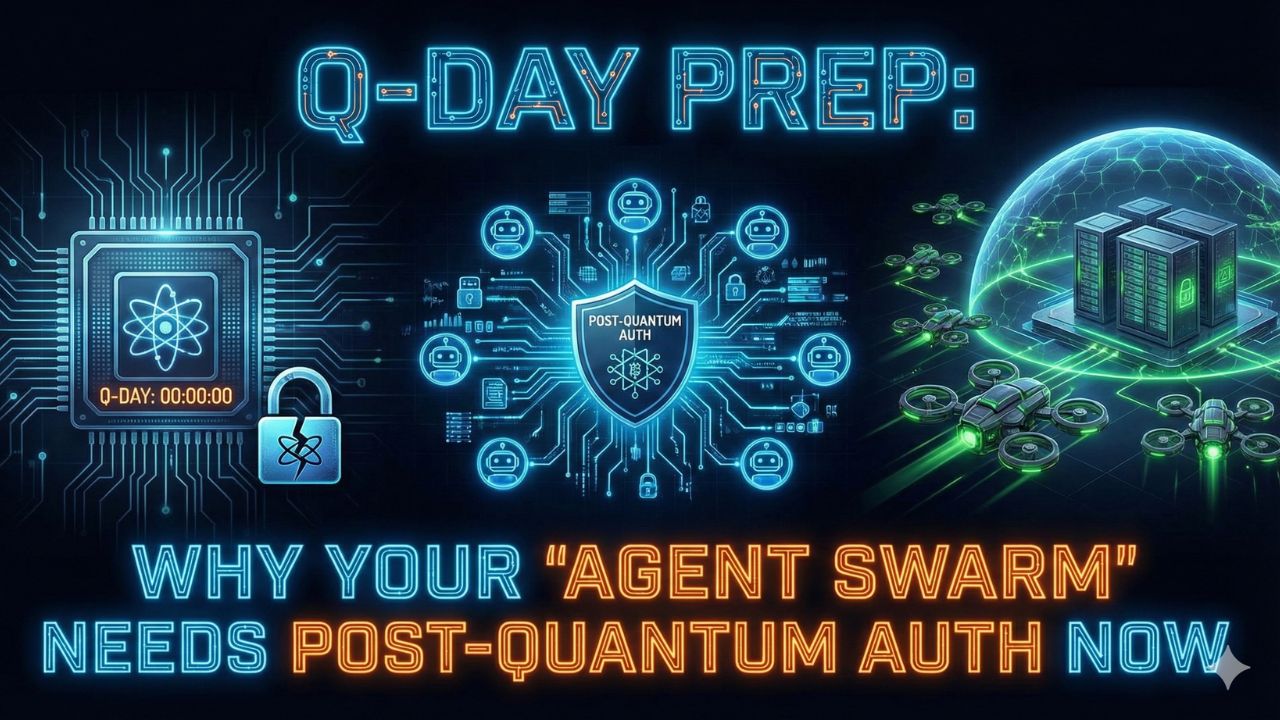
It is 2026, and the security foundation of the internet is cracking. For three decades, we have relied on a single mathematical assumption: that factoring large prime numbers is too hard for computers to solve. This assumption is the bedrock of RSA and Elliptic Curve Cryptography (ECC)—the very algorithms that secure every OAuth token, JWT, and API key your AI agents use today.
But the arrival of cryptographically relevant quantum computers (CRQC) changes the math. With Shor's Algorithm, a quantum computer can shatter RSA-2048 encryption not in billions of years, but in hours.
This guide explains why "Q-Day" is an identity crisis for the Agentic Enterprise and how to migrate your authentication stack to NIST's new Post-Quantum Cryptography (PQC) standards today.
1. The Vulnerability: The Death of RSA & ECC
Most CISOs assume Q-Day (the day quantum computers break encryption) is a "2035 problem." They are wrong. For AI agents, the threat is already here due to the "Harvest Now, Decrypt Later" (HNDL) attack vector.
How Shor's Algorithm Breaks Identity
Your AI agents use digital signatures (like RS256 or ES256 in JWTs) to authenticate. These signatures rely on the discrete logarithm problem. Shor's algorithm utilizes quantum superposition to find the "period" of a function efficiently, effectively solving the discrete logarithm problem in polynomial time.
Once the private key is derived, the attacker can mint their own tokens. They can sign malicious instructions—"Transfer $1M to Account X"—and your API gateways will accept them as valid because the mathematical signature is perfect.
2. The Solution: NIST's PQC Standards (ML-KEM & ML-DSA)
The defense is not "stronger RSA." The defense is a new kind of mathematics based on Structured Lattices. In August 2024, NIST finalized the first set of Post-Quantum Cryptography standards that all federal agencies and compliant enterprises must adopt.
The New Toolkit for 2026
- For Encryption (The Handshake): ML-KEM (FIPS 203). Formerly known as CRYSTALS-Kyber. This algorithm secures the initial exchange of keys between your agent and the server. It is efficient, with small key sizes, making it ideal for high-speed agent communication.
- For Identity (The Signature): ML-DSA (FIPS 204). Formerly known as CRYSTALS-Dilithium. This is the new standard for digital signatures. You must upgrade your JWT signing infrastructure to support ML-DSA to prevent identity forgery.
- The Backup: SLH-DSA (FIPS 205). Formerly SPHINCS+. A stateless hash-based signature scheme. It is slower and produces larger signatures but relies on different math (hashes) than lattices, providing a "safety net" if lattice-based crypto is ever broken.
3. Action Plan: Implementing "Crypto-Agility"
You cannot rewrite your entire application stack overnight. The strategy for 2026 is Crypto-Agility—architecting your systems to swap encryption algorithms without code changes.
Step 1: The Crypto-Census
Deploy automated scanning tools to inventory every certificate and key in your environment. You are looking for:
- Hard-coded RSA keys in legacy microservices.
- Agents using long-lived OIDC tokens (these are prime targets for HNDL).
- TLS 1.2 usage which does not support the new post-quantum cipher suites.
Step 2: Enable Hybrid Mode
Do not switch to pure PQC yet. The industry best practice for 2026 is Hybrid Cryptography. This combines a classical algorithm (like X25519) with a post-quantum one (like ML-KEM).
If the post-quantum algorithm turns out to have a flaw, the classical layer still protects you. If a quantum computer attacks, the post-quantum layer protects you. Cloudflare, AWS, and Google have all enabled these hybrid key exchanges by default.
Step 3: Service Mesh Enforcement
Offload cryptography from the agent's code to the infrastructure. Use a Service Mesh (like Istio or Linkerd) to handle mTLS. This allows you to upgrade the mesh to support ML-KEM globally without patching 5,000 individual agents.

Frequently Asked Questions (FAQ)
A: These are the official NIST standards for Post-Quantum Cryptography. ML-KEM (Module-Lattice-Based Key-Encapsulation Mechanism) is the standard for encryption keys, formerly known as CRYSTALS-Kyber. ML-DSA (Module-Lattice-Based Digital Signature Algorithm) is the standard for digital signatures, formerly known as CRYSTALS-Dilithium.
A: RSA relies on the difficulty of factoring large integers. Shor's Algorithm, running on a sufficiently powerful quantum computer, can solve this problem in polynomial time, allowing attackers to forge the digital signatures that agents use to prove their identity.
A: Adversaries are currently recording encrypted traffic (which they cannot yet read). Once a powerful quantum computer is built (Q-Day), they will retroactively decrypt this data. For agents, this is critical because it exposes long-lived secrets like API keys and OIDC tokens captured in logs today.
A: Yes. Major cloud providers and libraries (like OpenSSL 3.x and BoringSSL) support "Hybrid Mode," which combines classical elliptic curve algorithms (like X25519) with post-quantum algorithms (like ML-KEM). This provides protection against both current and future threats.

Sources & References
- NIST: NIST Post-Quantum Cryptography Standardization Project.
- Cloudflare: What is post-quantum cryptography (PQC)?.
- Microsoft Security: Post-Quantum Cryptography APIs Now Generally Available.
- Palo Alto Networks: Cryptographic Agility: The Key to Quantum Readiness.