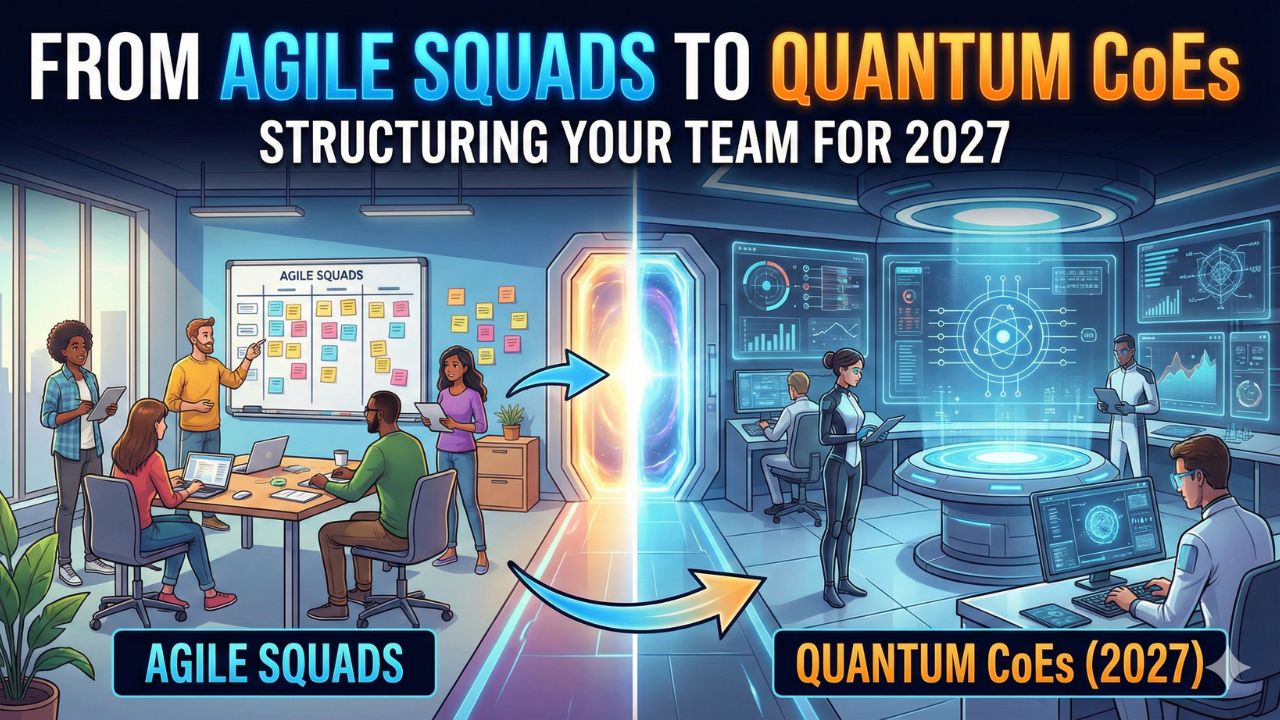
From Agile Squads to Quantum CoEs: Structuring Your Team for 2027
The "Quantum Talent Gap" is the single biggest bottleneck in the enterprise roadmap. As we approach Q-Day, demand for quantum-literate professionals is outstripping supply by a factor of 3 to 1. But the solution is not to compete with Google and IBM for the world's limited supply of Physics PhDs.
The winning strategy for 2027 is Internal Transformation: building a Quantum Center of Excellence (CoE) by upskilling your existing high-performing Agile teams. This playbook outlines the structure, skills, and governance needed to make that shift.
1. The Talent Gap: Why You Don't Need More PhDs
There is a persistent myth that you need a doctorate in quantum mechanics to add value. This is false. According to recent industry analysis, two-thirds of quantum jobs in the industrial sector require a Bachelor's degree or less.
Your goal is not to build a quantum computer; it is to consume Quantum-as-a-Service (QaaS). This requires skills your team already has: Python proficiency, cloud architecture experience, and linear algebra fundamentals.
2. The CoE Structure: The "Enabling Team" Model
How do you integrate quantum capability into an existing Agile organization? We recommend the "Enabling Team" topology.
Do not scatter quantum engineers across every squad yet. Instead, form a central CoE that acts as a service provider to the rest of the organization.
The Quantum CoE Mandate:
- Scouting: identifying high-value use cases (e.g., optimization, simulation) within the business.
- Tooling: Building the "Golden Path" libraries that allow standard developers to access quantum solvers (like Azure Quantum or AWS Braket) without managing the underlying physics.
- Governance: Enforcing the ethical and security guardrails defined in the CIO's Roadmap.
3. The Ethical Frontier: The Dual-Use Dilemma
Quantum computing power is neutral, but its applications are not. A CoE leader must also be an Ethics Officer.
The Governance Challenge
The same simulation capability that can discover a breakthrough cancer drug can also be used to design a potent toxin or bioweapon. This is known as the "Dual-Use Dilemma."
Your governance mesh must include:
- Access Control: strict RBAC (Role-Based Access Control) on who can submit jobs to the QPU.
- Job Inspection: Automated screening of quantum circuits to detect potentially malicious optimization targets.
- Privacy: Ensuring that no PII (Personally Identifiable Information) is ever sent to a public cloud quantum processor.
4. Resources: Upskilling Your Workforce
Ready to start training? These are the industry-recognized certifications to target for your 2026 Learning & Development budget.
For Leaders & Strategists
MIT xPRO: Quantum Computing for Business
A comprehensive course designed for executives to understand the business implications, hype vs. reality, and strategic timeline of the technology.
For Developers & Engineers
IBM Certified Associate Developer: Quantum Computation using Qiskit
The gold standard for technical practitioners. This certification proves your engineers can write, compile, and execute quantum circuits using the world's most popular SDK.

Frequently Asked Questions (FAQ)
A: Not necessarily. While a Lead Quantum Scientist is valuable, the majority of the work in 2026 involves software engineering, cloud integration, and algorithm translation. Upskilling your existing senior engineers in quantum literacy is often more effective than hunting for scarce PhD talent.
A: The Quantum CoE acts as an "Enabling Team" in the Team Topologies model. They do not own all quantum projects; instead, they provide the standards, tools, and "Golden Paths" that allow other stream-aligned squads to consume quantum services safely.
A: Quantum ethics focuses heavily on the "Dual-Use Dilemma." The same simulation capability that discovers a life-saving drug can also be used to design a potent bioweapon. Governance frameworks must strictly control access to these simulation capabilities.
A: For hands-on developers, the "IBM Certified Quantum Developer (Qiskit)" is the industry standard. For leadership and strategy roles, the "MIT xPRO Quantum Computing for Business" certification is highly recommended.

Sources & References
- MIT xPRO: Quantum Computing: Strategy and Impact Course.
- IBM Quantum: Qiskit Developer Certification v2.0.
- McKinsey & Company: The Quantum Technology Monitor 2025 - Talent Gap Analysis.
- World Economic Forum: Quantum Computing Governance Principles.