Quantum-as-a-Service: The CFO’s Guide to Renting Quantum Power
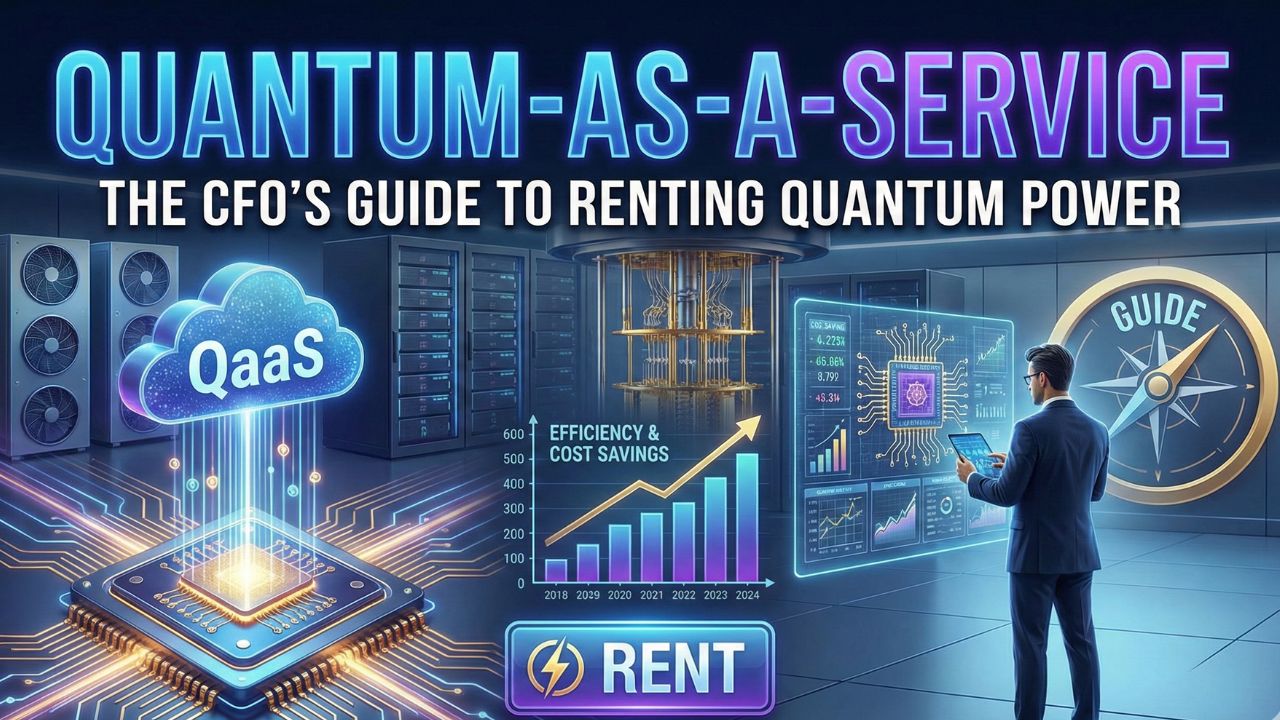
For the past decade, "Compute" has been synonymous with "NVIDIA." The H100 GPU cluster is the gold standard for training and inference. But in 2026, a new player has entered the enterprise infrastructure stack: Quantum-as-a-Service (QaaS).
We are not suggesting you replace your GPU clusters. We are suggesting that for specific, high-value problems—like supply chain logistics, portfolio optimization, and molecular simulation—using a GPU is like using a Ferrari to plow a field. It works, but it's expensive and inefficient.
This guide provides a cost-benefit analysis of renting Quantum Processor Units (QPUs) via cloud providers like Azure Quantum and AWS Braket versus traditional GPU clusters.
1. The Real Use Cases: Optimization vs. Generative
To understand the economics, you must first understand the workload. Quantum computers are not faster at everything. They are exponentially faster at finding the "global minimum" in a sea of possibilities.
| Workload Type | The Problem | Best Hardware (2026) | Why? |
|---|---|---|---|
| Generative AI | "Write a marketing email" or "Generate an image" | GPU (NVIDIA H100/B200) | These tasks require massive parallel matrix multiplication. GPUs are optimized for this. |
| Combinatorial Optimization | "Route 500 trucks to 5,000 locations to minimize fuel by 1%." | Quantum Annealer (QPU) | Classical computers (even GPUs) must check every route. Quantum annealers "tunnel" through the energy landscape to find the optimal solution instantly. |
| Simulation | "Simulate the binding affinity of a new drug molecule." | Hybrid (GPU + QPU) | Use GPUs for the protein structure, use QPU for the electron interactions. |
2. The Vendor Battle: AWS vs. Azure vs. Google
Just as you chose between AWS and Azure for cloud, you now have a choice for QaaS. Each provider has a distinct strategy for 2026.
AWS Braket: The "Swiss Army Knife"
AWS Braket is ideal for teams that want flexibility. It acts as a unified gateway to multiple hardware providers.
- Hardware: Access to IonQ (Trapped Ion), Rigetti (Superconducting), and QuEra (Neutral Atom).
- Pricing Model: Pay-per-Task + Pay-per-Shot. You only pay for the microseconds the QPU is running.
- Best For: R&D teams experimenting with different qubit modalities to see which works best for their problem.
Azure Quantum: The "Enterprise Optimizer"
Microsoft is betting big on "Quantum-Inspired Optimization" (QIO). These are algorithms that run on classical hardware today but mimic quantum effects.
- Hardware: Access to Quantinuum and IonQ. Unique "QIO" solvers that run on FPGAs/GPUs for immediate business value.
- Pricing Model: Consumption-based (Credit usage). Monthly subscription plans available for high-volume users (e.g., $125k/month for dedicated access plans).
- Best For: Logistics and Finance teams who need "Quantum-Ready" solutions that work in production today without waiting for perfect hardware.
Google Quantum AI: The "Scientific Breakthrough"
Google focuses on achieving "Quantum Advantage" in scientific discovery.
- Hardware: Sycamore processors (Superconducting). Focus on error correction and logical qubits.
- Best For: Materials Science and Pharma research requiring high-fidelity simulation.
3. The Cost Equation: Shots vs. Tokens
In the LLM world, you pay per 1,000 tokens. In the Quantum world, you pay per "Shot."
A "Shot" is a single execution of a quantum circuit. Because quantum mechanics is probabilistic, you rarely run a circuit once. You run it 1,000 or 10,000 times to build a probability distribution and find the correct answer.
GPU Cluster: Running a brute-force optimization on an H100 cluster for 4 hours = $15 - $20 (plus idle time costs).
Quantum Annealer: Running 10,000 shots on a D-Wave QPU via AWS Braket (approx. $0.30/task + $0.0009/shot) = ~$9.30.
The QPU is not only cheaper for this specific task; it provides a better answer. In logistics, finding a route that is 0.5% more efficient can save millions in fuel annually. The ROI of the "better answer" far outweighs the compute cost difference.
4. Hybrid Architecture: The Future is "CPU + QPU"
The winning architecture for 2026 is Hybrid. Your Autonomous Agents (running on CPUs) will act as the orchestrators.
The Workflow
- Step 1: The Agent receives a complex problem (e.g., "Rebalance this $10B portfolio").
- Step 2: The Agent preprocesses the data on a Classical CPU.
- Step 3: The Agent sends the core optimization matrix (QUBO) to a QPU via API (AWS Braket or Azure Quantum).
- Step 4: The QPU returns the optimal distribution in milliseconds.
- Step 5: The Agent executes the trades using classical APIs.
This allows you to leverage quantum power without rewriting your entire stack. The QPU becomes just another co-processor, similar to how you use a GPU today.

Frequently Asked Questions (FAQ)
A: For training Large Language Models (LLMs), no. GPUs are still far superior. However, for specific combinatorial optimization problems (like routing thousands of trucks or optimizing a financial portfolio), renting a QPU for a few seconds can be significantly cheaper and faster than running a GPU cluster for hours.
A: AWS Braket offers a unified SDK (Braket SDK) that works seamlessly with SageMaker and provides access to diverse hardware like IonQ and QuEra. Azure Quantum is deeply integrated into the Microsoft stack (including .NET and Q#) and offers unique "Quantum-Inspired Optimization" (QIO) solvers that run on classical hardware today.
A: A "Shot" is a single execution of a quantum circuit. Because quantum mechanics is probabilistic, you must run the same circuit multiple times (often 1,000 to 10,000 shots) to get a statistically accurate result. Pricing is typically per-task plus per-shot.
A: Yes, but primarily for optimization. Logistics companies use quantum annealing for route optimization, and financial firms use it for portfolio rebalancing. We are not yet at the stage of using quantum computers for general-purpose application hosting.

Sources & References
- AWS: Amazon Braket Pricing and Cost Examples.
- Microsoft Azure: Azure Quantum Pricing and Provider Plans.
- Research AIMultiple: Quantum Artificial Intelligence in 2026.
- D-Wave: Supply Chain Logistics with Quantum and Classical Annealing Algorithms.
- APCO Worldwide: Quantum Computing: The Quiet Revolution Transforming Logistics.