CloudZero vs. Vantage vs. Native Cost Explorers: Best FinOps Tools for AI Attribution
Your cloud bill says you spent $50,000 on "Compute." But how much of that was your new "Sales Agent" answering emails, and how much was the "Data Processing Bot" stuck in a loop? Most native tools can't tell you.
This review is a critical chapter in our CFO’s Guide to Agentic AI Costs. We are evaluating the tools that solve the "Black Box" problem of AI spending.
1. The Problem with Native Tools (AWS & Azure Cost Explorers)
Native tools were built for infrastructure (VMs, Storage, Databases). They struggle with the "Intelligence Layer" because:
- They lack "Unit Economics": AWS tells you the cost per server. It does not tell you the "Cost per Customer Support Ticket Resolved."
- Siloed Data: AWS Cost Explorer cannot see your OpenAI API invoice. Azure Cost Management cannot see your Anthropic spend. You end up with fragmented Excel sheets.
- Shared Resources: If you have one Vector Database serving 5 different agent teams, native tools usually dump 100% of the cost into a generic bucket unless your tagging is perfect.
2. CloudZero: The Engineering Choice
Best For: Complex, code-heavy agent fleets where "Tagging" is difficult.
CloudZero takes a different approach. Instead of relying solely on tags, it ingests code artifacts and maps them to costs. For AI, this is powerful because it can correlate "Telemetry Data" (e.g., number of agent loops) with billing data.
The Killer Feature for AI: "Cost Per Customer." CloudZero can ingest business metrics and divide your total AI infrastructure spend by them, giving you a live look at whether your agent is profitable on a per-unit basis.
3. Vantage: The Financial Choice
Best For: Multi-cloud visibility and executive reporting.
Vantage has rapidly become the favorite for CFOs due to its intuitive UI. For AI FinOps, Vantage shines with its "Virtual Tagging" ability. You can create rules in the UI (e.g., "If resource name contains 'gpt-4', assign to 'AI Ops Team'") without forcing engineers to redeploy infrastructure tags.
The Killer Feature for AI: Strong integrations with Snowflake, Datadog, and external providers, allowing for a more unified view of "Total Intelligence Cost."
4. The Showdown: Comparison Matrix
How do they stack up for the specific use case of Autonomous Agents?
| Feature | Native Cost Explorer | CloudZero | Vantage |
|---|---|---|---|
| AI Attribution | Basic (Tags only) | Advanced (Code & Telemetry) | Intermediate (Virtual Tags) |
| External API Costs | No (Siloed) | Yes (Custom Adapters) | Yes (Native Integrations) |
| Unit Economics | Impossible | Excellent | Good |
| Setup Time | Instant | High (Engineering effort) | Low (Connect & Go) |
5. The Self-Hosted Wildcard: Kubecost
If you aren't using APIs—if you are hosting Llama 3 70B on your own Kubernetes clusters (EKS/AKS)—then neither CloudZero nor Vantage is your first stop. You need Kubecost.
Kubernetes shares resources dynamically. A single GPU node might serve requests from the "Sales Bot" and the "HR Bot" in the same second. Kubecost is the only tool granular enough to split that bill based on pod execution time.
Read More: Serverless vs. Dedicated GPUs If you are self-hosting on Kubernetes, check our breakdown of GPU economics to see if you are overpaying.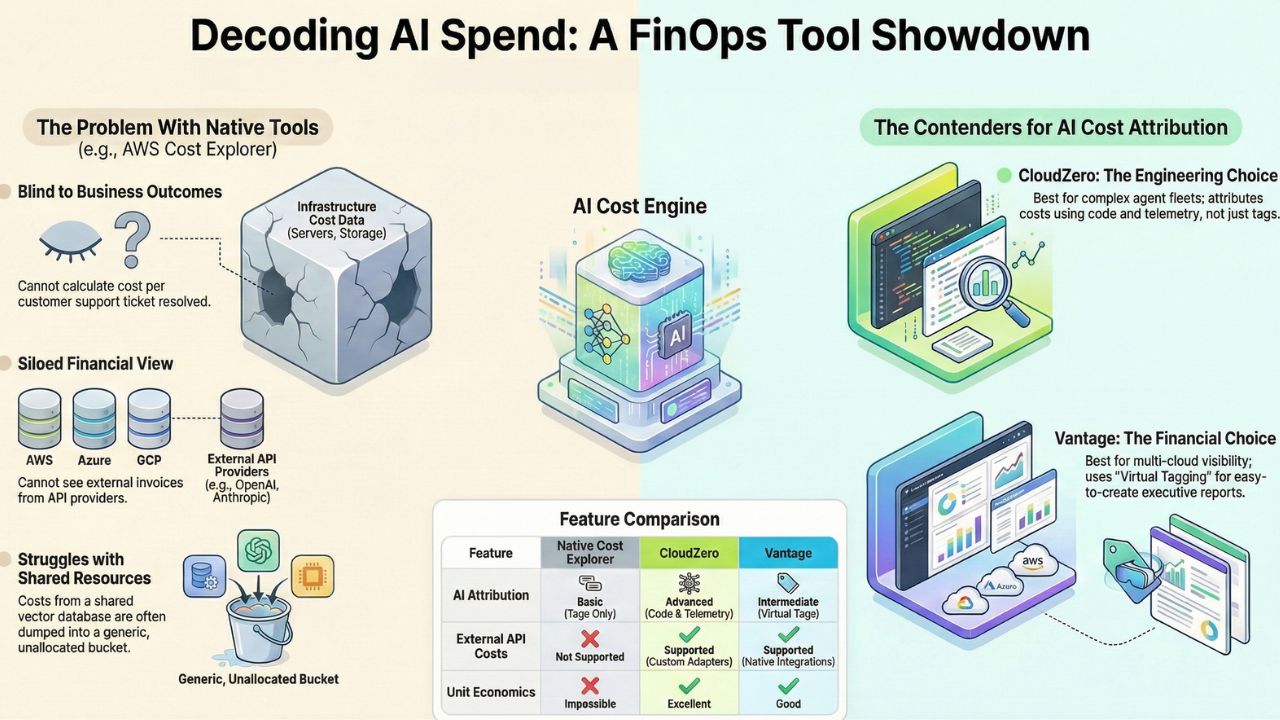
6. Frequently Asked Questions (FAQ)
A: No. AWS Cost Explorer only tracks resources within AWS (like Bedrock or EC2). It cannot see external invoices from OpenAI or Anthropic. To see your "Total AI Spend" in one place, you need a third-party FinOps tool like Vantage or CloudZero that supports "Bring Your Own Cost" ingestion.
A: CloudZero is engineer-focused, excelling at mapping complex code (like specific Lambda functions) to business outcomes without heavy tagging. Vantage is finance-focused, offering a superior UI, better forecasting reports, and "Autopilot" savings features that appeal to CFOs.
A: If you are self-hosting open-source models (like Llama 3) on Kubernetes clusters (EKS/AKS), Kubecost is essential. Neither CloudZero nor Vantage provides the deep, pod-level visibility needed to attribute GPU costs to specific agents sharing a cluster.