How to Spot Agentic Opportunities in Legacy Tech Systems: The Auditor's 2026 Checklist
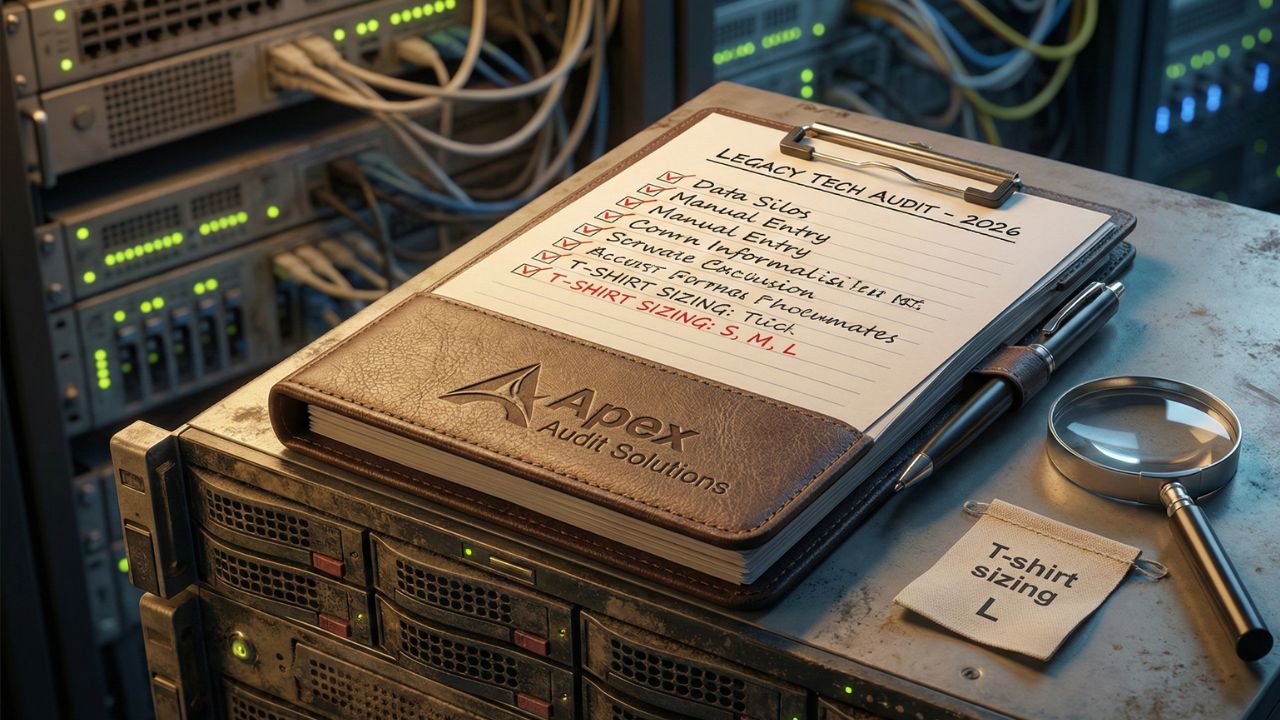
- Audit with precision: Use structured frameworks to find hidden value in outdated enterprise infrastructure.
- Predict ROI accurately: Learn the "T-shirt sizing" model to predict ROI on legacy AI modernization.
- Start small, scale fast: Focus initially on bounded use cases to minimize risk and prove immediate value.
- Unblock data pipelines: Identify and resolve manual data entry bottlenecks in siloed environments.
- Modernize safely: Integrate autonomous agents without breaking mission-critical legacy code.
Introduction to Legacy AI Auditing
Welcome to the definitive expert guide on how to spot agentic opportunities in legacy tech systems. Navigating outdated corporate infrastructure requires a precise, strategic eye to uncover hidden value.
This deep dive is part of our extensive guide on how to lead a client through ai transformation. If you want to drive high-ROI modernization in 2026, you must know where to look.
We will provide you with the ultimate auditor's checklist to identify bottlenecks, evaluate readiness, and deploy autonomous agents effectively.
Designing Your AI Readiness Audit
Conducting a successful system audit requires looking past the surface-level UI. You need to map the underlying data workflows and identify where human effort is wasted.
Look for highly repetitive tasks, delayed data syncing, and complex legacy report generation. These are prime targets for immediate agentic intervention.
To structure your pitch after the audit, refer to the consultant’s ai sales playbook for legacy tech to ensure leadership buy-in.
Identifying Bounded Use Cases
The most common mistake auditors make is recommending a massive, system-wide overhaul. Instead, you must focus on identifying bounded use cases for agentic AI.
Characteristics of a perfect bounded use case:
- Strict parameters: The agent operates within a clearly defined, narrow workflow.
- Low mission-critical risk: Failure won't crash the entire legacy system.
- High manual effort: It replaces a task that currently drains human hours.
The "T-Shirt Sizing" Model for ROI
Predicting the financial return on AI pilot projects can be difficult in messy environments. This is why you must use the "T-shirt sizing" model to predict ROI on legacy AI modernization.
- Small (S): Quick wins like automating manual data entry in siloed environments. Low cost, immediate ROI.
- Medium (M): Tasks like legacy report generation or custom code analysis. Moderate integration effort.
- Large (L): Complex orchestrations, such as wrapping legacy banking systems in ai reasoning layers. High effort, massive transformative ROI.
Executing the "Crawl, Walk, Run" Strategy
Never implement autonomous agents across an entire organization on day one. A phased deployment minimizes risk and builds organizational trust.
- Phase 1 (Crawl): Start with read-only agents that analyze data and provide recommendations to human workers.
- Phase 2 (Walk): Introduce "human-in-the-loop" agents that draft actions but require human approval to execute.
- Phase 3 (Run): Deploy fully autonomous agents for specific, bounded workflows with continuous monitoring.

Frequently Asked Questions (FAQ)
Bounded use cases are highly specific, narrowly defined processes where an AI agent operates within strict limitations, reducing operational risk while delivering measurable value.
AI agents can rapidly scan decades-old, undocumented codebases (like COBOL or outdated Java) to map dependencies, identify security vulnerabilities, and suggest modern refactoring paths.
It is a phased implementation approach: starting with low-risk, read-only AI pilots (Crawl), moving to human-assisted AI execution (Walk), and finally scaling to full autonomous workflows (Run).
You perform an audit by mapping data pipelines, identifying manual bottlenecks, evaluating API availability, and assessing the cleanliness of the data housed in the legacy infrastructure.
Red flags include skyrocketing API call costs, AI hallucination due to messy legacy data inputs, frequent system timeouts, and increased manual work to fix AI errors.
Agents can be programmed to pull data from disparate, siloed legacy databases on a schedule, synthesize the information, and generate comprehensive, real-time reports without human intervention.
Yes. Intelligent agents can act as middleware, automatically extracting data from one isolated system and correctly formatting and entering it into another, eliminating manual copy-pasting.
ROI is measured by comparing the cost of the AI implementation against the reduction in human hours spent on the task, decreased error rates, and the increased speed of task completion.
It is a simplified estimation framework (Small, Medium, Large) used by consultants to quickly categorize the complexity, cost, and potential ROI of various AI modernization opportunities.
By establishing a centralized "AI reasoning layer" or API gateway, organizations can route various specialized AI agents through a single, secure bridge connected to their legacy core.
Conclusion
Finding value in outdated infrastructure doesn't have to be a guessing game. By knowing exactly how to spot agentic opportunities in legacy tech systems, you can drive massive, high-margin transformations.
Apply the "T-shirt sizing" model, look for bounded use cases, and implement your solutions via the Crawl, Walk, Run strategy. The future belongs to those who can modernize the past.
Would you like me to create a downloadable, step-by-step PDF audit checklist based on these principles for your next client meeting?
Sources & References
- Parent Pillar Page: How to Lead a Client Through AI Transformation: The Strategic Consultant's 2026 Roadmap.
- Internal Hub Resource: Consultant’s AI Sales Playbook for Legacy Tech.
- Internal Hub Resource: Wrapping Legacy Banking Systems in AI Reasoning Layers.
- External Reference: McKinsey & Company: The Economic Potential of Generative AI (2025).
- External Reference: Gartner: Navigating Legacy Modernization with AI Agents (2026).