Measuring Value: 5 KPIs for the Next-Gen GCC Leader (Beyond Cost Savings)
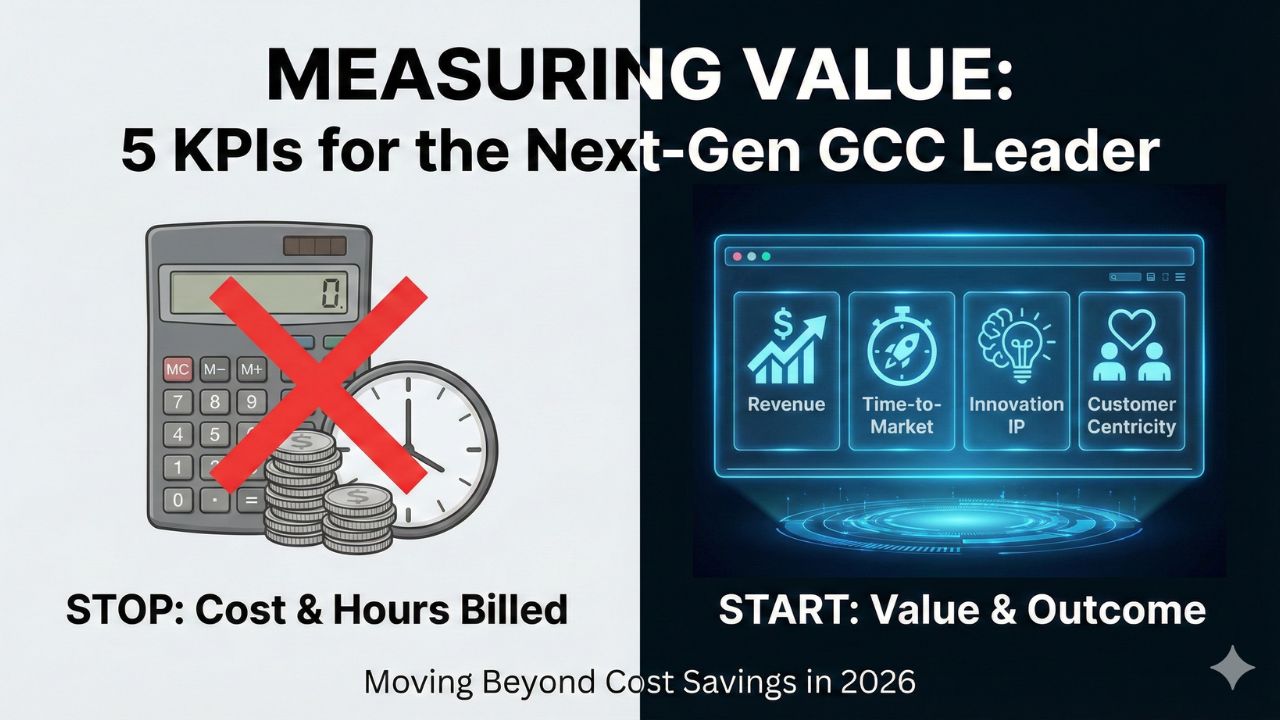
For twenty years, the "Report Card" of an Indian Global Capability Center (GCC) has looked the same. It was a spreadsheet filled with Cost Savings, Headcount (FTEs), and Utilization Rates.
If you take that same spreadsheet to a Global Board meeting in 2026, you will fail.
In the GCC 4.0 era, your headquarters doesn't just want a cheaper team; they want a better business. They want innovation, speed, and resilience. Yet, 60% of Indian GCC leaders struggle to quantify these contributions because they are still measuring "Activity" instead of "Outcome."
This shift in metrics is the foundation of the 'Builder Mindset' required for modern executives.
1. The "Stop" List: Metrics That Are Killing Your Strategy
Before you adopt new KPIs, you must retire the old ones that incentivize the wrong behavior.
- STOP Measuring: Hours Billed / Utilization Rates: Being "busy" is not the same as being "productive." High utilization often leads to burnout and zero innovation.
- STOP Measuring: Total Tickets Closed: This incentivizes solving easy problems quickly rather than fixing the root cause of complex problems.
- STOP Measuring: Cost Per FTE (as the primary metric): If your primary goal is to be cheap, you will never be strategic. "Cheapest" rarely equals "Best."
2. The "Start" List: 5 KPIs for the 2026 Leader
To justify your existence to a Global Board, speak the language of Business Value. Here are the 5 Key Performance Indicators (KPIs) you need on your dashboard.
KPI #1: Revenue Impact (The Holy Grail)
Can you draw a straight line from your team's code to the company's bank account?
The Metric: Percentage of Global Revenue Supported or Generated by the India Center.
How to track: If your team built the "One-Click Checkout" feature, track the conversion rate uplift and attribute that specific revenue increase to your center.
KPI #2: Time-to-Market (TTM) Reduction
Speed is the new currency. How much faster can the global organization move because they have you?
The Metric: Cycle time from "Idea" to "Production."
Target: A mature GCC should reduce global TTM by 30% through "Follow the Sun" models and automated QA pipelines.
KPI #3: Innovation IP Generated
Are you just executing orders, or are you creating assets?
The Metric: Number of Patents Filed, Proofs of Concept (POCs) converted to Production, or Internal Tools adopted globally.
KPI #4: Engineering Productivity (DORA Metrics)
Move beyond "lines of code." Use the industry-standard DORA (DevOps Research and Assessment) metrics to prove operational excellence.
The Metrics: Deployment Frequency, Lead Time for Changes, Change Failure Rate, and Mean Time to Recovery (MTTR).
KPI #5: Customer Centricity Score
This is critical for shifting focus from "Back Office" to "Front Office."
The Metric: Net Promoter Score (NPS) or Customer Retention Rate impacted by India-led initiatives.
(Tip: This metric is especially relevant if you are managing distributed squads in Tier-2 cities, ensuring they stay connected to the customer outcome.)
These metrics are the foundation of the new operating model. Read our full guide: GCC 4.0 Leadership Trends 20263. Case Study: The Pivot from Cost to Quality
The Scenario: A leading FinTech GCC in Pune was originally set up to handle L1/L2 support and backend payments processing.
The Old KPI: Cost Per Transaction. The team chose the cheapest server vendors and minimized code optimization time to save money. The result was high transaction failures, angry customers, and a "Cost Center" reputation.
The Shift: In 2024, a new Site Lead changed the primary KPI to Customer Retention Rate.
The Result (2026): Transaction costs went up by 10% because the team moved to a premium cloud tier. BUT transaction failures dropped to near zero, and customer churn reduced by 15%.
The ROI: The 10% cost increase saved the company millions in lost revenue (LTV). The Pune center is now the Global Center of Excellence for Payments.
4. How to Pitch These Metrics to HQ
Changing the scorecard is risky. Here is how to do it:
- Don't Switch Overnight: Run a "Shadow Dashboard." Report the old metrics (Cost) but present the new metrics (Value) alongside them for two quarters.
- Contextualize: "We spent $1M more this year, but we generated $5M in new IP."
- Get Executive Buy-in: Find a sponsor in the C-Suite who cares more about speed than savings (usually the CTO or CPO).
Your Call to Action
The transition from a "Cost Center Manager" to a "Value Creation Leader" is the single most important career pivot you will make this decade. The table stakes have changed. The opportunities are massive. The world is looking at India not just to save money, but to make money.
Register for the Next Leadership SummitFrequently Asked Questions (FAQ)
Q: How do I measure "Revenue Impact" for a backend infrastructure team?
A: Measure "Availability" and "Performance." If your platform is up 99.99% of the time instead of 99.9%, calculate the value of that uptime in terms of transactions processed. That is your revenue impact.
Q: My Finance team only cares about cost. How do I change their mind?
A: Speak their language: ROI (Return on Investment). Show them that for every $1 spent on "Quality Engineering," they save $3 in "Technical Debt" and "Support Costs" down the line.
Q: What is a good "Innovation Target" for a GCC?
A: A healthy target for a mature GCC is to have 10-15% of the workforce dedicated to R&D or "Change the Business" initiatives, rather than just "Run the Business."
