From 'Doer' to 'Builder': A Transition Guide for Indian GCC Executives
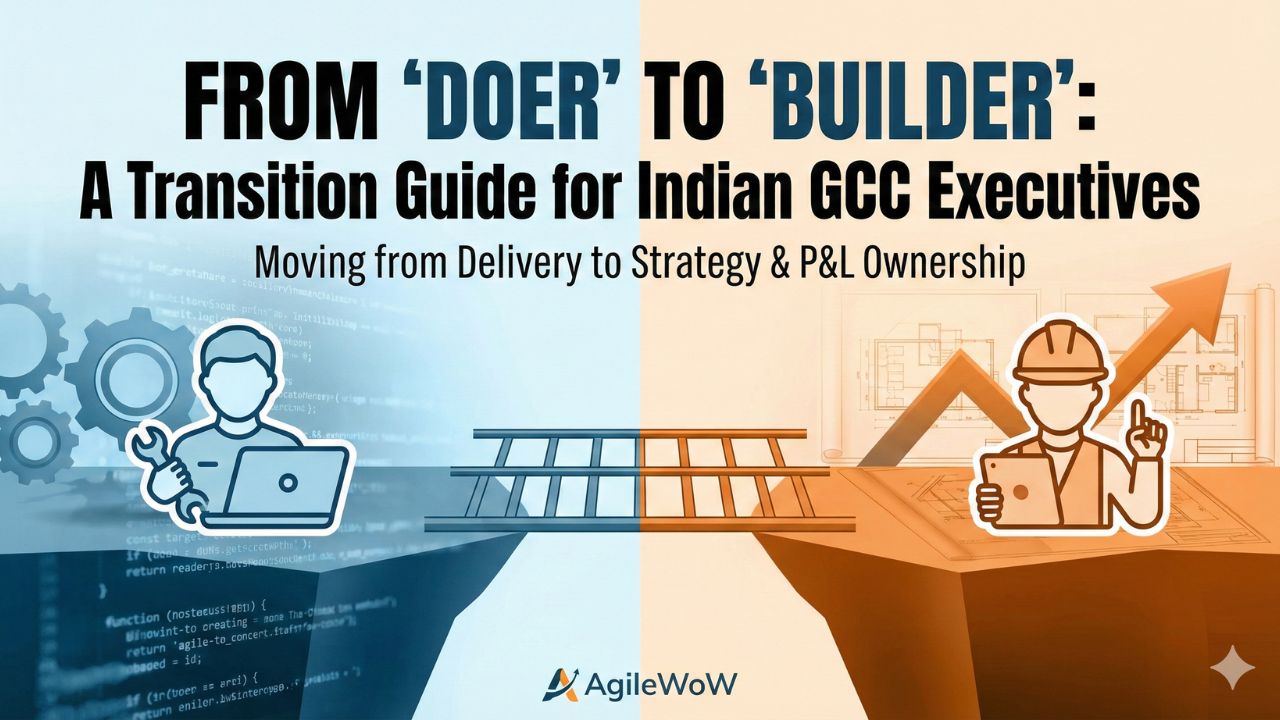
You execute flawlessly. Your SLAs are green. Your attrition is manageable. Your US/EU stakeholders love you because you "get things done."
But when the strategy meetings happen in New York or London, you aren't in the room.
This is the "Delivery Trap"—a glass ceiling that thousands of mid-senior leaders in India are hitting right now. As GCCs evolve from cost centers to value centers (read our 2026 GCC Trends Report for context), the definition of "good leadership" is changing.
This guide outlines the specific mindset shifts and skill upgrades required to make that leap.
1. The "Order Taker" Trap: Are You Stuck?
Many executives believe they are strategic, but their calendars tell a different story. You might be in the "Order Taker" trap if:
- Your team's roadmap is handed to you: You execute features decided by a Product Manager in the HQ.
- Success = "On Time, On Budget": You are measured by output (velocity), not outcome (revenue/retention).
- You are a "Translation Layer": Your primary role is translating HQ requirements for local developers.
- Crisis Management is your day job: You spend 80% of your week unblocking the team, not planning the future.
The Fix: You need to stop asking "When do you need this?" and start asking "Why are we building this?"
2. The "Builder" Mindset: Owning the P&L
To transition to a global role, you must think like a startup founder within the enterprise (Intrapreneurship).
A. Shift from Project to Product
Old Way: "We delivered the payments module on time."
Builder Way: "The payments module reduced checkout friction by 15%, leading to a $2M annualized revenue lift."
Action: Start tracking the business impact. If you don't know which metrics matter, read our guide on 5 Value Creation KPIs for GCC Leaders.
B. Challenge the Brief (Constructively)
Don't just say "Yes." If you see a better way to solve the customer's problem using local talent or new tech, propose it.
Example: Instead of just hiring 50 manual testers as requested, propose a smaller team of SDETs (Software Development Engineer in Test) to build an automation framework. This saves money and improves quality.
C. Influence Without Authority
You can't order your US counterparts to listen to you. You must earn influence by being the expert.
Build a "Glocal" Context: Use your unique position to bridge the gap. Explain how a global strategy will land in the Asian market. Become the eyes and ears for HQ in the region.
3. The Critical Skill Gaps (And How to Close Them)
We analyzed hundreds of successful GCC leaders who made the jump to global roles. They all mastered these three non-technical skills:
I. Financial Literacy (The Language of the Boardroom)
You know Python or Agile, but do you know EBITDA? Can you read a P&L statement?
- Why it matters: To pitch a new Innovation Lab or Center of Excellence (CoE), you need to speak the language of investment, ROI, and CAPEX/OPEX.
- Quick Win: Ask your Finance partner to walk you through the unit economics of your GCC. Understand the "fully loaded cost" of your team vs. the value they generate.
II. Strategic Storytelling
Indian leaders often focus on data and details. Global leaders focus on narrative.
The Shift: Stop reporting status ("We are 90% done"). Start telling stories ("We are on track to transform the user onboarding experience by next month").
III. Managing "Up and Across"
In a matrix organization, your boss isn't the only one who matters.
- Map your Stakeholders: Identify the influencers in HQ who aren't in your reporting line. Schedule virtual coffees with them. Ask about their pain points.
- Visibility: Don't let your work be invisible. Ensure your team's wins are communicated in global newsletters or town halls.
Your 90-Day Transition Plan
You can't change your reputation overnight, but you can start shifting the perception today.
- Month 1: The Audit. Review your calendar. Delegate 20% of your "running the business" meetings. Use that time to study the company's global strategy.
- Month 2: The Pilot. Identify one small area where you can take full ownership—from idea to execution—without waiting for HQ instructions.
- Month 3: The Pitch. Present a proactive proposal to your leadership. It could be a process improvement, a new tool, or a talent strategy. Show them you are a thinker, not just a doer.
Your Call to Action
The transition from a "Cost Center Manager" to a "Value Creation Leader" is the single most important career pivot you will make this decade. The table stakes have changed. The opportunities are massive. The world is looking at India not just to save money, but to make money.
Register for the Next Leadership SummitFrequently Asked Questions (FAQ)
Q: My HQ doesn't empower us to make decisions. What should I do?
A: Trust is earned, not given. Start small. delivering "suggestions" alongside your "execution." Once your suggestions prove valuable, the autonomy will follow.
Q: Do I need an MBA to move into a strategic role?
A: Not necessarily. While an MBA helps with financial literacy, practical experience in owning a product P&L is often more valuable in the tech world.
Q: How do I find time for strategy when I'm firefighting all day?
A: You must empower your second-in-command. If you are the only one who can solve a crisis, you haven't built a scalable team.
