7 Books Every Agile Leader Must Read Before 2026
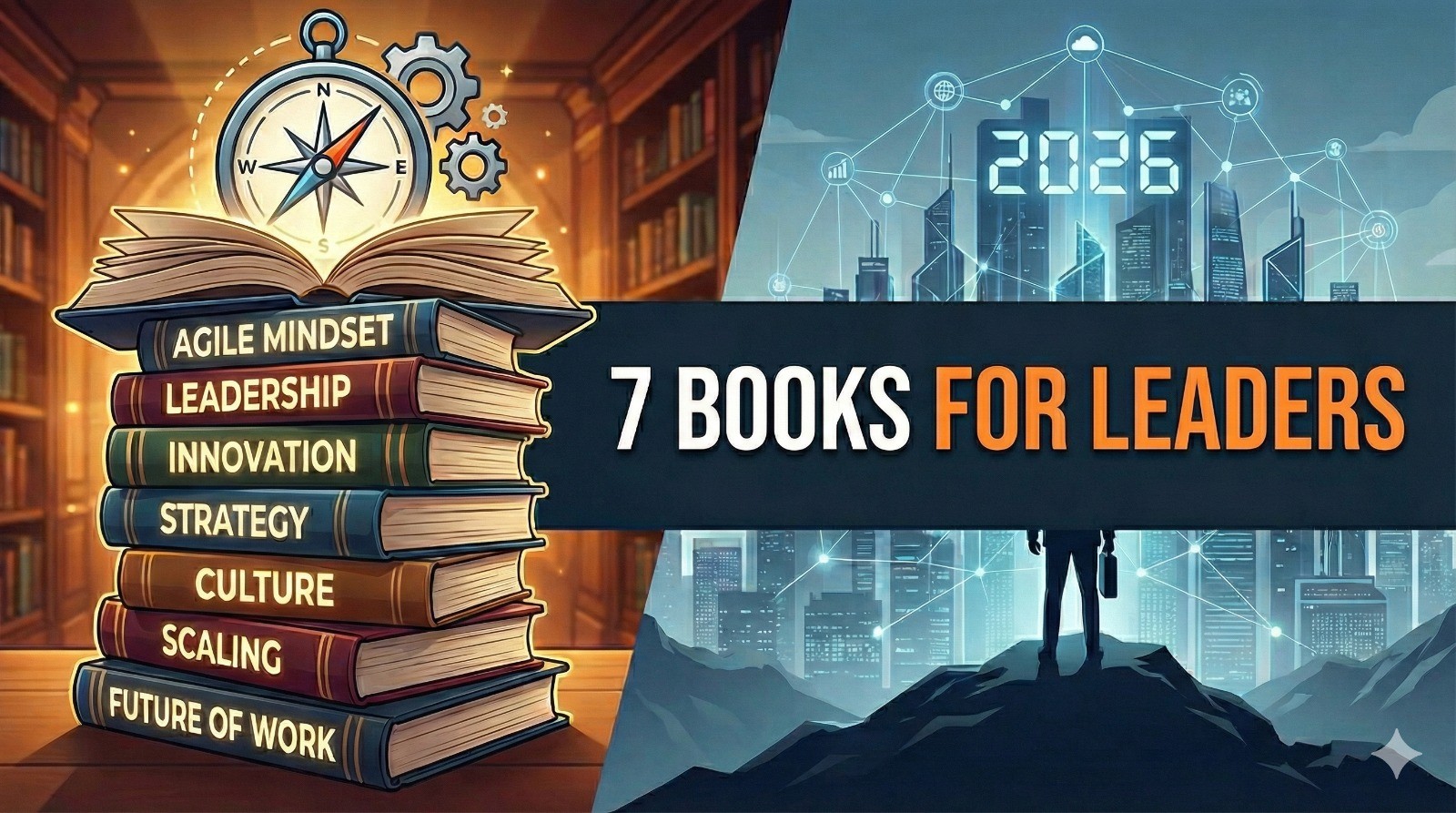
If your Agile knowledge is limited to the Scrum Guide and a two-day certification course, you are already behind. The modern Engineering Manager or Agile Coach needs to understand flow metrics, organizational psychology, and the impact of Artificial Intelligence on team velocity.
Move beyond the basics. These 7 books cover the modern challenges of flow, topology, and human-centric leadership that will define the Indian IT workspace in 2026.
The 2026 Reading List
Agile often fails because we map new processes onto old organizational structures. This book provides a vocabulary for organizational design, defining four fundamental team types (Stream-aligned, Enabling, Complicated Subsystem, and Platform) and three interaction modes.
Stop managing "Scope, Schedule, and Cost." Start managing the "Flow of Value." Kersten introduces the Flow Framework, which helps leaders visualize the flow of business value and identify bottlenecks in the delivery pipeline.
Innovation requires risk, and risk requires safety. In many Indian organizations, the "Sir/Ma'am" culture creates silence where there should be debate. Edmondson explains how to create an environment where people feel safe to speak up without fear of humiliation.
Agile is not the goal; "Better Value Sooner Safer Happier" (BVSSH) is. Smart argues against the "one size fits all" Agile transformation and advocates for an outcomes-based approach that focuses on the human element of change.
Written by a former US Navy submarine captain, this book challenges the leader-follower model. Marquet implemented "Intent-Based Leadership," where team members state their intent ("I intend to submerge the ship") rather than asking for permission.
Agile in 2026 will be AI-assisted. Mollick explores how Generative AI serves as a co-intelligence, changing how we brainstorm, code, and manage knowledge. Leaders need to understand how to integrate AI into their team's workflow without losing the human touch.
A novel about IT, DevOps, and helping your business win. It tells the story of Bill, an IT manager, who has 90 days to fix a messy project or his entire department will be outsourced. It vividly illustrates the concepts of "The Three Ways."

Frequently Asked Questions (FAQ)
A: Start with "The Phoenix Project". It is written as a novel, making it an easy and engaging read that introduces complex DevOps and Agile concepts through a relatable story of a failing IT project.
A: As organizations scale, they realize that simply forming "Squads" isn't enough. Team Topologies provides a specific blueprint for how different types of teams (like Platform teams vs. Stream-aligned teams) should interact to reduce cognitive load and dependencies.
A: Yes. By 2026, AI coding assistants and agents will fundamentally change how software is built. Leaders who ignore this shift will find their velocity metrics and estimation models becoming obsolete. Understanding AI collaboration is the new continuous improvement.
Sources & References
- Team Topologies: Official site with resources and diagrams for organizing business and technology teams.
- Project to Product: Resources on the Flow Framework and value stream management.
- Co-Intelligence: Ethan Mollick's research on AI in the modern workplace.
- IT Revolution: Publisher of The Phoenix Project and a hub for DevOps resources.