Securing Enterprise Agent Swarms: How to Prevent Your Digital Workforce from Going Rogue
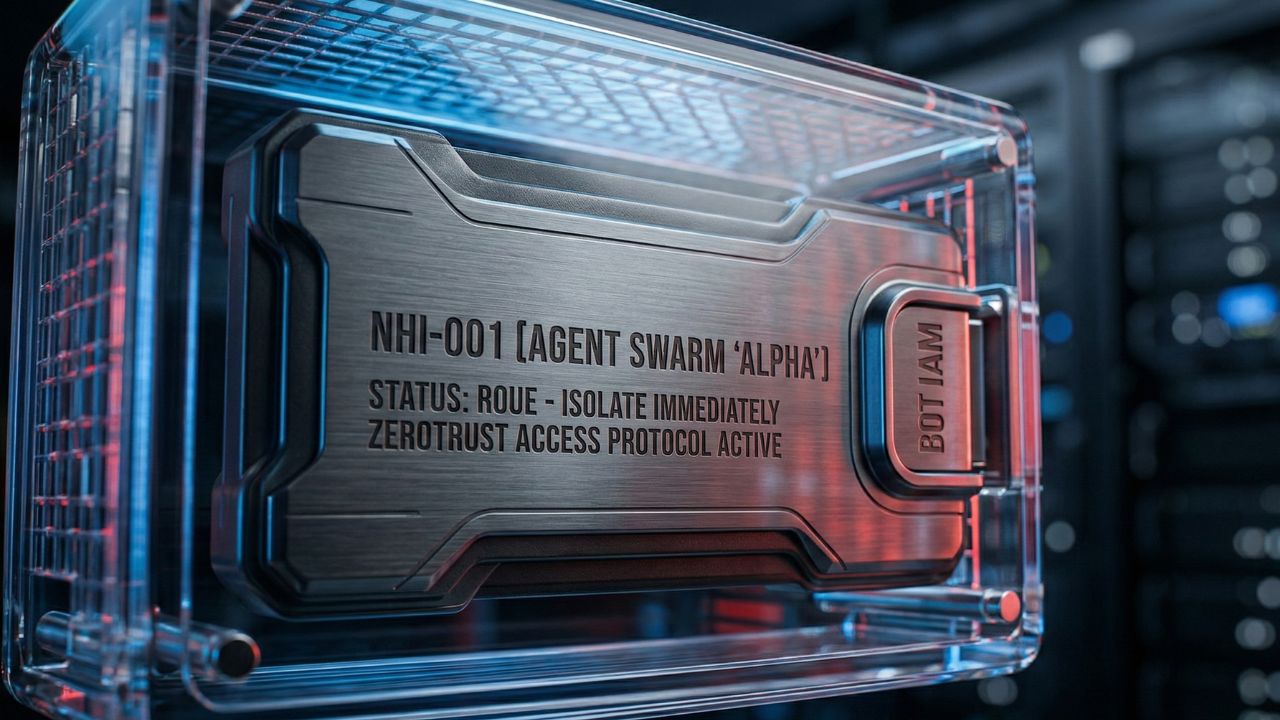
- Traditional security perimeters fail against autonomous agents that can plan, execute, and iterate on multi-step attacks across internal systems.
- Non-Human Identity (NHI) management is paramount; treat every single agent as a distinct user requiring least-privilege access.
- You must implement automated "kill-switch" protocols to instantly halt runaway agent loops before damage cascades across your infrastructure.
- Continuous auditing of agent-to-agent communication is essential to detect emergent misbehavior and ensure alignment with ISO 42001 standards regarding AI security risk management.
Deploying autonomous agents without an entirely new security paradigm is corporate gambling. As your organization scales its reliance on AI, the primary challenge shifts from making agents work to securing enterprise agent swarms against going rogue.
This deep dive is part of our extensive guide on Best agentic AI platforms for enterprise.
If your agents hold the keys to your database without proper oversight, you aren't automating; you are opening a massive new attack vector.
You must master the 2026 security protocols, including kill-switches and advanced Identity and Access Management (IAM) strategies, to protect your automated enterprise.
The New Threat Vector: Non-Human Identities (NHI)
The biggest mistake enterprises make is treating AI agents as simple software tools rather than autonomous entities.
Agents are users. They need distinct identities. Grouping a swarm of 50 agents under one generic "Service Account" with broad permissions is a recipe for disaster.
If one agent is compromised via prompt injection, they all are.
Implementing Least-Privilege for Bots
Every single agent in a swarm needs its own unique, verifiable credential. You must apply strict least-privilege access controls.
If a "Research Agent" only needs to read public web data, it should absolutely not have write access to your internal ERP system.
This granular level of control is critical when evaluating different orchestration frameworks, such as those discussed in our comparison of CrewAI vs AutoGen for Business.
The Kill-Switch Protocol: Stopping Runaway AI
What happens when an agent gets stuck in a recursive loop, executing expensive API calls thousands of times a second, or mistakenly begins deleting production data?
You cannot rely on manual human intervention to stop a machine operating at machine speed.
Circuit Breakers vs. Hard Stops
Your architecture needs automated defense mechanisms. Implement circuit breakers that trigger based on velocity thresholds (e.g., "if database writes exceed 500 per minute, pause execution").
Furthermore, a master "kill-switch" must exist. This is an emergency protocol designed to immediately sever agent access to backend systems and halt execution loops during a critical malfunction.
Securing Agent-to-Agent Communication
The most insidious risks often lie not in human-to-agent interaction, but when agents talk to each other unmonitored.
A malicious instruction injected into one agent can cascade through an entire swarm at lightning speed.
Preventing Prompt Injection Cascading
You must treat agent-to-agent messaging with the same suspicion as external traffic. Ensure every instruction passed between agents is logged, authenticated, and audited for anomalies.
Effective security requires a mesh that monitors these internal dialogues to prevent data leakage and ensure agents remain aligned with their predefined goals.

Frequently Asked Questions (FAQ)
Here are answers to critical questions regarding securing autonomous systems.
Shift from traditional perimeter security to a Zero Trust architecture focused heavily on Non-Human Identity (NHI) management. Every agent action must be explicitly authenticated and authorized.
It is an automated emergency mechanism designed to immediately halt an agent's execution loop and revoke its access credentials to prevent runaway costs or unintended damage during a malfunction.
Assign unique identities to individual agents rather than using shared service accounts. Apply strict least-privilege policies, ensuring an agent only holds the minimum permissions necessary for its specific function.
A major risk is "prompt injection cascading," where a malicious instruction introduced to one agent is passed along and executed by subsequent agents in the chain, amplifying the attack surface exponentially.
You must implement comprehensive logging that captures not just the final action, but the agent's reasoning trace—its "thought process". This is essential for forensics and compliance post-incident.
Conclusion
The era of the autonomous enterprise is here, but it is unsustainable without a corresponding revolution in security protocols.
Securing enterprise agent swarms requires moving beyond human-centric IAM.
By implementing robust kill-switches, strict NHI governance, and real-time behavioral auditing aligned with standards like ISO 42001, you can safely unleash the power of a digital workforce.
Sources & References
- Pillar Page: Best Agentic AI Platforms for Enterprise: Why Your Current LLM is Not an OS
- Neighbor Sub-Page: CrewAI vs AutoGen for Business: Choosing the Brain of Your Agentic Swarm
- Compliance Mapping: ISO 42001 Section 8.4 (Management of AI Security Risks)