CrewAI vs AutoGen for Business: Choosing the Brain of Your Agentic Swarm
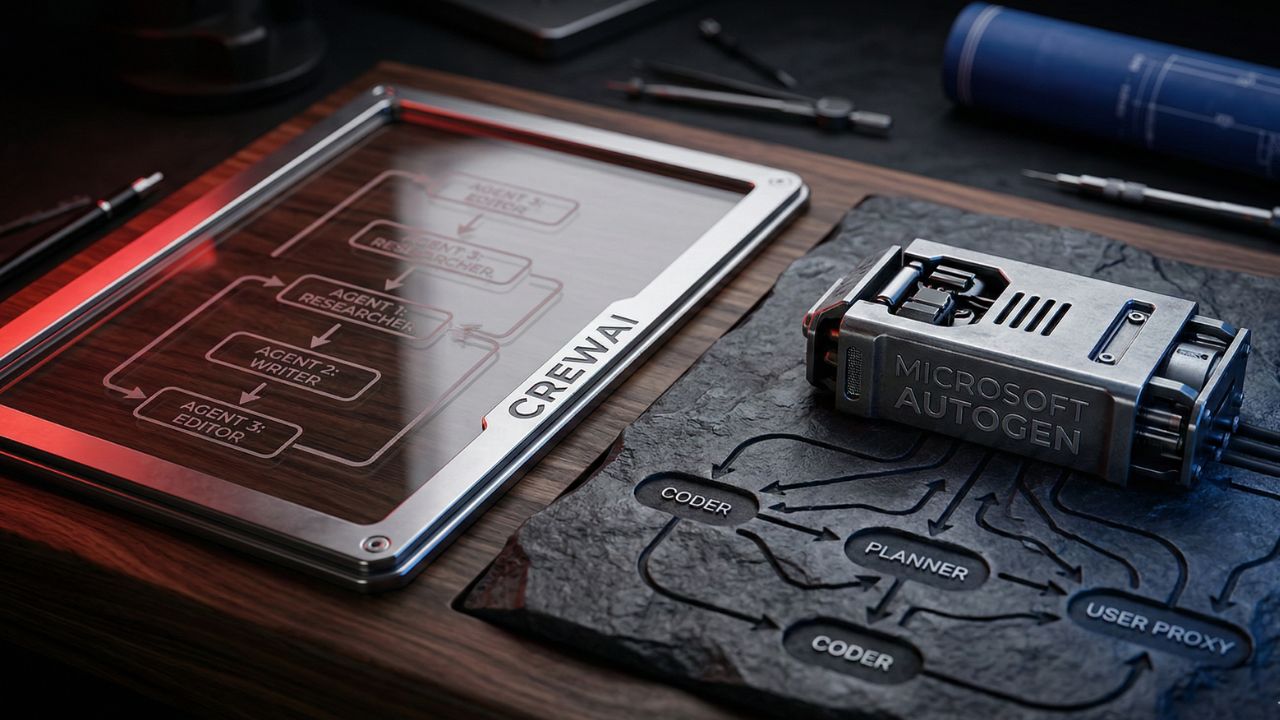
- CrewAI excels in structured, role-based workflows where agents follow sequential tasks, making it ideal for defined business processes.
- Microsoft AutoGen shines in dynamic, conversational environments requiring complex, multi-step reasoning and code execution.
- Both frameworks are open source, but differ significantly in architecture and enterprise readiness.
- Choosing the wrong framework now can create significant technical debt in your 2026 AI roadmap.
The battle for the "brain" of enterprise AI is heating up. As organizations move beyond simple LLM prompts to autonomous workflows, the choice of orchestration framework becomes critical.
This deep dive into CrewAI vs AutoGen for business explores which platform offers the technical robustness required for scalable operations. This analysis is part of our extensive guide on Best agentic AI platforms for enterprise.
Selecting the right framework determines how effectively your AI agents collaborate, share context, and execute complex tasks without constant human oversight.
The Contenders Defined
To choose the right tool, you must understand their fundamental design philosophies. They tackle multi-agent orchestration from different angles.
CrewAI: The Structured Specialist
CrewAI is designed around the concept of role-playing squads. You define specific agents with distinct roles, goals, and backstories.
It excels at orchestrating sequential pipelines where Task A must be completed before Task B begins. Think of CrewAI as a traditional assembly line manager.
It is highly effective for predictable workflows like content generation pipelines, market research reports, or structured data analysis. Its simplicity is its strength, allowing developers to spin up functional squads quickly.
AutoGen: The Conversational Architect
Backed by Microsoft, AutoGen views agent interaction as a conversation. It supports diverse communication patterns, including two-agent chats, hierarchical structures, and dynamic group chats where agents can volunteer to solve a problem.
AutoGen is significantly more flexible than CrewAI. It is built to handle ambiguous tasks requiring complex reasoning, tool use, and collaborative coding.
However, this flexibility comes with a steeper learning curve and higher complexity in managing conversation flows.
Enterprise Readiness and Technical Robustness
When evaluating CrewAI vs AutoGen for business, scalability and compliance are paramount. This aligns with NIST AI RMF standards regarding technical robustness.
Scalability and Complexity
AutoGen generally offers higher ceilings for complexity. Its ability to handle intricate, non-linear workflows makes it suited for large-scale enterprise problem-solving.
However, managing state and memory across dozens of conversing AutoGen agents can become chaotic without strict guardrails.
CrewAI’s structured approach is easier to scale linearly. If you need to add more steps to a defined process, CrewAI handles the addition predictably.
Security Considerations
Both frameworks are open source, meaning you are responsible for the hosting environment and security wrapper. Because AutoGen agents often have broad capabilities to write and execute code, the security surface area is larger.
Implementing robust sandboxing and access controls is critical when deploying AutoGen in production. For more on this, refer to our guide on securing enterprise agent swarms.
Business Use Cases: Where They Win
The "best" framework depends entirely on the job you need the agents to do.
Best Use Cases for CrewAI
Choose CrewAI if your business processes are clearly defined and repeatable.
- Marketing Operations: Creating an agent squad where one researches SEO keywords, another drafts content, and a third edits for tone.
- Financial Research: Sequentially gathering data from specific sources, summarizing findings, and formatting a briefing document.
- Customer Onboarding: Running a fixed sequence of checks and welcome tasks for new clients.
Best Use Cases for AutoGen
Choose AutoGen if the path to the solution is unknown or requires dynamic collaboration.
- Complex Software Development: Agents collaboratively planning, writing, debugging, and testing code.
- Dynamic Data Analysis: A group chat where a "Coder" agent, a "Statistician" agent, and a "Visualization" agent collaborate to answer open-ended business questions.
- Creative Problem Solving: Situations requiring multi-step reasoning where the next step depends entirely on the outcome of the previous one.
The Developer Experience vs. Leadership Needs
If you are a technical leader, you must balance power with usability.
CrewAI is often praised for its developer experience (DX). Its Pythonic structure feels intuitive, allowing teams to ship proofs-of-concept rapidly.
AutoGen is powerful but can feel academic. Configuring effective conversation patterns requires deep technical understanding.
If your primary goal is empowering non-technical managers to build their own workflows, neither of these code-heavy frameworks may be the right first step. You should investigate low-code agent builders for leaders instead.

Frequently Asked Questions (FAQ)
Here are answers to common questions regarding these agentic frameworks.
CrewAI focuses on structured, sequential, role-based tasks. AutoGen focuses on flexible, conversational interactions between agents, including complex coding tasks.
CrewAI is often better for defined, repeatable enterprise processes. AutoGen is better for complex, dynamic R&D or problem-solving workflows requiring code execution.
Not inherently. AutoGen is open source. While backed by Microsoft, you are responsible for securing the implementation, especially regarding code execution risks.
Yes, this is AutoGen's primary strength. Its conversational model allows agents to debate, iterate, and solve ambiguous problems dynamically.
Generally, no. While simpler than AutoGen, CrewAI still requires Python development knowledge to implement effectively.
Conclusion
The decision between CrewAI vs AutoGen for business is not about which tool is "better" in a vacuum. It is about matching the tool to your process maturity.
If your 2026 roadmap requires automating highly structured, repetitive pipelines, CrewAI offers a faster, more stable path to ROI.
If your goal is to unlock autonomous problem-solving and complex code generation, Microsoft AutoGen provides the necessary architectural horsepower.
Assess your technical robustness needs today to ensure your agentic swarm can scale tomorrow.
Sources & References
- Pillar Page: The Tech Stack Foundation
- Sub-page 1: The Orchestration Battle
- Compliance Mapping: NIST AI RMF Section 2.1 (Technical Robustness and Resilience)