Identity Threat: Leading Teams Who Think They’re Being Replaced

Your best senior engineer is suddenly nitpicking every suggestion from GitHub Copilot. Your marketing lead is refusing to use the new AI copy generator, claiming it "lacks soul." They aren't being difficult. They are experiencing Identity Threat.
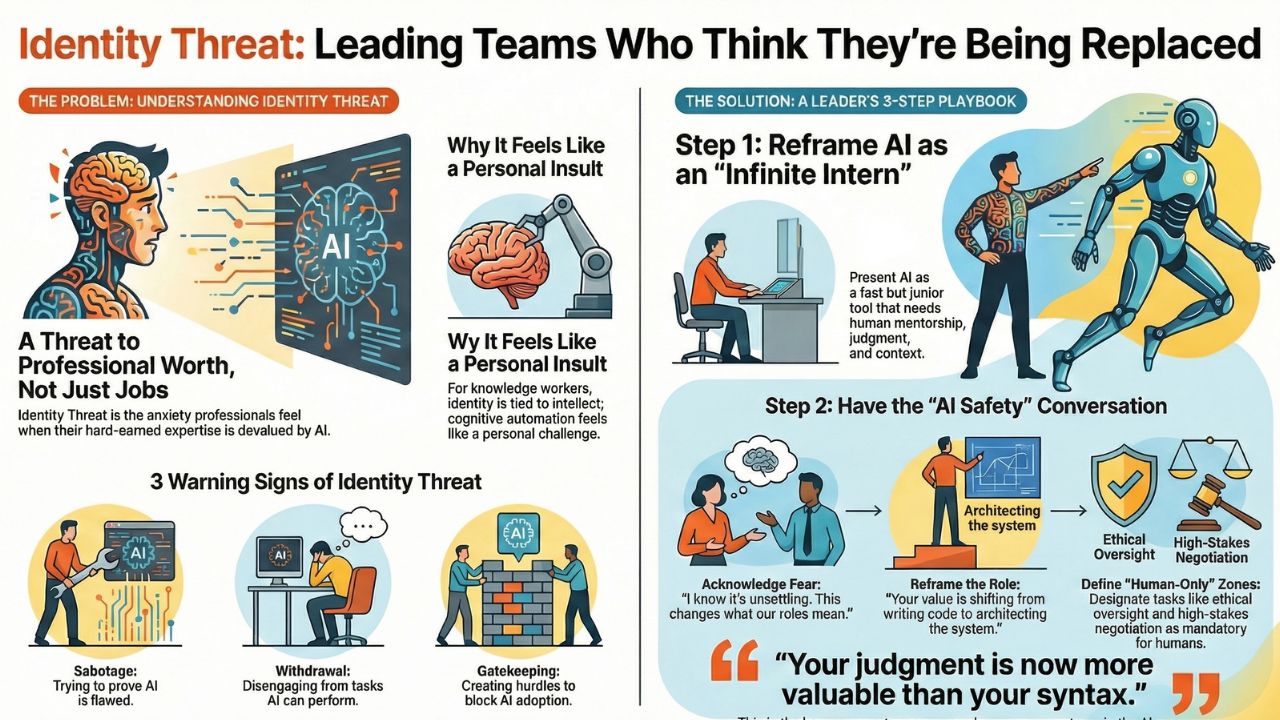
As AI agents take over complex cognitive tasks—coding, data analysis, and even architectural review—human employees experience a deep psychological anxiety. It is the sinking feeling that their hard-earned expertise, the very thing that gives them professional worth, is being rendered obsolete.
1. The Psychology: Why "Just Upskill" Doesn't Work
When a machine automates physical labor, we call it "progress." When a machine automates cognitive labor, we call it "an insult." For a knowledge worker, their identity is tied to their intellect. When an AI solves a problem in seconds that took them years to master, it triggers a defense mechanism.
This "Identity Threat" manifests in three ways:
- Sabotage: Finding edge cases where the AI fails to prove "humans are still better."
- Withdrawal: "If the AI can do it, why should I bother trying?"
- Gatekeeping: Creating artificial bureaucratic hurdles to prevent AI adoption.
2. The "Intern" Metaphor: Reframing the Relationship
To lead through this, you must change the metaphor. Stop calling AI a "Superhuman." Start calling it an "Infinite Intern."
An intern is eager, fast, and polite. But an intern lacks context, judgment, and political awareness. They need a senior mentor to review their work, correct their hallucinations, and guide their output. This elevates your team from "doers" to "mentors."
3. How to Have the "AI Safety" Conversation (Step-by-Step)
You cannot ignore the anxiety. You must address it directly in your 1:1s. Here is the framework for the "AI Safety" conversation.
Step 1: Acknowledge the Fear (Don't Gaslight)
Don't say "AI won't replace you." That's a lie. AI will replace parts of their job. Instead, say: "I know it's unsettling to see the AI write code that fast. It changes what 'being a developer' means."
Step 2: Reframe the Role (The Architect)
Script: "I don't need you to write the boilerplate code anymore. That's a junior task now. I need you to be the Architect. I need you to look at what the AI generated and tell me if it's secure, scalable, and fits our legacy system. Your judgment is now more valuable than your syntax."
Step 3: Define "Human-Only" Zones
Draw a circle around tasks where human judgment is mandatory. This reassures them that they have a permanent home.
Examples: Ethical oversight, high-stakes negotiation, mentoring junior staff, and empathetic customer handling.
Explore the Full Playbook
This article is part of the Agentic Manager’s Playbook. Understand the structural side of this problem in our previous chapter.
4. Frequently Asked Questions (FAQ)
A: Identity Threat occurs when professionals feel their expertise and self-worth are devalued or rendered obsolete by AI capabilities. It is not just about job security; it is about professional pride.
A: Focus on "Co-piloting" rather than "Replacing". Reframe AI as a tool to eliminate toil (repetitive tasks) and invest heavily in upskilling programs that help them master the new tools.
A: Tell them: "I don't need you to write the boilerplate code anymore. I need you to judge the architecture. Your value has shifted from syntax to system design."

5. Sources & Recommended Reading
- Harvard Business Review. How to Help Employees Who Are Worried About AI.
- MIT Sloan Management Review. Leading Workforce Transformation in the Age of AI.
- Psychology Today. The Psychology of AI Anxiety: Why We Fear the Machines.
- Google re:Work. Guide: Understand team effectiveness and psychological safety.