From Boss to Orchestrator: The New Career Ladder for Engineering Managers
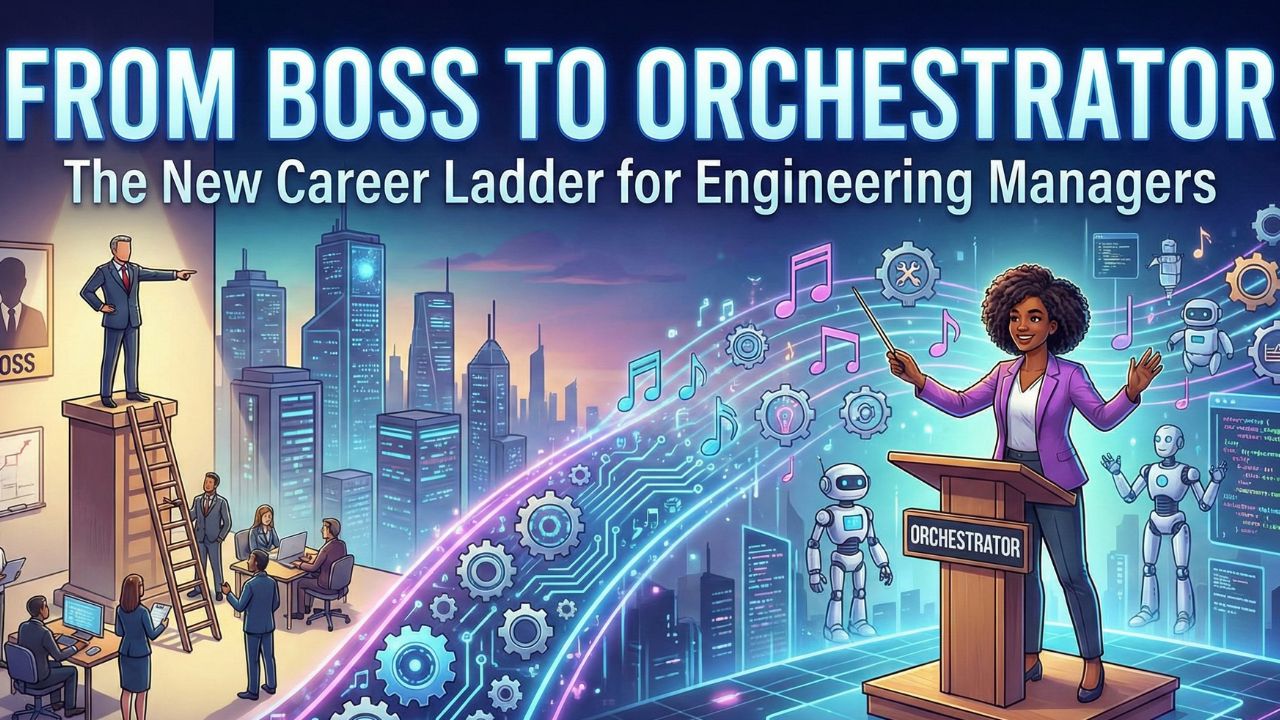
For decades, the Engineering Manager (EM) role has been a mix of technical guidance and administrative overhead. We spent 40% of our time in Jira, 30% in meetings, and 30% actually helping people. By 2026, the "administrative" portion of that pie chart will vanish.
AI agents now handle ticket routing, status updates, and even basic code reviews. This leaves EMs with a stark choice: Cling to the old "Boss" definition and become obsolete, or evolve into the AI Orchestrator.
1. The New Role: What is an Orchestrator?
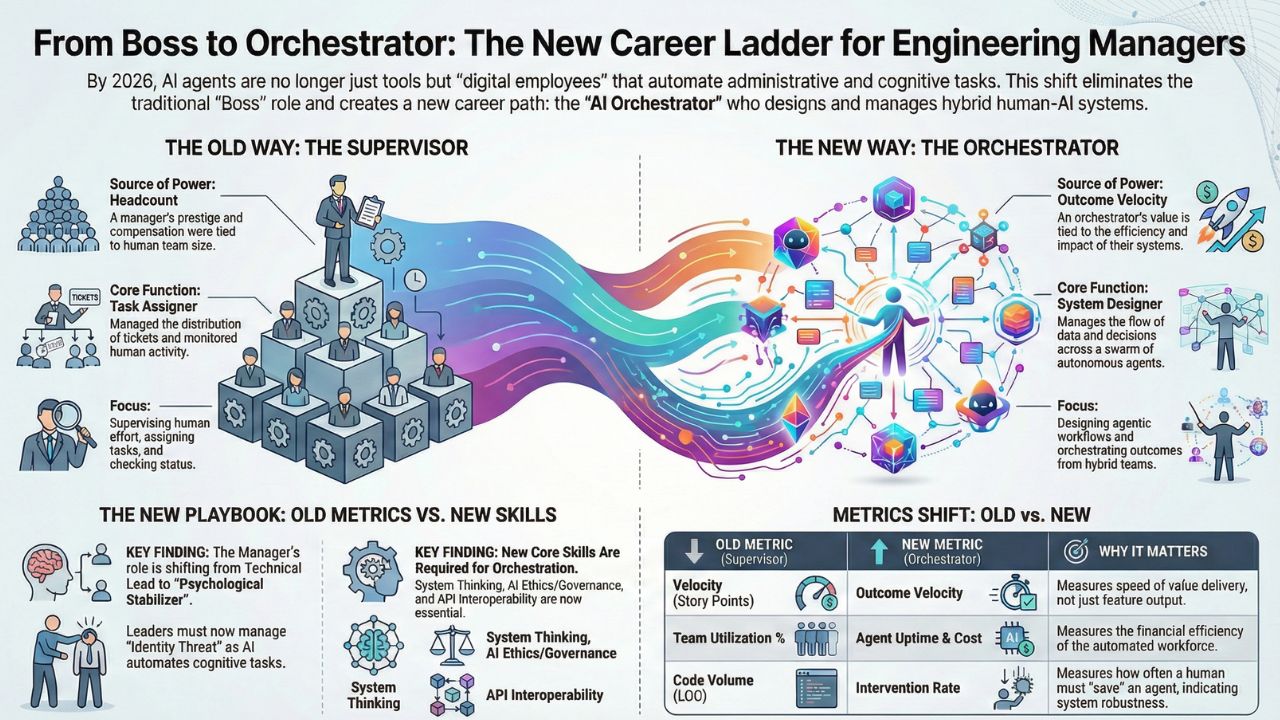
An Orchestrator does not "manage" people in the traditional sense. They manage a hybrid system of humans and autonomous agents. Their goal is not to maximize "hours worked," but to maximize "Outcome Velocity."
The Orchestrator operates at a higher layer of abstraction. Instead of assigning a task to a developer, they design an Agentic Workflow where an AI Planner breaks down the task, an AI Coder executes it, and a Human Expert reviews the architecture.
2. The Skill Stack of 2026
To survive this transition, you must acquire new skills that were previously considered "nice-to-haves" or strictly the domain of Staff Engineers.
A. System Thinking & Visualizing Flows
You must be able to visualize the flow of data and decisions across a swarm of autonomous agents. If Agent A fails, does it retry? Does it escalate to a human? Designing these escalation paths is your new "project management."
B. API Glue & MCP (Model Context Protocol)
Interoperability is king. You need to understand how to connect disparate agentic systems—like making your Sales Salesforce Agent talk to your Jira DevOps Agent. Understanding protocols like MCP (Model Context Protocol) is essential for 2026.
C. AI Ethics & Governance
You are the "Human-in-the-Loop." It is your job to ensure your agent workforce isn't introducing bias, leaking IP, or violating compliance standards. In a world of autonomous execution, Governance is the ultimate moat.
3. Recommended Credentials & Upskilling
Don't just rely on experience. Formalize your shift to orchestration with these targeted certifications.
Generative AI for Everyone (DeepLearning.AI)
Led by Andrew Ng, this is the foundational course for understanding what AI can (and cannot) do. It moves beyond the hype to the structural reality of AI deployment.
View CertificationAI Product Management Specialization (Duke University)
Orchestration requires a Product mindset. This specialization teaches you to manage the lifecycle of AI products, a skill now required for managing internal AI teams.
View CertificationExplore the Full Playbook
This article is part of the Agentic Manager’s Playbook. See how this role fits into the wider organizational strategy.
4. Frequently Asked Questions (FAQ)
A: AI will replace the administrative tasks of managers (status checks, ticket assignment), but will elevate the role to high-level system architecture and people development. The "Boss" disappears; the "Orchestrator" emerges.
A: They require a mix of "System Thinking," "AI Ethics/Governance," "Prompt Engineering," and advanced "Conflict Resolution."
A: Yes, but the nature of it changes. You need less syntax memory and more architectural understanding. You must be able to audit the logic of an agent's output, even if you aren't writing every line yourself.